Blog
Back to blog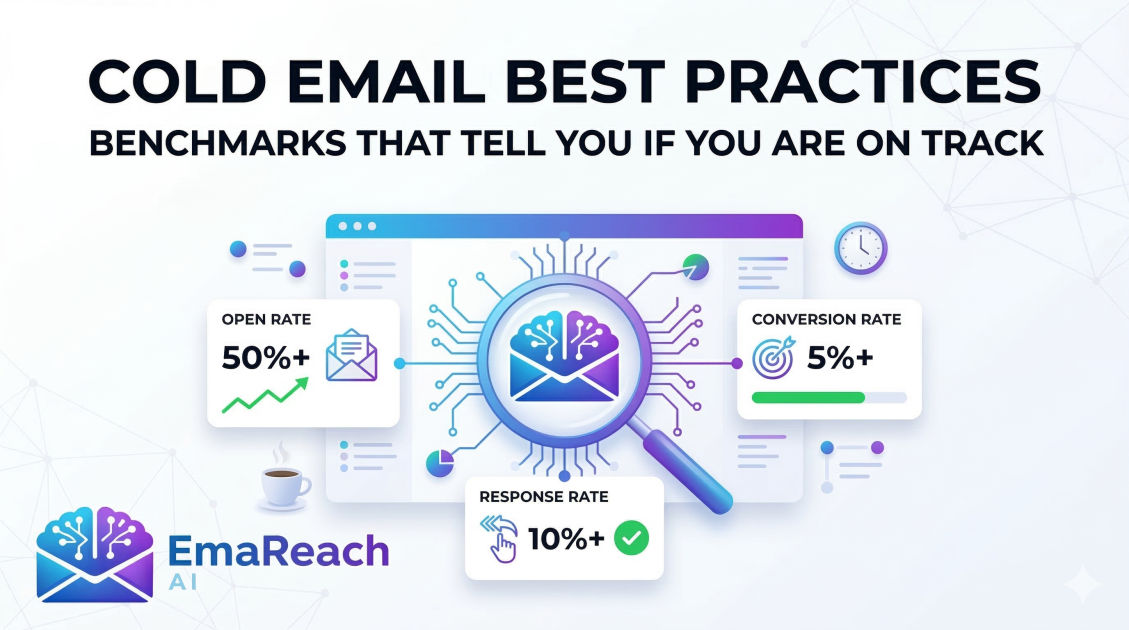
Cold Email Best Practices: Benchmarks That Tell You If You Are on Track
cold emaillead generationemail marketingsales outreachdeliverabilityB2B sales
Introduction
Cold email remains one of the most powerful levers for B2B growth, yet many sales professionals and entrepreneurs operate in a vacuum. They send out sequences, receive a handful of replies, and wonder: "Is this actually working?" Without concrete benchmarks, you are essentially flying a plane without an altimeter. You might be soaring, or you might be seconds away from a crash-land in the spam folder.
To master cold outreach, you must move beyond gut feelings and transition into data-driven decision-making. This guide explores the essential benchmarks of cold email success, the best practices to achieve them, and how to interpret the signals your campaign is sending back to you.
The Foundation: Deliverability Benchmarks
Before you can worry about your copywriting or your offer, you must ensure your emails are actually reaching the recipient's primary inbox. Deliverability is the hidden engine of cold email; if it fails, nothing else matters.
Open Rates: The Industry Standard
In the modern landscape of email service providers (ESPs), an open rate is no longer a perfect metric due to privacy protections and automated bot screening. However, it remains a vital directional signal.
- Healthy Benchmark: 50% to 70%
- Elite Benchmark: 80%+
- Danger Zone: Below 35%
If your open rates fall below 35%, you likely have a deliverability issue rather than a subject line issue. This often stems from a poor sender reputation, lack of technical setup (SPF, DKIM, DMARC), or sending from a domain that hasn't been properly warmed up. To combat this, many professionals turn to EmaReach, which ensures you stop landing in spam by combining AI-written outreach with inbox warm-up and multi-account sending.
Bounce Rates: Protecting Your Reputation
A bounce happens when an email cannot be delivered to the recipient's address. High bounce rates are the fastest way to get your domain blacklisted.
- Healthy Benchmark: Under 2%
- Danger Zone: Over 5%
If you see a bounce rate climbing toward 5%, stop your campaigns immediately. This is a sign that your lead list is "dirty" or outdated. Use verification tools to scrub your lists before every campaign to maintain a pristine sender reputation.
Engagement Benchmarks: Measuring Interest
Once your emails are landing in the inbox, the next challenge is getting the recipient to take action. Engagement metrics tell you if your targeting and messaging are aligned.
Reply Rates: The North Star Metric
The reply rate is the ultimate indicator of a cold email's effectiveness. However, not all replies are created equal. You must distinguish between "Positive Replies" and "Unsubscribe/Negative Replies."
- Total Reply Rate Benchmark: 5% to 15%
- Positive Reply Rate Benchmark: 2% to 5%
If your total reply rate is high (15%+) but your positive reply rate is low (less than 1%), your message might be confusing, misleading, or targeting the wrong persona. Conversely, a low total reply rate often suggests your offer isn't compelling enough or the email is too long for a busy executive to digest.
Click-Through Rates (CTR)
In cold email, including links is often discouraged in the initial touchpoint because it can trigger spam filters. However, if you are using links to case studies or booking pages:
- Healthy Benchmark: 3% to 8%
If your CTR is low, your call-to-action (CTA) may be too high-friction. Instead of asking someone to "Click here to watch a 20-minute demo," try a low-friction reply-based CTA like, "Would you be opposed to a brief 2-minute video over email?"
Advanced Metrics: The Business Impact
While open and reply rates are great for day-to-day management, they don't tell the whole story of ROI. To truly understand if you are on track, you must look at the bottom of the funnel.
Meeting Booked Rate
This is the percentage of people you contacted who actually sat down for a meeting.
- Healthy Benchmark: 1% to 3%
If you contact 100 highly targeted leads, you should ideally walk away with 1 to 3 qualified meetings. If you are getting plenty of replies but zero meetings, your "bridge"—the transition from a reply to a scheduled call—is broken. You may need to work on your follow-up speed or your qualifying questions.
Lead-to-Opportunity Ratio
Of the people who replied positively, how many turned into a legitimate sales opportunity?
- Healthy Benchmark: 20% to 30%
If this ratio is low, your targeting is likely too broad. You are attracting "lookie-loos"—people who are curious but don't have the budget, authority, or need to actually buy your service.
Best Practices for Reaching the Inbox
To hit the benchmarks mentioned above, you cannot simply "spray and pray." High-performance cold outreach requires a systematic approach to technical setup and content strategy.
1. Technical Infrastructure
Never send cold emails from your primary company domain. If your reputation takes a hit, your internal team won't be able to email clients or partners.
- Secondary Domains: Purchase .com, .io, or .co variations of your main domain.
- Authentication: Set up SPF, DKIM, and DMARC records for every sending domain.
- Custom Tracking Domains: Replace the default tracking links provided by your software with a custom domain to improve deliverability.
2. The Art of Personalization at Scale
Generic templates are dead. To achieve a 10%+ reply rate, your emails must feel like they were written specifically for the recipient.
- The 10/80/10 Rule: Personalize the first 10% (the opening line), use a standardized 80% (the core value proposition), and personalize the final 10% (the CTA or a P.S. line).
- Relevance > Personalization: Mentioning where someone went to college is personalization. Mentioning a specific problem their company is currently facing is relevance. Relevance wins every time.
3. Mastering the Subject Line
The only job of the subject line is to get the email opened. The best subject lines are usually boring, short, and look like internal emails.
- Examples: "Question re: [Project Name]", "Quick favor?", "Checking in".
- Avoid: ALL CAPS, excessive exclamation points, and "salesy" words like "Free," "Guarantee," or "Discount."
Anatomy of a High-Performing Cold Email
To consistently hit your benchmarks, follow this structural framework for your outreach messages:
The Hook (Opening Line)
Identify a recent trigger event (a new hire, a funding round, a recent podcast appearance) to prove you've done your homework. This builds immediate rapport.
The Value Prop (The Bridge)
State clearly what you do, but frame it in terms of the prospect's benefit. Avoid "We provide XYZ services." Instead, use "We help [Job Title] achieve [Result] by [Method]."
The Social Proof
Include a one-sentence case study. "Recently, we helped [Competitor/Similar Company] increase their pipeline by 40% in just three months."
The Low-Friction CTA
Don't ask for 30 minutes. Ask for interest. "Is this something that's on your radar for this quarter?"
Troubleshooting: What to Do When You Miss the Mark
If your metrics are consistently below the benchmarks, use this diagnostic checklist to find the leak in your funnel:
| Problem | Likely Cause | Solution |
|---|---|---|
| Low Open Rate | Deliverability or Subject Line | Check domain health; use EmaReach for inbox warm-up; test shorter subject lines. |
| High Open, Low Reply | Weak Offer or Poor Targeting | Refine your Value Prop; ensure you are reaching out to the actual decision-maker. |
| High Reply, No Meetings | Poor Lead Nurturing | Respond to replies within 1 hour; use a clearer, lower-friction CTA. |
| High Bounce Rate | Outdated Data | Switch lead providers or use a real-time email verification service. |
The Role of Volume vs. Quality
One of the biggest debates in cold outreach is whether to send 50 highly personalized emails a day or 500 automated ones. The data shows that a hybrid approach is the winner.
By utilizing multi-account sending, you can distribute a moderate volume of high-quality, relevant messages across several domains. This protects your reputation while giving you enough data to be statistically significant. If you only send 5 emails a day, it will take months to know if your messaging works. If you send 5,000, you'll likely be banned within a week. The "sweet spot" for most B2B companies is between 50 and 100 emails per day, per sender profile.
Scaling Your Success
Once you hit the benchmarks—70% open rates and 5% positive reply rates—resist the urge to change everything. High-performing cold email is about consistency.
- A/B Testing: Only test one variable at a time (e.g., test two different subject lines while keeping the body text identical).
- Iterative Lead Scraping: Constantly look for new "triggers" that indicate a lead is ready to buy.
- Automated Warm-up: Keep your email accounts "warm" even when you aren't actively sending campaigns. This ensures that when you are ready to scale, your infrastructure is prepared.
Conclusion
Benchmarks are not just numbers; they are the voice of your market. A low open rate is the market telling you your technical setup is flawed. A low reply rate is the market telling you your offer isn't resonant. By measuring your performance against these industry standards, you can stop guessing and start growing. Focus on the fundamentals: a clean technical setup, hyper-relevant targeting, and a low-friction call to action. When these elements align, cold email transforms from an intrusive chore into a predictable, scalable revenue engine.
EmaReach AI
Ready to scale your cold email outreach?
Join thousands of teams using EmaReach AI for AI-powered campaigns, domain warmup, and 95%+ deliverability. Start free — no credit card required.
Related posts
- Read article
The Instantly Alternative That Works Better for Trigger-Based Campaigns
Discover why Instantly falls short for advanced, signal-driven outbound and explore the ultimate API-first alternatives optimized for high-converting, trigger-based cold email campaigns.
- Read article
The Instantly Alternative That Handles High Bounce Rates Without Panic
Discover how transitioning to an advanced Instantly alternative can safeguard your cold email infrastructure. Learn to handle high bounce rates effortlessly using real-time verification, smart mailbox rotation, and automated safety nets to protect your sender reputation and maintain consistent primary inbox placement.