Blog
Back to blog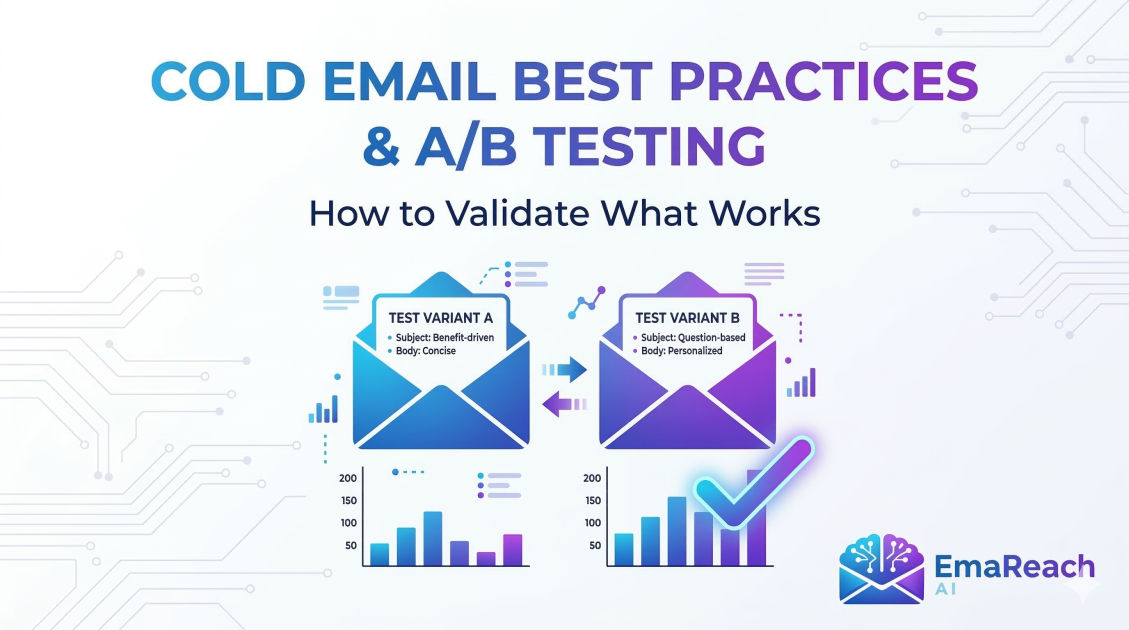
Cold Email Best Practices and A/B Testing: How to Validate What Works
cold emailab testingemail marketinglead generationsales outreachdeliverability
The Art and Science of Cold Outreach
Cold email remains one of the most effective ways to generate leads, build partnerships, and grow a business. However, the landscape has shifted from a volume-based game to one of precision and high-level strategy. Sending hundreds of generic messages no longer yields results; instead, it often leads to blacklisted domains and frustrated prospects. To succeed, modern marketers must blend creative communication with rigorous data analysis.
This guide explores the foundational best practices of cold email and dives deep into the world of A/B testing—the only definitive way to validate what resonates with your specific audience. By treating your outreach as a series of experiments, you can move away from guesswork and toward a predictable, scalable revenue engine.
Foundational Best Practices for Cold Email
Before you can effectively test your emails, you must ensure you are following the core principles that govern modern outreach. Without these, even the best A/B test will fail due to poor deliverability or high bounce rates.
1. Master Your Deliverability
Deliverability is the backbone of cold email. If your message lands in the spam folder, it doesn't matter how clever your subject line is. Technical setup is the first step: ensure your SPF, DKIM, and DMARC records are correctly configured. Furthermore, you should never send high volumes from your primary business domain. Use secondary domains to protect your brand's reputation.
For those looking to streamline this process, EmaReach (https://www.emareach.com/) offers a powerful solution. EmaReach helps you stop landing in spam by providing cold emails that reach the inbox. Their platform combines AI-written outreach with inbox warm-up and multi-account sending, ensuring your emails land in the primary tab and get replies.
2. Hyper-Personalization Beyond the First Name
Prospective clients can spot a template from a mile away. True personalization involves researching the individual or the company to find a "hook." This could be a recent news article about their firm, a specific comment they made on a podcast, or a shared professional interest. The goal is to prove that you have done your homework and that this email was written specifically for them.
3. Focus on the Prospect’s Problems, Not Your Features
A common mistake in cold email is the "feature dump." Prospects don't care about what your product does; they care about what it does for them. Shift your messaging from "Our software has an AI dashboard" to "Our dashboard helps your team save ten hours a week on manual data entry."
The Role of A/B Testing in Outreach
A/B testing, or split testing, is the process of sending two variations of an email to a small segment of your list to see which performs better. Once a winner is identified, you send the winning version to the rest of your audience. This iterative process is the only way to truly understand the psychology of your market.
Why You Must Test
No matter how experienced a marketer is, they cannot predict human behavior with 100% accuracy. Factors like industry trends, cultural shifts, and even the time of day can influence how a person interacts with an email. A/B testing removes the ego from decision-making and replaces it with cold, hard data.
Determining Sample Size
For an A/B test to be statistically significant, you need a large enough sample size. If you send version A to five people and version B to five people, a single click can swing the results by 20%. Ideally, aim for at least 100-200 recipients per variation before drawing conclusions. If your total list is small, focus on testing one variable at a time over a longer period.
High-Impact Variables to A/B Test
Not all elements of an email are created equal. To get the best results, focus your testing efforts on the variables that move the needle the most.
Subject Lines
The subject line has one job: to get the email opened. This is the most common element to test.
- Short vs. Long: Test a two-word subject line (e.g., "Quick question") against a more descriptive one (e.g., "Question regarding your Q3 growth strategy").
- Personalized vs. Generic: Use the prospect's name or company name in one version and leave it out of the other.
- Curiosity vs. Directness: Test a vague subject line that piques interest versus a direct one that states exactly what the email is about.
The Hook (Opening Line)
Once the email is open, the first sentence determines whether the reader continues or hits delete.
- The Compliment: "I saw your recent post on LinkedIn about..."
- The Observation: "I noticed your company recently expanded into the European market."
- The Direct Approach: "I’m writing to you because we help companies like yours reduce churn."
The Call to Action (CTA)
The CTA is where many cold emails fall apart. If the ask is too big, the prospect will ignore it. If it’s too vague, they won't know what to do.
- The Frictionless CTA: "Is this something you'd be open to learning more about?"
- The Specific CTA: "Do you have 10 minutes on Thursday at 2:00 PM?"
- The Value-First CTA: "I put together a brief audit of your site; can I send it over?"
How to Structure Your Experiments
To validate what works, you need a structured approach to your experiments. Follow these steps to ensure your data is clean and actionable.
Step 1: Define Your Hypothesis
Don't just change things randomly. Start with a hypothesis. For example: "I believe that a shorter, more casual subject line will result in a 15% higher open rate among SaaS founders because they are busy and prefer direct communication."
Step 2: Change Only One Variable
This is the golden rule of A/B testing. If you change the subject line and the CTA at the same time, you won't know which change caused the difference in performance. Keep everything identical except for the specific element you are testing.
Step 3: Set Success Metrics
What does success look like for this specific test? If you are testing subject lines, your primary metric is Open Rate. If you are testing the body copy or CTA, your primary metrics are Click-Through Rate (CTR) or Reply Rate. Be wary of "vanity metrics" and focus on the data that leads to conversions.
Step 4: Run the Test Concurrently
External factors can skew your results. If you send Version A on a Monday morning and Version B on a Friday afternoon, the difference in performance might be due to the timing, not the content. Send both versions at the same time to ensure a fair comparison.
Analyzing the Results
Once the data is in, it's time to analyze the results. However, don't just look at the raw numbers. Dig deeper into the implications of the data.
Statistical Significance
Before declaring a winner, ensure the result isn't just a fluke. There are many online calculators that can help you determine if your results are statistically significant. If the difference is marginal, it may be worth running the test again with a larger group.
Looking for Patterns Across Segments
You might find that Version A worked better for CEOs, while Version B worked better for Marketing Managers. This level of granular analysis allows you to create highly targeted sub-campaigns that maximize ROI across different personas.
The "Why" Behind the Data
Data tells you what happened, but you need to infer why. If a direct CTA outperformed a soft CTA, it might suggest that your audience is high-intent and values their time. Use these insights to inform your overall brand voice and future marketing efforts.
Advanced A/B Testing Strategies
Once you have mastered the basics, you can move on to more complex testing methodologies to squeeze every bit of performance out of your campaigns.
Testing the Follow-Up Sequence
Most sales happen in the follow-up, yet many people only A/B test the first email. Try testing the frequency of your follow-ups (e.g., every 2 days vs. every 4 days) and the content of those follow-ups. Does a "break-up" email actually increase replies, or does it annoy your prospects?
Multivariate Testing
While A/B testing looks at one variable, multivariate testing looks at how multiple variables interact with each other. This requires a very large volume of emails and sophisticated software, but it can reveal complex insights that simple A/B tests might miss.
Testing Personalization Methods
You can test different types of personalization. For instance, does mentioning a specific technology the company uses (technographic data) perform better than mentioning a recent job posting (intent data)? This helps you prioritize your research efforts.
Avoiding Common A/B Testing Pitfalls
Even seasoned pros make mistakes when it comes to testing. Be on the lookout for these common traps:
- Testing Too Many Things: If you try to test everything at once, you’ll end up with messy data. Focus on the high-impact areas first.
- Ignoring the Long Game: Sometimes a variation might get more opens but fewer high-quality replies. Don't sacrifice the quality of your leads for the sake of higher engagement metrics.
- Stopping Too Early: Optimization is a continuous process. What works today might not work six months from now as your industry evolves.
- Small Sample Sizes: As mentioned earlier, don't make major strategic shifts based on the behavior of 20 people.
Conclusion
Cold email is not a "set it and forget it" strategy. It is a dynamic discipline that requires constant refinement. By adhering to core best practices—such as maintaining high deliverability, personalizing your outreach, and focusing on prospect value—you build a strong foundation. By layering rigorous A/B testing on top of that foundation, you gain the ability to validate your assumptions and pivot based on real-world evidence.
Remember, every "failed" test is actually a success, as it provides you with valuable data on what doesn't work, bringing you one step closer to the perfect sequence. Start small, test often, and let the data guide your path to outreach mastery.
EmaReach AI
Ready to scale your cold email outreach?
Join thousands of teams using EmaReach AI for AI-powered campaigns, domain warmup, and 95%+ deliverability. Start free — no credit card required.
Related posts
- Read article
The Instantly Alternative That Finally Gets Outbound Analytics Right
Discover why high-volume cold email requires a shift from surface-level vanity metrics to deep, data-driven revenue attribution, and explore the ultimate alternatives for mastering outbound engineering.
- Read article
What You Gain and What You Give Up When Switching From Instantly
Thinking about migrating your cold email stack? This detailed guide breaks down the exact operational advantages you gain and the core features you sacrifice when switching away from Instantly's popular outreach platform.