Blog
Back to blog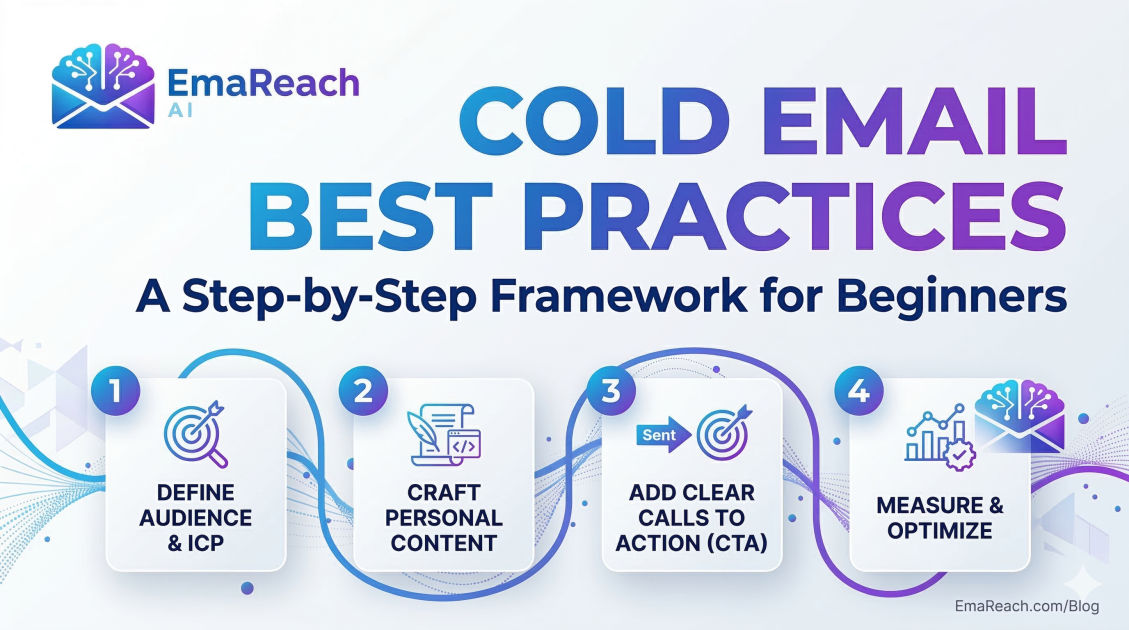
Cold Email Best Practices: A Step-by-Step Framework for Beginners
cold emailoutreachsales strategylead generationemail marketingdeliverability
Introduction to Cold Email Mastery
Cold email is often misunderstood as a digital numbers game—a scattergun approach where you send thousands of messages and hope for a tiny fraction of a percentage in responses. However, in the modern landscape of digital communication, cold email has evolved into a sophisticated art of high-stakes networking. When done correctly, it is one of the most powerful levers for business growth, allowing you to bypass gatekeepers and land directly in the inbox of decision-makers.
For beginners, the challenge isn't just writing a message; it’s ensuring that message is seen, read, and acted upon. This comprehensive guide provides a step-by-step framework to transition from a novice sender to a strategic outreach professional. We will cover everything from technical setup and deliverability to psychological triggers and follow-up sequences.
Section 1: The Foundation of Technical Deliverability
Before you write a single word of your email, you must ensure your infrastructure is sound. If your technical setup is flawed, your emails will end up in the spam folder, regardless of how brilliant your copy is. This is known as email deliverability.
Domain Reputation and Authentication
To protect your primary business domain, it is best practice to purchase a 'lookalike' domain for outreach. For example, if your company is company.com, you might use getcompany.com for your cold emails. This ensures that if your outreach domain is ever flagged, your internal business communications remain unaffected.
Once your domain is ready, you must configure three essential authentication protocols:
- SPF (Sender Policy Framework): A DNS record that lists the IP addresses authorized to send emails on behalf of your domain.
- DKIM (DomainKeys Identified Mail): A digital signature that verifies the email was indeed sent by the domain owner and wasn't tampered with during transit.
- DMARC (Domain-based Message Authentication, Reporting, and Conformance): A policy that tells receiving servers what to do if an email fails SPF or DKIM checks.
The Importance of Inbox Warm-up
New domains are treated with suspicion by email service providers (ESPs). You cannot start sending 50 emails a day from a brand-new account. You must 'warm up' the inbox by gradually increasing the volume of sent and received messages. This process builds a positive sender reputation. For those looking to streamline this process, EmaReach provides a comprehensive solution. EmaReach AI combines AI-written cold outreach with inbox warm-up and multi-account sending, ensuring your emails land in the primary tab and get replies rather than landing in spam.
Section 2: Identifying and Researching Your Ideal Customer Profile (ICP)
The most common mistake in cold email is 'spraying and praying'—sending the same generic message to a broad, unrefined list. To succeed, you must define your Ideal Customer Profile (ICP).
Defining Your ICP
Your ICP is a detailed description of the type of company that derives the most value from your product or service. Consider the following attributes:
- Industry: Which sectors benefit most from your solution?
- Company Size: Are you targeting agile startups or established enterprises?
- Geography: Does location matter for your service delivery?
- Revenue: Can they afford your services?
- Technographic Data: What tools or software do they already use?
Finding the Right Decision-Maker
Once you have the company profile, you need to find the right person within that organization. Sending a technical pitch to a Marketing Director or a creative pitch to a CTO usually results in a quick delete. Use professional networking platforms and specialized databases to find titles that align with your solution’s value proposition.
Section 3: Crafting the Perfect Subject Line
The subject line has one job: to get the email opened. It is the gatekeeper of your entire campaign. Beginners often try to be too clever or too salesy, which triggers 'spam filters' in the human brain.
Principles of High-Open Subject Lines
- Curiosity over Certainty: Give them a reason to click without giving everything away.
- Short and Sweet: Aim for 3-5 words. Short subject lines feel more personal and less like a formal marketing blast.
- Personalization: Including the recipient's name or company can increase open rates, but only if it feels natural.
- The 'Internal Email' Look: Write your subject line as if you were emailing a colleague. Lowercase letters often perform better because they look less like a polished marketing header.
Examples of Effective Subject Lines:
- Question about [Company Name]
- Idea for your [Specific Department] team
- Quick thought on [Recent News]
- [Name], a quick question
Section 4: Writing the Email Body - The Framework
A cold email should be a bridge, not a brochure. Your goal is to start a conversation, not close a deal in the first message. Use the following framework to structure your content:
The Hook (Personalization)
The first sentence must prove you have done your homework. Mention a recent LinkedIn post they wrote, a company milestone, or a specific challenge their industry is facing. This breaks the 'cold' barrier immediately.
The Bridge (The Why)
Explain why you are reaching out to them specifically. Connect your research to the reason for your email. This transition should feel seamless and logical.
The Value Proposition (The What)
This is where many beginners fail by listing features. Instead, focus on outcomes. Don't say "We have a cloud-based storage system." Say "We help remote teams reduce file-access latency by 40%." Focus on the 'pain' you solve or the 'gain' you provide.
The Call to Action (CTA)
Your CTA should be 'low friction.' Asking for a 30-minute demo is a high-friction request for someone who doesn't know you. Instead, ask for interest or a simple 'yes/no' response.
- Low Friction: "Would you be open to a brief chat about this next week?"
- High Friction: "Can we jump on a 45-minute call tomorrow at 2 PM to go over our slide deck?"
Section 5: The Art of the Follow-Up
Persistence is where the profit lies. Statistics consistently show that the majority of responses come from the second, third, or fourth follow-up email. However, there is a fine line between being persistent and being a nuisance.
The Follow-Up Schedule
A standard cadence might look like this:
- Day 1: Initial Outreach
- Day 3: First Follow-up (Quick bump or additional value)
- Day 7: Second Follow-up (Case study or social proof)
- Day 14: Third Follow-up (New perspective or resources)
- Day 21: The Break-up Email
Value-Added Follow-Ups
Never send an email that just says "Just circling back" or "Checking in on this." Every touchpoint should provide value. Share a relevant article, mention a competitor's success story, or offer a new insight that relates to their business goals.
The Break-up Email
The final email in your sequence should politely inform the recipient that you won't be reaching out again. This often triggers a response from busy prospects who intended to reply but forgot. It shows respect for their time and maintains your professional integrity.
Section 6: Testing, Analyzing, and Optimizing
Cold email is an iterative process. You will rarely hit a home run on your first attempt. You must treat your campaigns like a scientist treats an experiment.
Key Metrics to Track
- Open Rate: If this is below 50%, your subject line or deliverability needs work.
- Reply Rate: If people open but don't reply, your hook or value proposition is likely the issue.
- Positive Response Rate: Not all replies are good. Track how many leads are actually interested in a conversation.
- Bounce Rate: Keep this under 2% to protect your domain reputation.
A/B Testing
Test one variable at a time. Run a campaign where half the recipients get Subject Line A and the other half get Subject Line B. Once you find a winner, move on to testing the CTA or the opening hook. Over time, these marginal gains lead to massive improvements in ROI.
Section 7: Common Pitfalls to Avoid
To ensure your success, stay away from these common beginner mistakes:
- Using 'Spammy' Words: Avoid words like "Free," "Guarantee," "Cash," or excessive exclamation points in your subject lines.
- Writing Too Much: Long emails are ignored. Aim for under 150 words total.
- Lack of Clarity: If the recipient has to guess what you do or what you want, they will delete the email.
- Poor Formatting: Use short paragraphs and bullet points. Avoid large blocks of text that are difficult to read on mobile devices.
- Forgetting the Mobile Experience: Most business emails are read on smartphones. Ensure your links are easy to click and your formatting holds up on a small screen.
Conclusion
Mastering cold email is a journey of continuous learning and refinement. By focusing on technical health, deep research, personalized copywriting, and persistent follow-ups, you can build a predictable engine for lead generation. Remember that at the other end of every email is a human being with their own goals, pressures, and challenges. Treat them with respect, provide genuine value, and you will find that the 'cold' in cold email quickly turns into warm, productive business relationships. Start small, test rigorously, and build your framework one step at a time.
EmaReach AI
Ready to scale your cold email outreach?
Join thousands of teams using EmaReach AI for AI-powered campaigns, domain warmup, and 95%+ deliverability. Start free — no credit card required.
Related posts
- Read article
The Instantly Alternative That Works Better for Trigger-Based Campaigns
Discover why Instantly falls short for advanced, signal-driven outbound and explore the ultimate API-first alternatives optimized for high-converting, trigger-based cold email campaigns.
- Read article
The Instantly Alternative That Handles High Bounce Rates Without Panic
Discover how transitioning to an advanced Instantly alternative can safeguard your cold email infrastructure. Learn to handle high bounce rates effortlessly using real-time verification, smart mailbox rotation, and automated safety nets to protect your sender reputation and maintain consistent primary inbox placement.