Blog
Back to blog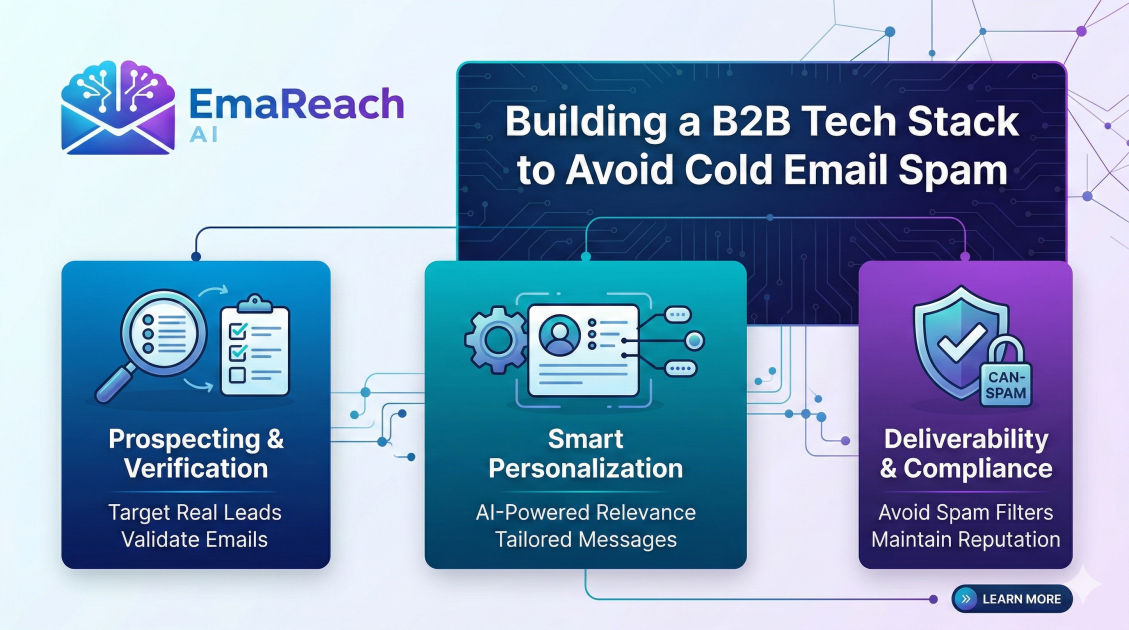
Building a B2B Tech Stack to Avoid Cold Email Spam
cold emailB2B salesdeliverabilityemail marketingsales tech stacklead generation
Introduction
In the modern B2B landscape, the line between high-performance outreach and unsolicited spam has become razor-thin. For many businesses, cold emailing remains a primary engine for growth, yet the technical environment in which these emails are sent is more hostile than ever. Internet Service Providers (ISPs) and email clients have significantly tightened their filters, employing sophisticated machine learning algorithms to identify and intercept anything that looks like mass-distributed marketing noise.
Building a tech stack that avoids the spam folder is no longer just about writing catchy subject lines; it is about engineering a technical foundation that signals trust, authority, and relevance. A fragmented or poorly configured stack can lead to blacklisted domains, ruined sender reputations, and missed revenue opportunities. To succeed, B2B leaders must approach their outreach infrastructure with the precision of a systems architect. This guide explores the essential components of a robust B2B tech stack designed to ensure your messages reach the primary inbox.
The Anatomy of Email Deliverability
Before selecting tools, it is vital to understand what happens when you click "send." Deliverability is not a binary outcome but a score based on three pillars: Technical Infrastructure, Sender Reputation, and Content Quality.
Technical Infrastructure
This is the basement of your tech stack. It includes your domain settings, DNS records, and the servers used to route mail. If these are not configured correctly, filters will reject your mail before a human ever sees it.
Sender Reputation
ISPs track the behavior of your domain and IP address. If you send 1,000 emails suddenly from a new domain, or if users frequently mark your mail as spam, your reputation plummets. A high reputation acts as a pass-through filter for busy inboxes.
Content Quality
While technical settings get you through the gate, the content gets you to the table. Modern filters scan for "spammy" keywords, suspicious links, and unnatural patterns in text. Personalization is the primary defense against content-based filtering.
Step 1: Foundation – Domain Architecture and DNS Management
The most common mistake in B2B outreach is sending cold emails from your primary company domain (e.g., company.com). If your outreach campaign is flagged, your entire company’s internal communication—including emails to current clients and investors—could be blocked.
Using Secondary Domains
Smart stacks utilize secondary domains (e.g., getcompany.com or companylabs.io). This creates a "firewall" that protects your brand’s core digital asset. Each secondary domain should be treated as a separate entity with its own reputation.
Essential DNS Records
To avoid being flagged as a spoofer, your stack must include three critical authentication protocols:
- SPF (Sender Policy Framework): A list of IP addresses authorized to send email on behalf of your domain.
- DKIM (DomainKeys Identified Mail): A digital signature that ensures the email wasn't tampered with during transit.
- DMARC (Domain-based Message Authentication, Reporting, and Conformance): A policy that tells receiving servers what to do if SPF or DKIM fails. Setting this to
p=quarantineorp=rejectsignals to ISPs that you take security seriously.
Step 2: The Warming Engine – Building Trust Gradually
A brand-new domain has no history. In the eyes of an ISP, a domain with no history sending 50 emails a day is a red flag. This is where "Warm-up" tools become indispensable. These tools simulate human interaction by sending small volumes of mail to a network of "friendly" inboxes that open, reply, and mark the mail as "not spam."
By gradually increasing volume over 4-6 weeks, you build a "health score" that allows you to scale without triggering alarms. Integrating an automated warming solution into your stack is the only way to maintain long-term deliverability in a high-volume environment.
Step 3: Data Integrity – The Prospecting Layer
Spam filters are triggered by high bounce rates. If more than 2% of your emails bounce (meaning the address doesn't exist), you are flagged as someone using a low-quality, scraped list—a hallmark of a spammer. Your B2B tech stack must include a multi-stage verification process.
Real-time Verification
Never import a list directly into a sending tool. Use a verification layer that pings the recipient's mail server to confirm the inbox is active without sending an actual email. This filters out "catch-all" addresses and invalid accounts that have been deactivated.
Data Enrichment
Relevance is the enemy of spam. A stack that includes data enrichment tools allows you to segment your audience by industry, recent funding, or specific technologies used. The more specific your segment, the less likely your mail will be perceived as generic noise.
Step 4: The Sending Platform – Managing Volume and Velocity
Not all sending platforms are created equal. For B2B outreach, you need a tool that mimics human sending behavior. This means avoiding "Email Marketing" tools (like those used for newsletters) which send thousands of emails at once from shared IP addresses. Instead, use "Sales Engagement" platforms that send emails one by one, with randomized intervals between them.
Multi-Account Sending
To reach a large audience without exceeding the daily limits of a single inbox (typically 30-50 cold emails per day for safety), your stack should support multi-account sending. This involves rotating the "From" address across several different accounts and domains. If one account sees a dip in performance, the others keep the campaign moving.
For businesses looking to simplify this complex web of accounts and technical settings, EmaReach provides a comprehensive solution. By combining AI-written outreach with automated inbox warm-up and multi-account sending, it ensures that cold emails land in the primary tab and get replies, effectively acting as the "brain" of your deliverability stack.
Step 5: Personalization via AI and Dynamic Fields
Generic templates are easily identified by spam filters using "fingerprinting" technology. If a filter sees the same 200-word block of text sent to 500 people, it labels it as a mass blast. Your tech stack must allow for deep personalization.
Dynamic Variables
Beyond just {{First_Name}}, modern stacks use variables for {{Company_News}}, {{Competitor_Name}}, or {{Specific_Pain_Point}}.
AI-Generated Opening Lines
AI tools can now read a prospect’s LinkedIn profile or website and generate a unique first sentence for every email. This makes every outbound message unique in the eyes of the ISP, making it virtually impossible for filters to apply a single "spam fingerprint" to your campaign.
Step 6: Monitoring and Feedback Loops
You cannot fix what you cannot measure. A professional B2B tech stack requires a monitoring layer to track the health of your domains.
Postmaster Tools
Tools like Google Postmaster provide direct data from the ISP regarding your domain's reputation, encryption levels, and delivery errors. If your spam rate climbs above 0.1%, these tools will warn you before your domain is fully blacklisted.
Blacklist Monitoring
There are hundreds of public blacklists (like Spamhaus or Barracuda). Your stack should include an automated monitor that alerts you the moment one of your sending domains appears on these lists, allowing you to pause campaigns and remediate the issue immediately.
Strategy: The "Ideal" B2B Outreach Stack Architecture
To visualize how these pieces fit together, consider this workflow:
- Lead Generation: A tool to find prospects based on ICP (Ideal Customer Profile).
- Verification: A tool to scrub the list and remove dead emails.
- CRM / Source of Truth: A central hub to ensure you aren't emailing current customers or active leads.
- Sequencing Engine: The software that schedules the emails, manages follow-ups, and handles the multi-account rotation.
- Warm-up Service: A background process that keeps the "sending muscles" of your inboxes strong.
- AI Layer: A tool to inject unique, personalized snippets into every outgoing message.
Avoiding the Technical "Kiss of Death"
Even with a great stack, certain behaviors can ruin your efforts. Here are the technical pitfalls to avoid:
- Tracking Links: Custom tracking domains are a must. Using the default tracking link provided by a sending tool means you are sharing a reputation with every other user of that tool. If a spammer uses the same tool, their bad behavior taints your link.
- Large Attachments: Never include attachments in a cold email. They are high-risk triggers for malware filters. Use plain text or a link to a trusted domain instead.
- HTML Complexity: Keep your email code clean. Heavy HTML, multiple fonts, and excessive images make your email look like a promotional flyer rather than a 1-to-1 business communication.
The Role of Engagement in Deliverability
Deliverability is a virtuous cycle. When people reply to your emails, ISPs see that your content is valuable. This increases your reputation, which makes it easier for your next email to hit the inbox.
This is why "Reply-to" addresses must be valid and monitored. If an ISP sees you sending from an unmonitored "noreply@" address, or if they notice that you never receive incoming mail, they will categorize you as a broadcast-only sender. A healthy stack encourages two-way communication.
Conclusion
Building a B2B tech stack to avoid cold email spam is an investment in your company’s long-term digital sovereignty. By moving away from "spray and pray" tactics and toward a sophisticated, multi-layered infrastructure, you protect your brand and ensure your sales team spends their time talking to prospects rather than fighting filters.
Success in outbound today requires a balance of technical configuration, high-quality data, and genuine personalization. When you treat your email infrastructure with the same respect you treat your product code, the primary inbox becomes a predictable, scalable channel for growth. The tools are available; the strategy is clear. Now is the time to audit your current setup and bridge the gaps between the "send" button and the prospect's attention.
EmaReach AI
Ready to scale your cold email outreach?
Join thousands of teams using EmaReach AI for AI-powered campaigns, domain warmup, and 95%+ deliverability. Start free — no credit card required.
Related posts
- Read article
The Instantly Alternative That Finally Gets Outbound Analytics Right
Discover why high-volume cold email requires a shift from surface-level vanity metrics to deep, data-driven revenue attribution, and explore the ultimate alternatives for mastering outbound engineering.
- Read article
What You Gain and What You Give Up When Switching From Instantly
Thinking about migrating your cold email stack? This detailed guide breaks down the exact operational advantages you gain and the core features you sacrifice when switching away from Instantly's popular outreach platform.