Blog
Back to blog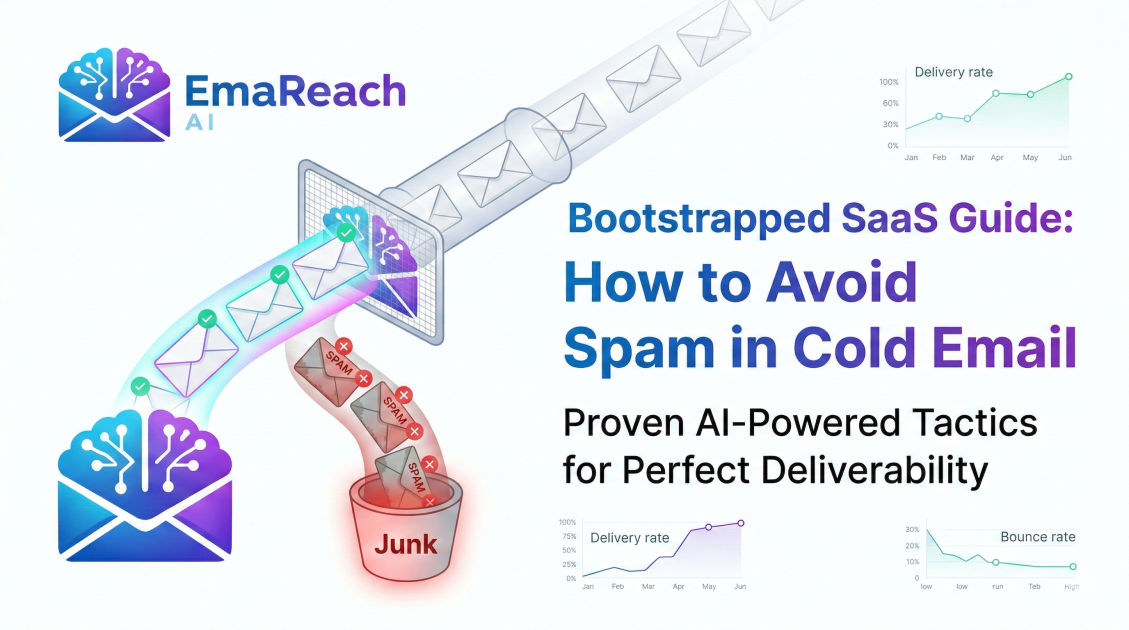
Bootstrapped SaaS Guide: How to Avoid Spam in Cold Email
cold emailSaaS marketingdeliverabilityemail automationbootstrappingoutreach strategy
Introduction
For a bootstrapped SaaS founder, cold email is often the most cost-effective channel for customer acquisition. Unlike paid ads, which require a significant upfront budget and constant monitoring, cold email allows you to reach out directly to your ideal customers with nothing more than a well-crafted message and a reliable sending infrastructure. However, the barrier to entry has increased significantly. Internet Service Providers (ISPs) and email clients have become incredibly sophisticated at filtering out unsolicited messages.
If your outreach lands in the spam folder, your efforts are wasted. Even worse, a poor reputation can lead to your domain being blacklisted, crippling your ability to communicate with existing customers. This guide provides a comprehensive framework for bootstrapped founders to build a cold email machine that bypasses spam filters and lands directly in the primary inbox.
The Technical Foundations of Deliverability
Before you write a single line of copy, you must ensure your technical setup is flawless. Think of this as building the engine before you worry about the paint job on the car. If the engine doesn't start, the car isn't going anywhere.
Domain Authentication: SPF, DKIM, and DMARC
Authentication is how you prove to receiving servers that you are who you say you are. Without these records, you are essentially a stranger knocking on a door without ID.
- SPF (Sender Policy Framework): This is a DNS record that lists the IP addresses authorized to send emails on behalf of your domain.
- DKIM (DomainKeys Identified Mail): This adds a digital signature to your emails, allowing the receiver to verify that the email was actually sent by the domain owner and wasn't altered in transit.
- DMARC (Domain-based Message Authentication, Reporting, and Conformance): This tells the receiving server what to do if an email fails SPF or DKIM checks. Setting this to 'quarantine' or 'reject' over time improves your sender authority.
The Importance of a Separate Tracking Domain
Most cold email tools track opens and clicks by inserting a small pixel or rewriting links. If you use the default tracking domain provided by a software provider, you share a reputation with every other user of that tool. If one user sends spam, it can affect your deliverability. By setting up a Custom Tracking Domain (CTD) that maps to your own domain, you isolate your reputation and appear more professional to spam filters.
Using Secondary Domains
One of the biggest mistakes bootstrapped founders make is sending cold emails from their primary company domain (e.g., company.com). If you get flagged for spam, your internal team emails and transactional emails (like password resets) will stop delivering. Always purchase secondary domains (e.g., getcompany.com or companyapp.io) specifically for outreach. This creates a 'firewall' around your main brand.
Warm-up: The Crucial Grace Period
A brand-new domain has no reputation. If you suddenly start sending 50 or 100 emails a day from a fresh domain, ISPs will immediately flag you as a spammer. You need to 'warm up' the inbox. This process involves sending a small volume of emails and gradually increasing that volume over several weeks, ensuring that those emails are opened, replied to, and marked as 'not spam' if they land in the junk folder.
For those looking to automate this tedious process, EmaReach provides an integrated solution. It combines AI-written cold outreach with automated inbox warm-up and multi-account sending, ensuring your emails land in the primary tab and get replies. This is particularly useful for bootstrapped teams who don't have the time to manually manage dozens of warm-up sequences.
Data Quality and List Hygiene
Your deliverability is only as good as your data. High bounce rates are the fastest way to destroy your sender reputation. A 'hard bounce' (the email address doesn't exist) tells the ISP that you are using a guessed or outdated list, which is a hallmark of spamming.
Verifying Your Leads
Never send to a list without running it through a verification service. These tools check if the mail server exists and if the specific mailbox is active without actually sending an email. Aim for a bounce rate of less than 2%. Anything higher than 5% puts your accounts at serious risk.
Avoiding 'Catch-all' Emails
Some domains are configured to accept all emails sent to them, regardless of whether the specific recipient exists. These are known as 'catch-all' or 'unverifiable' emails. While it might be tempting to include them in your campaigns, they carry a higher risk. For a bootstrapped SaaS where every lead counts, it is often safer to skip these or handle them with extreme caution in smaller, highly targeted batches.
Crafting the Message: Avoiding Spam Triggers
Once the technical infrastructure is solid, the content of your email determines whether you stay in the inbox or get moved to the junk folder by the user. Spam filters look for specific patterns in your text.
The Keyword Trap
Certain words act as red flags for filters. Words like 'Free,' 'Winner,' 'Cash,' 'Investment,' or 'Risk-free' can trigger alerts, especially when used in subject lines. However, modern filters are smarter than just keyword matching; they look for the 'vibe' of the email. If it sounds like a sales pitch from 2005, it will be treated like one.
HTML vs. Plain Text
While beautiful, branded HTML emails work well for newsletters, they are often a negative signal for cold outreach. Personal emails are usually plain text. By keeping your cold emails in a plain-text format (or very simple HTML with no heavy imagery), you mimic natural human behavior, which filters prefer.
Personalization at Scale
Generic emails get marked as spam by users. When a recipient clicks 'Report Spam,' it is the most damaging signal you can receive. To avoid this, you must demonstrate that you have done your research. Use liquid syntax or AI tools to insert specific details about the recipient’s company, recent news, or specific pain points. A highly personalized email that solves a problem is rarely reported as spam.
The Strategic Use of Multi-Account Sending
Instead of sending 200 emails a day from one account, it is much safer to send 25 emails a day from eight different accounts across multiple domains. This is a core strategy for high-growth bootstrapped SaaS companies. It spreads the risk; if one account hits a snag, the rest of your lead generation continues uninterrupted.
Using a platform like EmaReach allows you to manage this multi-account complexity effortlessly. By distributing the load, you stay under the radar of ISP rate limits while maintaining a high total volume of outreach.
Monitoring and Maintenance
Deliverability is not a 'set it and forget it' task. It requires ongoing monitoring to ensure your systems are functioning correctly.
Tracking Sender Reputation
You should regularly check your domain and IP reputation using tools like Google Postmaster Tools. This provides direct feedback from Google on how they perceive your traffic. If you see your reputation dipping from 'High' to 'Medium,' it is time to pause your campaigns and investigate your data quality or content.
Handling Unsubscribes Graciousy
Nothing makes a person hit the spam button faster than an inability to opt-out. You have two choices: a clear 'Unsubscribe' link or a 'Reply to opt-out' sentence. For cold email, a simple sentence like "If you'd rather not hear from me again, just let me know" often feels more personal and less automated, which can actually help deliverability.
Advanced Tactics: Spin Tax and Variation
Spam filters look for identical messages being sent in large quantities. If you send the exact same subject line and body to 500 people, it looks like a blast. 'Spin tax' allows you to create variations of your copy.
For example:
{Hi|Hello|Hey} {{first_name}}, I {noticed|saw|observed} your recent post about...
This creates hundreds of unique permutations of the same basic message, making it much harder for automated filters to identify a mass-mailing pattern.
The Psychology of the 'Primary' Tab
To land in the primary tab, your email needs to look like it belongs there. This means avoiding too many links (aim for one or zero in the initial touchpoint) and avoiding attachments entirely in the first email. Your goal is to start a conversation, not to close a sale in the first message. When a lead replies to your cold email, your deliverability for that recipient (and their entire domain) skyrockets because the ISP sees a two-way engagement.
Conclusion
Avoiding the spam folder is a multifaceted challenge that requires a blend of technical precision, data integrity, and thoughtful copywriting. For the bootstrapped SaaS founder, mastering this discipline is a competitive advantage. By setting up proper authentication, using secondary domains, warming up your inboxes, and focusing on high-quality personalization, you can build a sustainable outbound engine that drives growth without the need for massive advertising spend.
Success in cold email isn't about how many people you can reach; it's about how many people you can actually get through to. Focus on the infrastructure, protect your reputation, and always provide value in every interaction.
EmaReach AI
Ready to scale your cold email outreach?
Join thousands of teams using EmaReach AI for AI-powered campaigns, domain warmup, and 95%+ deliverability. Start free — no credit card required.
Related posts
- Read article
The Instantly Alternative That Finally Gets Outbound Analytics Right
Discover why high-volume cold email requires a shift from surface-level vanity metrics to deep, data-driven revenue attribution, and explore the ultimate alternatives for mastering outbound engineering.
- Read article
What You Gain and What You Give Up When Switching From Instantly
Thinking about migrating your cold email stack? This detailed guide breaks down the exact operational advantages you gain and the core features you sacrifice when switching away from Instantly's popular outreach platform.