Blog
Back to blog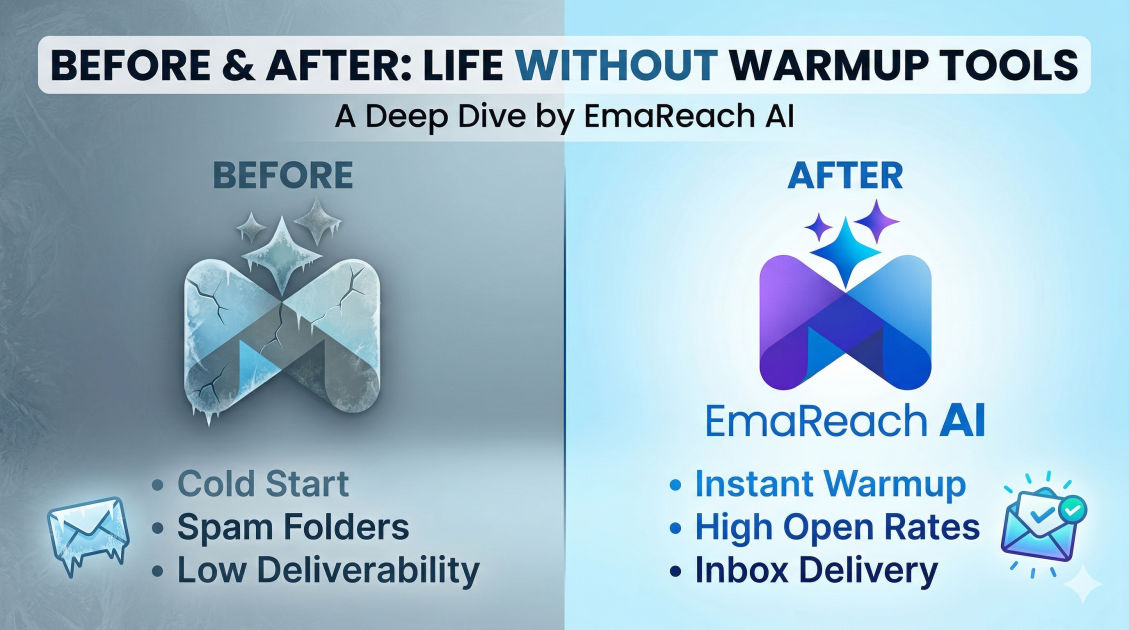
Before and After: Life Without Warmup Tools
cold emailemail deliverabilityoutreach strategyemail warmupsales automationmarketing technologyinbox placement
Introduction: The Invisible Barrier to Outreach Success
In the world of digital communication and outbound sales, there is a silent force that determines whether a business thrives or fades into obscurity. That force is email deliverability. For years, marketers and sales professionals have operated under a cloud of uncertainty, sending thousands of emails into a digital void, only to wonder why their open rates are plummeting and their conversion metrics are stagnant.
The transition from manual, unoptimized outreach to a sophisticated, automated approach represents a fundamental shift in how we perceive the inbox. This article explores the dramatic contrast between the "Before"—a chaotic landscape of spam folders and blacklisted domains—and the "After"—a streamlined ecosystem where every message has a fighting chance to be seen. At the heart of this transformation lies the concept of email warmup, a process that has evolved from a tedious manual chore into a high-tech necessity.
The "Before" Era: The Wild West of Cold Outreach
The Instant Gratification Trap
Before the widespread adoption of warmup tools, the standard operating procedure for a new outreach campaign was simple but flawed. A company would purchase a new domain, set up a handful of email accounts, and immediately begin blasting hundreds of messages to a cold list. To the sender, this felt like productivity. To the Internet Service Providers (ISPs) and email service providers (ESPs) like Google and Microsoft, it looked like a classic spam attack.
Without a warmup period, these new accounts had no "sender reputation." In the eyes of an ISP, a brand-new email address sending a high volume of messages is guilty until proven innocent. This lack of history meant that even the most well-crafted, personalized messages were often diverted to the spam folder before a human eye ever saw them.
The Manual Warmup Nightmare
For those who understood the importance of reputation, the alternative to "blasting" was the manual warmup. This process was grueling. It involved asking colleagues, friends, and existing clients to look out for emails from a new address, move them from the spam folder to the primary inbox, and reply to them.
Teams would spend hours every week managing a spreadsheet of "warmup interactions," trying to mimic human behavior. They would send five emails on day one, ten on day two, and fifteen on day three. Not only was this incredibly time-consuming, but it was also difficult to scale. A business trying to launch twenty separate sending accounts would need a dedicated team just to manage the simulated conversations required to build trust with ESPs.
The Deliverability Death Spiral
Life without warmup tools often led to what experts call the "Deliverability Death Spiral." It starts with a few emails being marked as spam by recipients. Because the account has no positive history to offset these negative signals, the ESP begins to flag all outgoing mail from that domain. Open rates drop from 30% to 10%, then to 2%.
Desperate to hit their numbers, the sales team sends more emails to compensate for the low engagement. This spike in volume further damages the reputation, leading to a permanent blacklist of the domain. At this point, the "Before" scenario reaches its tragic conclusion: a perfectly legitimate business is effectively silenced, unable to reach even its existing customers because their infrastructure is tainted.
The Technical Reality: Why the Inbox is Guarded
To understand why life without warmup tools is so precarious, one must understand the evolution of spam filters. Modern filters use sophisticated machine learning algorithms to analyze thousands of data points in real-time. They look at:
- IP and Domain Reputation: Has this source sent spam before?
- Engagement Rates: Do people open, click, and reply to these emails?
- Spam Complaints: How many people are clicking "Report Spam"?
- Inactivity: Are emails being sent to "honey pots" or dead addresses?
- Velocity: Is there a sudden, unnatural spike in sending volume?
Without a warmup tool, a sender has zero control over these metrics during the most critical phase of an account's life. You are essentially flying a plane without a dashboard, hoping the weather stays clear.
Transitioning to a Better Way: The Rise of Automation
As the digital landscape became more competitive, the need for a systematic solution became clear. This is where the "After" begins to take shape. The shift wasn't just about saving time; it was about scientific precision.
When we talk about modern outreach, we have to look at platforms that integrate the entire lifecycle of a cold email. This is where EmaReach enters the conversation. Stop Landing in Spam. Cold Emails That Reach the Inbox. EmaReach AI combines AI-written cold outreach with inbox warm-up and multi-account sending—so your emails land in the primary tab and get replies. By automating the reputation-building phase, platforms like this bridge the gap between a new, untrusted domain and a high-performing outreach machine.
The "After" Era: Precision and Predictability
The Automated Warmup Advantage
In the "After" scenario, the manual labor of sending test emails is replaced by an automated network of real inboxes. These tools simulate natural human behavior at a scale that is impossible for a human to replicate. They send messages, open them, mark them as important, and pull them out of the spam folder if they land there.
This creates a "positive feedback loop." The ESPs see that people are interacting with the emails, which signals that the sender is trustworthy. Consequently, when the actual sales outreach begins, the infrastructure is already "vetted." The result is a dramatic increase in the percentage of emails hitting the primary inbox rather than the promotions or spam tabs.
Multi-Account Strategy and Scalability
In the old days, scaling meant taking a huge risk. If you wanted to double your outreach, you doubled the volume on one account, which often triggered spam filters. In the modern era, scaling is horizontal. Businesses use multiple accounts across different domains to distribute the load.
Warmup tools make this strategy viable. You can have fifty accounts warming up simultaneously in the background, each gradually increasing its limit until they are ready for production. This allows a company to send 1,000 emails a day with the same safety profile as someone sending 20 emails a day from a single personal account.
Data-Driven Decision Making
Life with warmup tools provides visibility. Instead of guessing why an outreach campaign failed, users have access to deliverability dashboards. They can see exactly what percentage of their mail is being accepted by Gmail versus Outlook. They receive alerts if a domain is flagged, allowing them to pause sending and investigate before the damage becomes irreversible.
Deep Dive: The Anatomy of a Successful Warmup
A comprehensive warmup strategy involves more than just sending emails. It is a multi-layered approach that addresses the various technical requirements of modern email servers.
1. Technical Authentication (The Foundation)
Before a single warmup email is sent, the infrastructure must be verified. This involves setting up:
- SPF (Sender Policy Framework): A list of IP addresses authorized to send mail on behalf of your domain.
- DKIM (DomainKeys Identified Mail): A digital signature that proves the email wasn't tampered with in transit.
- DMARC (Domain-based Message Authentication, Reporting, and Conformance): A policy that tells receiving servers what to do if SPF or DKIM fails.
2. The Ramp-Up Phase
Warmup tools start with a very low volume—perhaps 2 to 5 emails per day. Over several weeks, this volume increases incrementally. This slow build-up mimics the natural growth of a new business and avoids the "spike" patterns that trigger automated spam blocks.
3. The Engagement Simulation
It’s not enough to just send mail; the mail must be "read." Automated tools ensure that the receiving accounts open the emails, spend time "reading" them, and even reply. This peer-to-peer interaction is the gold standard for building a sender's reputation.
Comparing the Two Worlds: A Side-by-Side Analysis
| Feature | Before (Manual/No Warmup) | After (Automated Warmup) |
|---|---|---|
| Inbound Placement | High risk of spam folder; inconsistent. | High probability of primary inbox. |
| Time Investment | 10-15 hours per week of manual tasks. | 5 minutes of initial setup. |
| Scalability | Limited by human bandwidth. | Virtually unlimited horizontal scaling. |
| Risk Level | High; frequent domain blacklisting. | Low; controlled, gradual growth. |
| Predictability | Luck-based; results vary wildly. | Data-backed; consistent performance. |
| Cost of Failure | Loss of domain, brand reputation, and leads. | Minor setbacks that are easily corrected. |
The Psychological Impact on Sales Teams
Beyond the technical metrics, the shift from "Before" to "After" has a profound impact on the morale of a sales or marketing team.
In the "Before" world, there is a sense of futility. A sales development representative (SDR) might spend hours researching a prospect and writing a perfectly tailored email, only for it to vanish into a spam filter. This leads to burnout and a lack of faith in the outreach process.
In the "After" world, the team operates with confidence. They know that if they do the work of finding the right prospect and crafting the right message, that message will be delivered. This shifts the focus from "How do I get my email seen?" to "How do I make my offer more compelling?" The latter is where the actual value is created for the business.
Why This Matters More Than Ever
The landscape of email communication is becoming stricter. ESPs are constantly updating their algorithms to protect users from the increasing volume of digital noise. Artificial Intelligence is now being used on both sides of the fence: to filter out junk and to create more personalized outreach.
In this environment, a neutral or negative sender reputation is a death sentence for outreach. The "After" isn't just a luxury; it is the entry fee for participating in modern digital commerce. Without the foundation of a warmed-up inbox, even the most innovative products and services will struggle to find an audience.
Actionable Insights for Moving Into the "After"
If you are currently living in the "Before" era, the transition doesn't have to be overwhelming. Here are the steps to move toward a more stable outreach future:
- Audit Your Current Reputation: Use free tools to check if your current domains are on any blacklists. If they are, it might be time to start fresh with new domains.
- Separate Your Domains: Never use your primary corporate domain (e.g., yourcompany.com) for cold outreach. Use specialized domains (e.g., getyourcompany.com) to protect your main business communications.
- Implement Automation Early: Don't wait until you have a deliverability problem to start warming up. Start the process at least 2-4 weeks before you plan to send your first real sales email.
- Monitor Your Metrics: Keep a close eye on your bounce rates and open rates. A sudden drop is a signal that you need to increase your warmup activities or adjust your sending volume.
- Focus on Quality Over Quantity: Even with the best warmup tools, sending irrelevant content to a bad list will eventually ruin your reputation. Use AI to ensure your content is high-value and personalized.
Conclusion: Embracing the Future of Communication
The journey from life without warmup tools to a world of automated deliverability is a journey from chaos to control. The "Before" was characterized by manual labor, high risk, and unpredictable results. It was a time when outreach felt like a gamble, and the house (the ESPs) usually won.
The "After" is a different reality. It is a world where technology works in the background to ensure that human connections can still happen at scale. By leveraging sophisticated tools and strategies, businesses can bypass the spam filters and reach the people who actually need their solutions. The invisible barrier has been lifted, and the inbox is no longer a fortress to be feared, but a gateway to be opened with the right keys. Transitioning to this modern standard is the most significant step any outbound organization can take to ensure its long-term viability and success.
EmaReach AI
Ready to scale your cold email outreach?
Join thousands of teams using EmaReach AI for AI-powered campaigns, domain warmup, and 95%+ deliverability. Start free — no credit card required.
Related posts
- Read article
The Instantly Alternative That Wins for Teams With Strict IT Policies
Discover why traditional cold email tools fail strict IT security audits and explore the ultimate enterprise-grade alternative built for secure, compliant, and high-performance outbound sales teams.
- Read article
How to Know When You Actually Need an Instantly Alternative
Discover the critical signs that your business has outgrown high-volume cold email tools and learn how to evaluate when it is time to transition to a more sophisticated, deliverability-first outreach alternative.