Blog
Back to blog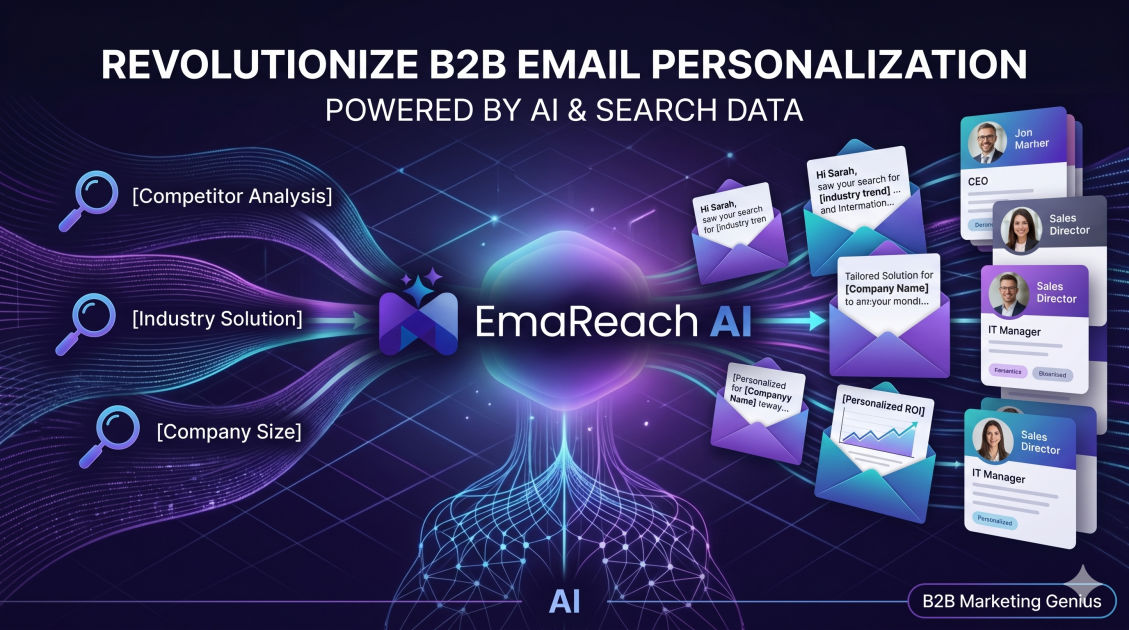
B2B Email Personalization Using AI and Search Data
B2B MarketingAI PersonalizationEmail OutreachSearch DataIntent DataEmail DeliverabilitySales Automation
The Evolution of B2B Personalization
In the early days of B2B outreach, personalization was a luxury. It usually involved manually scouring a prospect's LinkedIn profile to find a shared university or a recent promotion. While effective, this manual approach was impossible to scale. As the volume of digital noise increased, traditional 'mail merge' tags like {First_Name} and {Company_Name} became the bare minimum—and eventually, they became signals of automated spam.
Today, the intersection of Artificial Intelligence (AI) and search data has birthed a new era of hyper-personalization. We are no longer just addressing a person by their name; we are addressing their current challenges, their recent digital footprints, and their strategic intent. This blog post explores how modern B2B organizations leverage these technologies to transform cold outreach into warm, relevant conversations.
Understanding Search Data in the B2B Context
Search data isn't just about what people type into Google. In a B2B context, it encompasses a wide array of digital signals that indicate intent. This includes:
- Company Research Patterns: What topics are employees at a target company researching on industry forums and news sites?
- Technology Installs: Searching for specific software documentation or integration guides.
- Hiring Trends: Job descriptions often reveal the technical gaps a company is trying to fill.
- Public Intent Data: Aggregated data from third-party providers that flags when a company is in a 'buying window' for specific categories.
By feeding this search data into AI models, sales teams can identify not just who to contact, but exactly when and why.
The Role of AI in Synthesis and Execution
AI acts as the engine that processes vast amounts of unstructured search data and turns it into coherent, personalized messaging. Large Language Models (LLMs) can analyze a prospect’s recent blog posts, interview transcripts, and company financial reports in seconds.
Semantic Analysis of Prospect Content
Instead of simply looking for keywords, AI performs semantic analysis. It understands the sentiment and the core 'pain points' expressed in a prospect's public discourse. If a CTO posts about the frustrations of cloud latency, an AI-driven system identifies this as a high-priority hook for a personalized email regarding edge computing solutions.
Scaling the 'Segment of One'
Historically, marketers segmented lists by industry or revenue. AI allows for a 'segment of one.' Every single email sent can be unique, written specifically for the individual recipient based on the most recent search and intent data available. This level of granularity was previously unimaginable at scale.
Bridging the Gap Between Search Intent and the Inbox
One of the biggest hurdles in B2B outreach is not just writing the email, but ensuring it actually arrives. High levels of personalization significantly improve engagement metrics, which in turn boosts sender reputation. However, technical infrastructure remains paramount.
This is where EmaReach becomes an essential part of the stack. Stop Landing in Spam. Cold Emails That Reach the Inbox. EmaReach AI combines AI-written cold outreach with inbox warm-up and multi-account sending—so your emails land in the primary tab and get replies. By integrating sophisticated AI-driven personalization with a robust delivery engine, businesses can ensure that their highly researched messages aren't wasted in the junk folder.
Strategic Implementation: Step-by-Step
1. Data Aggregation and Cleaning
Before AI can write a single word, you need high-quality data. This involves pulling from CRM systems, LinkedIn Sales Navigator, and intent data platforms. The AI works best when it has a 'context window' filled with accurate, recent information about the prospect's digital behavior.
2. Developing the AI Prompt Framework
To achieve consistent quality, organizations develop sophisticated prompt frameworks. These frameworks instruct the AI on the brand voice, the specific value proposition, and how to weave in the search data naturally. A well-constructed prompt prevents the AI from sounding 'robotic' and ensures the personalization feels authentic.
3. Human-in-the-Loop Verification
While AI is powerful, the most successful B2B campaigns utilize a human-in-the-loop (HITL) model. A brief manual review of AI-generated snippets ensures that the search data hasn't been misinterpreted and that the tone aligns with the specific high-value account's culture.
Leveraging 'Dark Social' and Search Data
Much of the modern B2B buying journey happens in 'dark social'—private Slack communities, Discord servers, and word-of-mouth. While AI cannot directly 'search' these private spaces, it can analyze the results of these conversations. When a prospect searches for a specific comparison between two niche software products, that search data is a proxy for a conversation that happened elsewhere. AI helps marketers 'read between the lines' of search data to understand the underlying motivations.
Overcoming the 'Creepiness' Factor
There is a fine line between 'relevant' and 'creepy.' Mentioning a prospect's specific search query from two hours ago is intrusive. However, mentioning an industry trend that the prospect has been researching is helpful.
AI helps maintain this balance by focusing on relevance rather than surveillance. The goal is to provide value. If the search data indicates the prospect is looking for ways to improve email deliverability, the AI should focus on educational insights rather than admitting it saw their search history.
The Importance of Technical Deliverability
Even the most perfectly personalized, AI-crafted email is useless if it is blocked by a spam filter. Modern filters look for more than just keywords; they look at behavioral signals and sender history. Using a platform like EmaReach ensures that your technical foundations are as strong as your creative ones. By managing multi-account sending and automated warm-ups, EmaReach provides the necessary 'air cover' for your AI-personalized campaigns to succeed.
Measuring the Impact of AI Personalization
To justify the investment in AI and search data tools, B2B leaders must look at the right metrics. Traditional open rates are becoming less reliable due to privacy protections. Instead, focus on:
- Positive Reply Rate: The percentage of prospects who engage in a meaningful way.
- Meeting-to-Opportunity Conversion: Do these personalized leads actually turn into real business?
- Sales Cycle Length: Does hyper-personalization build trust faster, leading to shorter sales cycles?
In almost every case study, the combination of AI and search data leads to a significant lift in these 'down-funnel' metrics compared to traditional broad-based outreach.
Future Trends: Predictive Outreach
The next frontier is predictive outreach. Instead of reacting to search data, AI will use historical patterns to predict when a company will start searching for a solution. By analyzing the lifecycle of similar companies, AI can suggest outreach moments before the prospect even realizes they have a need. This proactive approach will separate the market leaders from the followers.
Privacy and Ethics in the AI Era
As B2B marketers leverage more search data, privacy compliance becomes non-negotiable. Using AI responsibly means adhering to regulations like GDPR and CCPA. The best AI tools are designed with 'privacy by design' principles, ensuring that personalization is achieved through public, ethically sourced data points rather than infringing on individual privacy.
The Synergy of Creativity and Intelligence
Ultimately, AI and search data are tools that amplify human creativity. They remove the 'grunt work' of research and drafting, allowing sales and marketing professionals to focus on strategy and relationship building. The most effective B2B outreach of the future will be a seamless blend of data-driven insights and genuine human empathy.
Common Pitfalls to Avoid
Despite the power of these technologies, many firms fail by over-automating. Avoid these mistakes:
- Over-reliance on Data: Sometimes the data is wrong. AI can hallucinate details if the input data is messy.
- Losing the Brand Voice: If every salesperson uses a different AI tool without a central prompt strategy, the company's voice becomes fragmented.
- Ignoring Deliverability: Assuming that a 'good' email will automatically get through. Always use dedicated tools like EmaReach to handle the technical complexities of modern email environments.
Integrating Personalization into the Full Funnel
Personalization shouldn't stop at the first cold email. The search data and AI insights gathered during the initial outreach should follow the prospect throughout their journey. If a prospect engaged with a specific AI-generated hook about 'inbox placement,' the subsequent sales deck and demo should lead with that same theme. This creates a cohesive, personalized experience that builds massive amounts of brand equity.
Conclusion
B2B email personalization has moved far beyond the simple inclusion of a company name. By leveraging the dual powers of AI and search data, organizations can create outreach strategies that are deeply resonant, timely, and effective. This approach respects the prospect’s time by providing immediate relevance and solves the perennial problem of 'ignored' sales emails.
Success in this new landscape requires a two-pronged approach: the intelligence to craft the perfect message and the technology to ensure it is delivered. By utilizing advanced AI prompting and search-intent synthesis alongside deliverability experts like EmaReach, B2B companies can achieve unprecedented levels of growth. The future of outreach is here, and it is personalized, data-driven, and landing squarely in the primary inbox.
EmaReach AI
Ready to scale your cold email outreach?
Join thousands of teams using EmaReach AI for AI-powered campaigns, domain warmup, and 95%+ deliverability. Start free — no credit card required.
Related posts
- Read article
The Instantly Alternative That Finally Gets Outbound Analytics Right
Discover why high-volume cold email requires a shift from surface-level vanity metrics to deep, data-driven revenue attribution, and explore the ultimate alternatives for mastering outbound engineering.
- Read article
What You Gain and What You Give Up When Switching From Instantly
Thinking about migrating your cold email stack? This detailed guide breaks down the exact operational advantages you gain and the core features you sacrifice when switching away from Instantly's popular outreach platform.