Blog
Back to blog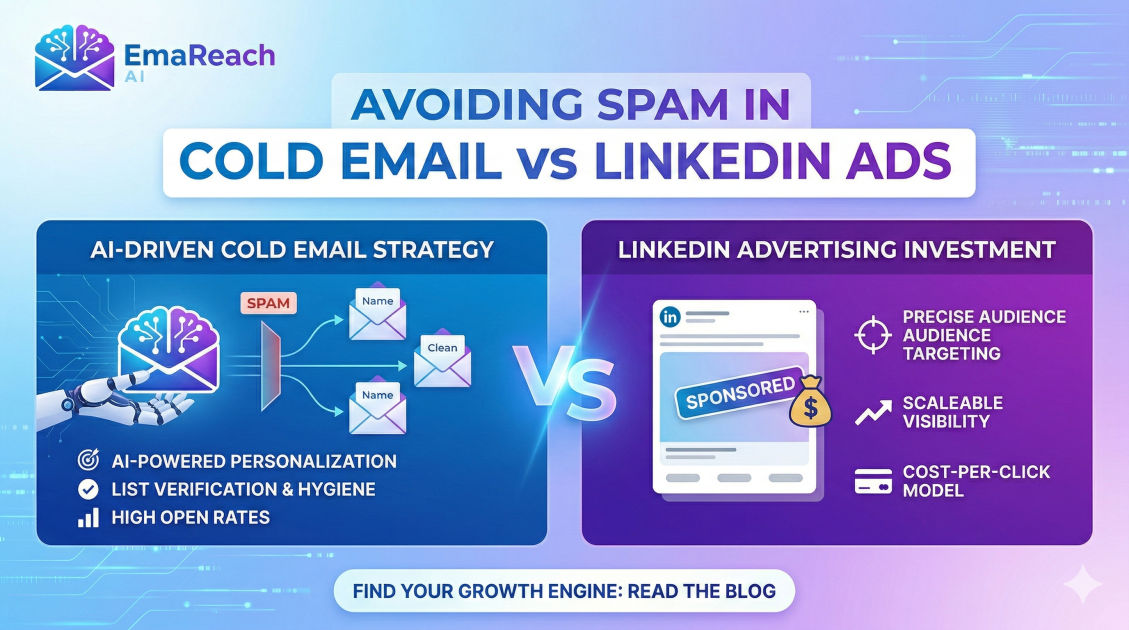
Avoiding Spam in Cold Email vs Paying for LinkedIn Ads
cold emaillinkedin adsdeliverabilityB2B marketingoutreach strategyemail spam
Introduction
In the modern B2B landscape, the struggle for attention is fiercer than ever. For growth-focused companies, two primary channels dominate the conversation: cold email and LinkedIn advertising. While both offer a direct line to decision-makers, they operate on fundamentally different mechanics. Cold email is a high-reward, high-risk endeavor where the primary obstacle is the dreaded spam folder. LinkedIn ads, conversely, offer a 'pay-to-play' environment where the barrier isn't technical deliverability, but rather the rising cost of acquisition and creative fatigue.
Choosing between these two—or finding the right balance—requires a deep understanding of how to navigate technical hurdles and financial investments. This guide explores the intricacies of maintaining email deliverability, the economics of LinkedIn ads, and how to decide which path leads to the highest ROI for your specific business model.
The Technical Battle: Avoiding the Spam Folder
Cold email is often criticized as being 'spammy,' but there is a distinct difference between unsolicited commercial email and high-quality outbound prospecting. The difference lies in deliverability and relevance. To succeed in cold email today, you must treat your sending infrastructure with the same respect as your product code.
Understanding Spam Filters and Algorithms
Modern Email Service Providers (ESPs) like Google and Microsoft use sophisticated machine learning models to protect their users. These filters look at hundreds of signals, which can be categorized into three main buckets: technical setup, sender reputation, and content quality.
1. Technical Authentication (The Foundation)
If your technical records are missing or incorrect, your emails will likely be blocked before they are even scanned for content. You must configure:
- SPF (Sender Policy Framework): A list of IP addresses authorized to send emails on behalf of your domain.
- DKIM (DomainKeys Identified Mail): A digital signature that proves the email was not tampered with during transit.
- DMARC (Domain-based Message Authentication, Reporting, and Conformance): A policy that tells receiving servers what to do if SPF or DKIM fails.
2. Sender Reputation and IP Warm-up
Sending 500 emails from a brand-new domain is a surefire way to get blacklisted. ESPs look for a history of consistent, low-volume sending. This is why 'warming up' an inbox is critical. By gradually increasing volume and ensuring high engagement (opens and replies), you signal to the algorithms that you are a legitimate human sender.
For those looking to scale without the headache of manual maintenance, tools like EmaReach (https://www.emareach.com/) can be a game-changer. EmaReach helps you stop landing in spam by ensuring cold emails reach the inbox through a combination of AI-written outreach, automated inbox warm-up, and multi-account sending. This ensures your messages land in the primary tab where they actually get read.
The Role of Content in Deliverability
Once the technical foundation is solid, the content determines whether you stay in the inbox. Avoid 'spam trigger words' like 'Free,' 'Buy Now,' or 'Guaranteed.' More importantly, avoid heavy tracking pixels and excessive links. The more your email looks like a newsletter or a marketing blast, the more likely it is to be filtered into the 'Promotions' or 'Spam' tabs. High-performing cold emails are usually plain text, short, and focused on a single call to action.
The Financial Battle: Paying for LinkedIn Ads
While cold email requires technical mastery, LinkedIn Ads require financial mastery. The platform is widely regarded as the most expensive social network for advertising, but for B2B, it offers unparalleled targeting precision.
Why LinkedIn Ads Are a 'Safe' Alternative to Cold Email
The primary advantage of LinkedIn Ads is that you never have to worry about a 'spam folder.' You are paying LinkedIn to guarantee that your message appears in front of the target audience. This eliminates the technical anxiety of domain health and blacklists.
The Economics of the Feed
LinkedIn operates on an auction system. You are competing with other advertisers for the same 'real estate' in a decision-maker's feed. Because the audience—CEOs, CTOs, VPs of Sales—is highly sought after, the Cost Per Click (CPC) can be staggering, often ranging from $5 to $15 or more depending on the industry.
To make LinkedIn Ads work, your Lifetime Value (LTV) of a customer must be high enough to absorb a high Customer Acquisition Cost (CAC). If your product sells for $50 a month, LinkedIn Ads will likely bankrupt your marketing budget. If your contract value is $20,000 a year, the math starts to make sense.
Targeting vs. Reach
LinkedIn’s greatest strength is its data. You can target users by:
- Job Title and Seniority
- Specific Company Name or Industry
- Company Size and Growth Rate
- Member Groups and Skills
This precision allows you to reach the exact person who has the power to sign your contract. However, unlike cold email, which is proactive and lands directly in an inbox, an ad is passive. The user must be scrolling through their feed and find your creative compelling enough to stop.
Comparing the Two: Side-by-Side Analysis
To help determine which strategy fits your current stage, consider the following comparison table:
| Feature | Cold Email Outreach | LinkedIn Advertising |
|---|---|---|
| Primary Cost | Time & Specialized Tools | Direct Ad Spend |
| Barrier to Entry | High (Technical Knowledge) | Low (Credit Card Required) |
| Scalability | Linear (Requires more accounts) | Exponential (Requires more budget) |
| Control | High (Direct 1-to-1) | Medium (Platform Algorithm) |
| Risk | Domain Blacklisting | High Financial Loss |
| Response Type | Conversational/Direct | Lead Form/Website Traffic |
Strategic Deep Dive: When to Choose Cold Email
Cold email is the ultimate 'lean' growth lever. It is best suited for companies that have a clearly defined ICP (Ideal Customer Profile) and a compelling, personalized offer.
The 'Relationship' Factor
Cold email, when done correctly, feels like the start of a relationship. It is a person-to-person communication. If your sales process requires high-touch consultative selling, starting that conversation in the inbox is often more effective than showing them a generic 'Download our Whitepaper' ad on LinkedIn.
Navigating the Challenges
The biggest challenge remains the 'Spam' label. To avoid this, you must pivot away from 'blasting' and toward 'segmenting.' Instead of sending 1,000 generic emails, send 50 highly researched emails. This is where AI and automation come in. By using intelligent platforms to manage your sending reputation and personalize your copy at scale, you can maintain the intimacy of a 1-to-1 email with the efficiency of a mass campaign.
Strategic Deep Dive: When to Choose LinkedIn Ads
LinkedIn Ads are the preferred choice for 'Top of Mind' awareness and lead generation at scale. If your brand is unknown in a crowded market, seeing an ad multiple times can warm up a prospect before a salesperson ever reaches out.
The 'Retargeting' Powerhouse
One of the most effective ways to use LinkedIn Ads isn't for 'cold' traffic, but for retargeting. If someone visits your website via a cold email or an organic search, you can use LinkedIn to stay in front of them. This multi-channel approach significantly increases the chances of a conversion.
The Content Friction
LinkedIn users are there to learn, network, or look for jobs. They are not necessarily looking to buy software. Therefore, your ads must provide value. 'Gated content' (ebooks, webinars, reports) usually performs better on LinkedIn than a direct 'Book a Demo' request. This creates a longer sales cycle but builds a larger database of leads.
The Hybrid Approach: A Modern Framework
Rather than viewing these as an 'either/or' choice, the most successful B2B organizations use them in tandem. Here is a framework for a combined strategy:
- Phase 1: Awareness (LinkedIn Ads): Run 'Brand Awareness' or 'Thought Leadership' ads targeting your top 500 accounts. Don't ask for anything yet; just show them your expertise.
- Phase 2: Direct Outreach (Cold Email): Once your brand has some recognition, launch a personalized cold email campaign to those same accounts. Mention a specific insight related to the content you promoted in your ads.
- Phase 3: Reinforcement (LinkedIn Retargeting): For those who opened your email but didn't reply, show them a specific 'Case Study' ad on LinkedIn to build social proof.
This 'surround sound' marketing ensures that by the time a prospect speaks to you, they feel like they already know your brand, and your emails are far less likely to be marked as spam because they are expected and relevant.
Optimizing the Email Side of the Hybrid Model
As you integrate these channels, the technical health of your email remains paramount. Using a platform like EmaReach ensures that as you increase your volume to match your LinkedIn ad reach, your deliverability doesn't suffer. With its multi-account sending and inbox warm-up, it provides the safety net needed to run aggressive, multi-channel campaigns without risking your primary business domain.
Key Considerations for Deliverability Longevity
To ensure your cold email efforts don't fall into the spam trap over the long term, you must adopt a 'Deliverability First' mindset. This involves regular maintenance and a commitment to quality.
List Hygiene
Sending emails to dead addresses is a major red flag for ESPs. Use verification tools to 'clean' your list before every campaign. A bounce rate higher than 3% can permanently damage your sender reputation.
Feedback Loops
Monitor your 'Spam Complaint' rate. If more than 0.1% of recipients mark your email as spam, you need to stop and re-evaluate your targeting or your copy. Usually, spam complaints happen because the email was irrelevant or too aggressive.
The Evolution of Privacy Laws
Stay informed about regulations like GDPR and CCPA. While cold email is legal in most jurisdictions (provided there is a clear way to opt-out and a legitimate interest), the 'vibe' of the internet is moving toward more privacy. Authenticity and transparency are no longer just 'nice to have'; they are essential for staying out of the filter.
Conclusion
Choosing between avoiding spam in cold email and paying for LinkedIn ads isn't a matter of which tool is better, but which tool is right for your current objective. Cold email remains the most cost-effective way to initiate direct conversations, provided you can navigate the technical labyrinth of deliverability. LinkedIn Ads offer a scalable, guaranteed way to reach an audience, provided you have the budget to sustain the high costs.
Success in the current climate requires a dual-pronged approach. Master the technical foundations of email—authentication, warm-up, and personalization—to ensure your message is heard. Simultaneously, leverage the targeting power of LinkedIn to build the brand equity that makes your emails more welcome. By balancing the precision of ads with the intimacy of email, you create a robust engine for sustainable B2B growth.
EmaReach AI
Ready to scale your cold email outreach?
Join thousands of teams using EmaReach AI for AI-powered campaigns, domain warmup, and 95%+ deliverability. Start free — no credit card required.
Related posts
- Read article
The Instantly Alternative That Finally Gets Outbound Analytics Right
Discover why high-volume cold email requires a shift from surface-level vanity metrics to deep, data-driven revenue attribution, and explore the ultimate alternatives for mastering outbound engineering.
- Read article
What You Gain and What You Give Up When Switching From Instantly
Thinking about migrating your cold email stack? This detailed guide breaks down the exact operational advantages you gain and the core features you sacrifice when switching away from Instantly's popular outreach platform.