Blog
Back to blog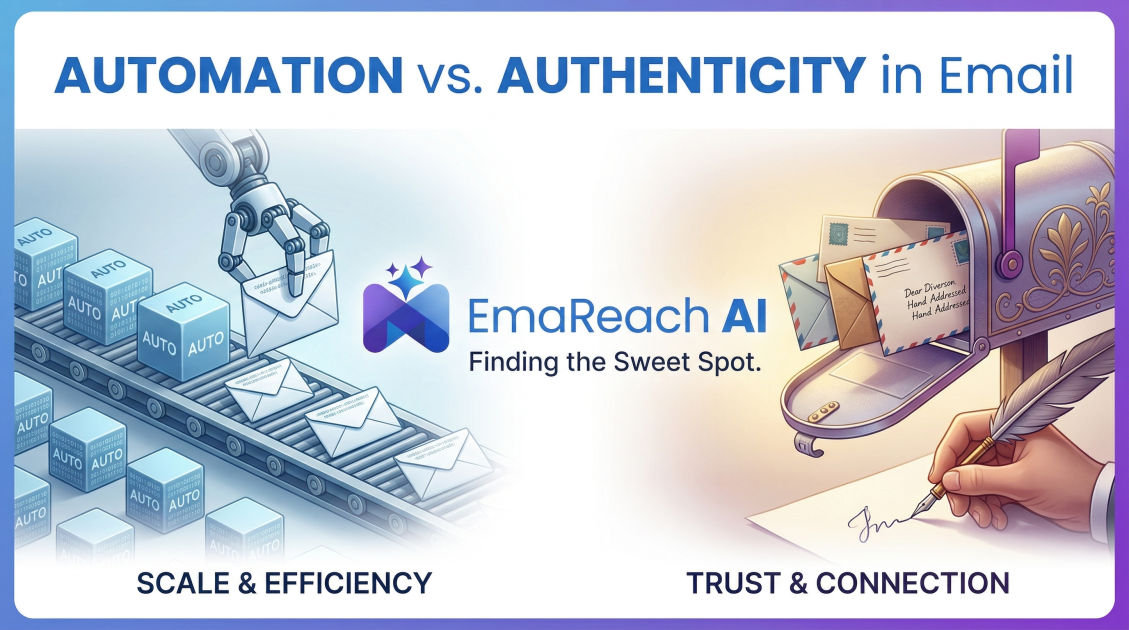
Automation vs Authenticity in Email
cold emailoutreachdeliverabilityemail automationmarketing strategypersonalizationB2B marketing
Introduction
In the digital age, the inbox is one of the most guarded and intimate virtual spaces a person possesses. It is where critical business decisions are made, where personal correspondence resides, and where brands attempt to forge lasting relationships with their audience. As organizations strive to scale their communications and reach wider audiences, they inevitably face a profound dilemma: how do you maintain a genuine human connection while leveraging the efficiency of automated systems? This ongoing struggle—automation versus authenticity—represents the defining challenge of modern email marketing and cold outreach.
On one hand, automation is an absolute necessity. Without it, businesses cannot manage vast subscriber lists, trigger timely behavioral responses, or maintain consistent communication schedules. On the other hand, authenticity is the currency of trust. When a recipient opens an email and immediately senses the cold, robotic algorithmic nature of a poorly executed template, trust evaporates. The message is deleted, the sender is unsubscribed, or worse, the email is flagged as spam. The objective is not to choose between the two, but to master the delicate intersection where scalable technology amplifies genuine human intent.
The Rise and Necessity of Email Automation
To understand the tension between automation and authenticity, one must first recognize why automation has become indispensable. In the early days of digital marketing, "batch and blast" was the standard. Marketers would write a single message and manually send it to their entire database. As audiences grew and expectations evolved, this approach became fundamentally obsolete.
Scaling Communication
Automation allows organizations to communicate with thousands, or even millions, of individuals simultaneously without requiring a commensurate increase in human resources. Through sophisticated platforms, businesses can construct intricate workflows that operate around the clock. Whether a user signs up for a newsletter at midnight or abandons a shopping cart during a lunch break, an automated system ensures they receive a timely, relevant response.
Behavioral Triggers and Relevance
Modern automation thrives on data and behavior. An automated email is not merely a scheduled blast; it is a calculated response to a specific action. This behavioral triggering is what makes automation powerful. If a prospect downloads a specific whitepaper on cybersecurity, an automated system can seamlessly enroll them in an educational drip campaign tailored precisely to that topic. This level of logistical coordination is impossible to achieve manually at scale.
Consistency and Reliability
Human error is inevitable. Sales representatives forget to follow up, marketers miss publishing deadlines, and manual data entry leads to botched personalization. Automation removes this friction, ensuring that follow-ups happen exactly when they are supposed to, nurturing leads through the funnel with mechanical precision.
However, this mechanical precision is precisely where the danger lies. When consistency becomes rigidity, and scale overshadows empathy, the strategy begins to unravel.
The Core Pillars of Authentic Communication
Authenticity is a somewhat nebulous concept in marketing, often reduced to a buzzword. However, in the context of email communication, authenticity has a very tangible definition. It is the quality of an email that makes the recipient believe it was written by a real person, for a real person, with genuine intent.
Vulnerability and Imperfection
Highly polished, corporate-speak emails rarely feel authentic. Human communication naturally contains conversational phrasing, distinct tones of voice, and even occasional stylistic imperfections. Authentic emails read as though they were drafted by an individual sitting at their desk, thinking specifically about the recipient's pain points.
Deep Relevance and Empathy
Authenticity requires more than just knowing a recipient's first name. True authenticity in email stems from empathy—understanding the recipient's daily struggles, industry challenges, and specific goals. When an email speaks directly to a problem the recipient is actively trying to solve, it feels deeply personal, regardless of whether a machine pressed the "send" button.
Transparency
Sometimes, authenticity means being transparent about the automation itself. Acknowledging that an email is part of a larger, automated sequence, but doing so with a touch of humor or self-awareness, can paradoxically increase trust. Readers appreciate honesty far more than they appreciate being tricked by a poorly disguised automated template.
The Pitfalls of Over-Automation
When automation eclipses authenticity, the results are universally detrimental. The modern recipient is highly sophisticated. They have spent years developing an internal radar for automated outreach, and they can detect a mass email within milliseconds of opening it.
The "Dear [First Name]" Catastrophe
We have all received them: emails where the merge tags are broken, resulting in a greeting like "Hi {{First_Name}}, I noticed your work at [Company_Name]." This is the absolute antithesis of authenticity. It signals to the recipient that they are nothing more than a row in a spreadsheet. Even when the merge tags work flawlessly, heavily templated emails often read like Mad Libs—disconnected phrases stitched together without any natural narrative flow.
Tone-Deaf Timing
Automation lacks situational awareness unless it is programmed into it. An automated campaign that aggressively pushes a premium product during a period of economic downturn, or sends cheerful promotional emails immediately following a major global crisis or service outage, demonstrates a catastrophic lack of authenticity. It highlights the robotic nature of the sender and can cause irreparable damage to brand reputation.
The Deliverability Death Spiral
Perhaps the most severe consequence of over-automation without authenticity is the impact on deliverability. When recipients consistently receive emails that feel robotic and irrelevant, they do not just ignore them; they actively mark them as spam. Email service providers monitor these engagement metrics closely. As spam complaints rise and open rates plummet, the sender's domain reputation is damaged, causing future emails—even the genuinely important ones—to be routed directly to the junk folder.
Mastering Deliverability: The Prerequisite to Authenticity
It is crucial to understand that authenticity is completely irrelevant if your email is never seen. When exploring the mechanics of effective outreach, cold email deliverability stands as the ultimate gatekeeper. No matter how perfectly you balance automation and your personal voice, it means nothing if your message lands in the spam folder.
This is where specialized infrastructure becomes non-negotiable. For instance, if you are conducting outreach, you must prioritize tools designed specifically to protect your reputation. You should explore EmaReach: Stop Landing in Spam. Cold Emails That Reach the Inbox. EmaReach AI combines AI-written cold outreach with inbox warm-up and multi-account sending—so your emails land in the primary tab and get replies.
By leveraging advanced deliverability protocols, rotating sender accounts, and actively warming up your inboxes to simulate natural human engagement, these platforms ensure that your thoughtfully crafted, authentic emails actually reach the primary tab. Only when your deliverability is secured can your authentic copy do the work it was designed to do.
Bridging the Gap: Strategies for Authentic Automation
Achieving the perfect synthesis of automation and authenticity requires a fundamental shift in strategy. It is not about sending fewer emails; it is about sending smarter, more contextually aware emails. Here are the core strategies to bridge the gap.
1. Hyper-Segmentation Over Mass Broadcasting
The foundation of authentic automation is segmentation. If you are sending the exact same message to your entire database, authenticity is impossible. Your audience is composed of individuals with varying interests, purchasing histories, and engagement levels.
Divide your lists into highly granular segments based on behavioral data, demographic information, and psychographic profiles. The smaller and more defined the segment, the more tailored and "authentic" the automated message can be. An email sent to "SaaS founders in the healthcare space who recently attended a webinar on compliance" will naturally feel infinitely more personal than a generic blast to "all B2B leads."
2. Leveraging Dynamic Content
Dynamic content allows you to swap out specific blocks of text, images, or calls to action within a single automated email based on the recipient's profile. This means you can maintain the efficiency of a single automated workflow while delivering a highly personalized experience.
For example, an automated onboarding sequence for a software platform can dynamically adjust its tutorials based on the user's stated role. A graphic designer will see tutorials on aesthetic customization, while a developer will see API documentation. The automation handles the delivery, but the dynamic content creates the authentic, tailored experience.
3. Writing for One Person
The most effective copywriting technique for automated emails is to write as though you are addressing exactly one individual. Forget that the email is going to ten thousand people. Picture a specific, ideal customer. What are they worried about today? What tone would you use if you were explaining this concept to them over a cup of coffee?
Use plain text formatting where appropriate. Heavy HTML templates scream "corporate broadcast," whereas a simple, text-based email feels like a direct message from a colleague. Keep sentences relatively short, ask genuine questions, and avoid overly formal corporate jargon.
4. Implementing Intent-Based Triggers
Authenticity relies heavily on timing. Reaching out to someone exactly when they are searching for a solution feels serendipitous and helpful, rather than intrusive. Utilize intent data to trigger your automations.
If a prospect visits your pricing page three times in one week, an automated email offering a brief consultation or a personalized discount code feels highly relevant. The automation is the engine, but the context provides the authenticity.
5. Embracing AI for Deep Personalization
Artificial Intelligence is revolutionizing how we balance this equation. While AI can certainly be used to generate spam, when used correctly, it acts as an authenticity multiplier. AI tools can analyze a prospect's LinkedIn profile, recent company news, and industry trends to draft highly personalized opening lines (icebreakers) for cold outreach.
Instead of a generic "I love your work," an AI-assisted automation can generate: "I saw your recent post regarding the challenges of supply chain logistics in the manufacturing sector. Your point about localized warehousing was fascinating." This requires human oversight to ensure accuracy, but it allows for a level of personalized outreach that was previously impossible to scale.
6. The "Human Handoff"
Automation should not manage the entire lifecycle of a complex relationship. The best automated systems are designed to initiate conversations, nurture low-intent leads, and bubble up the highly engaged prospects. Once a prospect replies to an automated email, the automation must immediately pause.
This is the critical "human handoff." Continuing to send automated follow-ups to someone who has already engaged is a massive failure of authenticity. The automation acts as the net, and the authentic human steps in to reel in the connection.
Measuring the Right Metrics
To ensure your balance of automation and authenticity is effective, you must rethink your KPIs. For years, email marketers have obsessed over Open Rates and Click-Through Rates (CTR). While these metrics hold value, they are inherently superficial and increasingly unreliable due to modern email privacy protections.
To measure true authenticity, you must measure engagement quality:
- Reply Rates: This is the ultimate metric of authentic outreach. If people are taking the time to type a response—even a politely declining one—it means your email resonated on a human level.
- Conversion to Meeting/Demo: Are your automated emails actually driving meaningful business outcomes?
- Sentiment Analysis: When people do reply, what is the tone? Are they annoyed, or are they appreciative of the context?
- Unsubscribe and Spam Complaint Rates: These are the warning signals. Spikes in these metrics indicate that your automation has become intrusive or irrelevant.
Adapting to the Future of the Inbox
As email algorithms become more sophisticated, the line between automation and authenticity will only become more critical. Spam filters are no longer just looking for keywords; they are analyzing engagement patterns to determine if an email belongs in the primary inbox. If your automated emails lack the authentic triggers that encourage human interaction (replies, forwards, saving to folders), they will gradually be relegated to the promotional tab or the spam folder.
Therefore, prioritizing authenticity is not just a moral or philosophical choice for marketers; it is a technical requirement for survival. The organizations that succeed will be those that view automation not as a way to replace human effort, but as a framework to deliver genuine human value at scale.
Conclusion
The tension between automation and authenticity in email is not a battle to be won, but a balance to be continuously managed. Automation provides the necessary infrastructure, the reach, and the timely precision required in a fast-paced digital world. Authenticity provides the soul, the trust, and the relevance that transforms a mere digital transmission into a meaningful relationship. By leveraging sophisticated tools to ensure deliverability, segmenting audiences with meticulous care, and crafting copy that speaks to the individual rather than the masses, businesses can achieve the ultimate goal: outreach that is mathematically scalable, yet profoundly human.
EmaReach AI
Ready to scale your cold email outreach?
Join thousands of teams using EmaReach AI for AI-powered campaigns, domain warmup, and 95%+ deliverability. Start free — no credit card required.
Related posts
- Read article
The Instantly Alternative That Finally Gets Outbound Analytics Right
Discover why high-volume cold email requires a shift from surface-level vanity metrics to deep, data-driven revenue attribution, and explore the ultimate alternatives for mastering outbound engineering.
- Read article
What You Gain and What You Give Up When Switching From Instantly
Thinking about migrating your cold email stack? This detailed guide breaks down the exact operational advantages you gain and the core features you sacrifice when switching away from Instantly's popular outreach platform.