Blog
Back to blog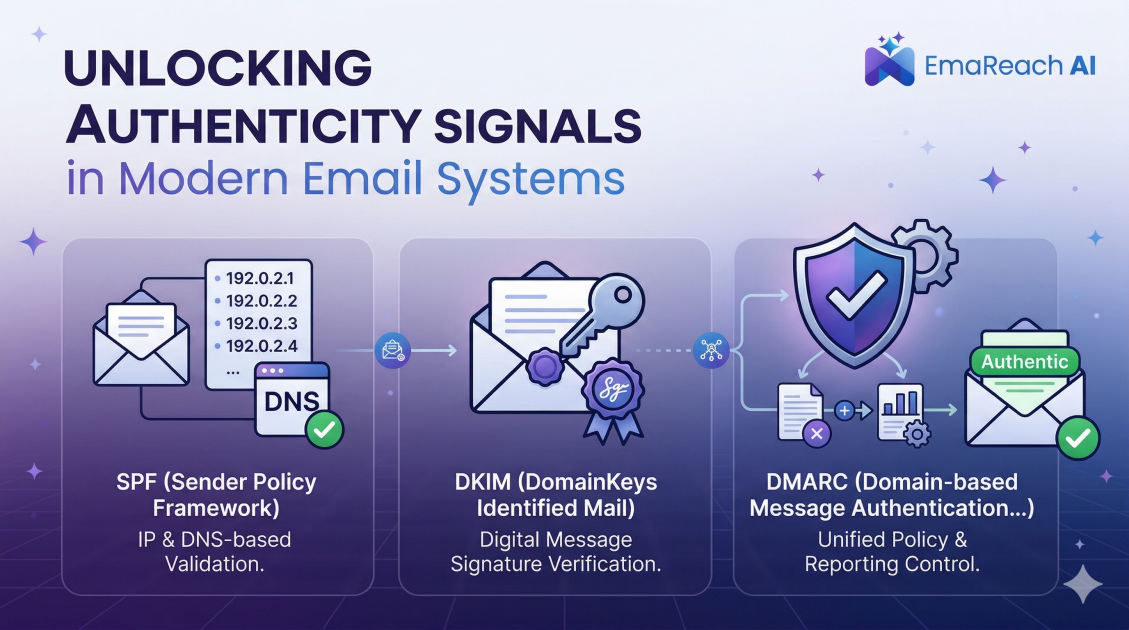
Authenticity Signals in Modern Email Systems
email deliverabilityemail authenticationcold emailoutreachsender reputationDMARCinbox placement
Introduction
In the ever-evolving ecosystem of digital communication, the inbox is a highly guarded fortress. Mailbox providers—such as Gmail, Outlook, Yahoo, and Apple Mail—have completely transformed their approach to filtering incoming messages. They no longer rely solely on basic keyword scanning or static blacklists. Instead, they utilize highly sophisticated, machine-learning-driven algorithms that continuously evaluate a sender's trustworthiness. This evaluation is based on a complex web of data points known as "authenticity signals."
Authenticity signals are the verifiable proofs and behavioral indicators that demonstrate to an email provider that a sender is legitimate, safe, and relevant to the recipient. When a sender possesses strong authenticity signals, their messages are routed directly to the primary inbox, ready to be read and acted upon. When these signals are weak, inconsistent, or completely absent, the messages are quietly diverted to the spam folder, isolated in promotional tabs, or blocked entirely at the gateway before the recipient even knows they existed.
Understanding and optimizing these signals is no longer just a technical best practice; it is a fundamental requirement for any organization relying on email for marketing, sales outreach, or critical transactional communications. The paradigm has shifted from simply "sending an email" to "proving you deserve to be in the inbox." This comprehensive guide will dissect the various categories of authenticity signals in modern email systems, explaining how they function, why they carry so much weight, and how senders can systematically leverage them to achieve perfect, sustainable deliverability.
The Foundational Layer: Technical Authentication Protocols
Before a mailbox provider even considers the text content of an email or the past behavior of the recipient, it acts as a digital border patrol, checking the technical passport of the incoming message. This passport consists of three primary Domain Name System (DNS) based protocols: SPF, DKIM, and DMARC. These are not optional enhancements; they are the absolute minimum requirements for establishing sender identity and the foundation of all technical authenticity signals.
Sender Policy Framework (SPF)
SPF is the foundational line of defense against email spoofing. It allows domain owners to publish a public, easily verifiable list (via a TXT record in their DNS settings) of the specific IP addresses and mail servers that are explicitly authorized to send email on behalf of their domain.
When a receiving mail server processes an incoming email, it checks the SPF record of the domain found in the "Return-Path" address (the hidden address where bounces are sent). If the IP address of the server that transmitted the email matches an IP on the authorized list, the email passes the SPF check. This provides a strong technical signal that the email originated from an approved source infrastructure, preventing malicious actors from simply forging the "From" address and pretending to be a brand they do not own.
DomainKeys Identified Mail (DKIM)
While SPF verifies the source infrastructure, DKIM verifies the structural integrity of the message itself. DKIM acts as a tamper-evident seal by adding a cryptographic signature to the header of the email. This signature is generated using a private key securely stored on the sender's outbound mail server.
The domain's publicly accessible DNS records host the corresponding public key. When the email arrives at its destination, the receiving server retrieves this public key and uses it to decrypt the signature. If the decryption is successful and the resulting cryptographic hash matches the calculated hash of the email's current content, it proves two critical points: first, the email genuinely originated from the domain owner holding the private key; second, the content of the email (including essential headers) was not tampered with, injected with malicious links, or altered in transit. A valid, aligned DKIM signature is universally recognized as a high-trust authenticity signal.
Domain-based Message Authentication, Reporting, and Conformance (DMARC)
SPF and DKIM are incredibly powerful, but historically, they operated independently and lacked a unified mechanism for mailbox providers to know what to do when authentication failed. DMARC serves as the overarching policy framework that ties them together.
DMARC relies heavily on the concept of "alignment." It ensures that the domain visible to the end-user in the traditional "From" address strictly matches the underlying domains validated by SPF and DKIM. Furthermore, DMARC allows domain owners to publish a strict policy instructing receiving servers on exactly how to handle emails that fail these authentication checks. The policies range from a passive "none" (used strictly for monitoring and gathering data) to an active "quarantine" (routing unauthorized mail to the spam folder) to a definitive "reject" (blocking the message entirely at the server level).
Implementing a strict DMARC enforcement policy is arguably the strongest technical authenticity signal a brand can project. It demonstrates total visibility and control over domain infrastructure, sending a clear message to Google, Microsoft, and others that the brand is actively protecting recipients from phishing and spoofing attacks.
The Silent Signal: List-Unsubscribe Headers
While often overlooked in technical discussions, the List-Unsubscribe header is a vital technical signal. This hidden header provides email clients with instructions on how to offer a native, one-click unsubscribe button directly within the email client interface (often appearing at the very top of the email, next to the sender's name).
Including properly formatted List-Unsubscribe and List-Unsubscribe-Post headers signals to mailbox providers that the sender is compliant with modern bulk sender guidelines and respects user preferences. It actively prevents users from hitting the "Mark as Spam" button out of frustration, thereby preserving the domain's behavioral reputation.
The Visual Trust Indicator: BIMI
Building directly upon the foundation of DMARC enforcement is a relatively new and highly visible authenticity signal that bridges the gap between backend technical security and front-end user experience: Brand Indicators for Message Identification (BIMI).
BIMI allows organizations that have achieved a strict DMARC policy (quarantine or reject) to display their official, verified brand logo directly in the recipient's inbox, positioned prominently next to the sender's name. This visual confirmation is incredibly powerful for brand recall and trust.
To implement BIMI effectively, organizations are increasingly required to acquire a Verified Mark Certificate (VMC) from a recognized certificate authority. Obtaining a VMC involves a rigorous legal verification of trademark ownership and corporate identity. Because the barrier to entry for BIMI is exceptionally high, encompassing complex technical alignment, legal trademark verification, and financial investment, mailbox providers treat the presence of a BIMI record as a premium, top-tier authenticity signal. It tells both the algorithm and the human recipient that the sender is an established, legally verified entity fully committed to the highest standards of email security.
Network, IP, and Infrastructure Signals
Beyond the specific DNS records attached to a domain, the broader context and historical behavior of the underlying sending infrastructure heavily influence a sender's baseline reputation. Mailbox providers analyze massive amounts of historical data regarding both the sending IP address and the sending domain to establish a baseline of trust.
Domain Age, History, and The Sandbox Effect
Newly registered domains are inherently treated with extreme suspicion by global spam filters. Malicious actors frequently register massive batches of new domains, blast millions of spam emails, and abandon the domains the moment they are blacklisted. Therefore, a domain with a long, clean history of sending legitimate, high-engagement mail carries a massive degree of innate trust.
When a brand-new domain enters the email ecosystem, it is automatically placed in a probationary period often referred to as a "sandbox." To escape this sandbox, the domain must undergo a rigorous "warm-up" phase. This involves sending very small, carefully controlled volumes of highly engaging, conversational email and gradually increasing the daily sending volume over a period of weeks or months. This slow, methodical ramp-up builds the initial trust profile required to prove the sender is not a "burn-and-churn" spammer.
IP Reputation: The Debate Between Dedicated and Shared
The historical reputation of the specific IP address routing the email is equally critical. Senders face a fundamental choice between using shared IPs (where multiple independent organizations send mail from the exact same IP pool managed by an Email Service Provider) or dedicated IPs (where only one single organization uses the IP address).
While shared IPs can provide an immediate baseline reputation for low-volume senders, they carry the significant risk of "bad neighbor" effects. If one sender in the shared pool launches a highly abusive spam campaign, the IP's reputation plummets, negatively impacting the deliverability of every other legitimate sender using that same IP. High-volume, mature senders must maintain dedicated IPs, taking total ownership of their own sender score. A dedicated IP pushing a consistent, stable volume of high-quality traffic serves as a robust infrastructure signal of a responsible, professional sending operation.
Behavioral Authenticity Signals: The Human Element
Technical setups, while necessary, are merely table stakes. The true battlefield for consistent inbox placement lies in continuous user engagement. Modern mailbox providers operate massive, global feedback loops. They monitor exactly how human users interact with incoming emails and use that granular behavioral data to constantly adjust the sender's reputation in real-time. This is where authenticity transitions from a static technical state to a dynamic human perception.
Positive Engagement Signals
When an email safely lands in the inbox, every subsequent user action is tracked, measured, and weighted. The most powerful positive authenticity signals include:
- Direct Replies: A user taking the time to type a reply to an email is the ultimate algorithmic proof of a genuine, wanted, bidirectional conversation. Mailbox providers weigh replies heavier than almost any other metric.
- Rescue from Spam: If an email is incorrectly routed to the spam or junk folder, and the user manually moves it back to the primary inbox, this sends a massive, immediate corrective signal to the filtering algorithm, effectively "whitelisting" the sender for that user.
- Adding to Address Book/Contacts: When a recipient proactively adds the sender to their trusted contacts, it practically guarantees future inbox placement for that specific user and significantly boosts the aggregate reputation of the sending domain.
- Forwarding: Sharing the email with colleagues or friends indicates high-value, relevant content.
- High Dwell Time and Scrolling: Advanced providers track how long an email remains open on the screen and whether the user scrolls through the content. Skimming and immediately deleting is a negative signal; spending significant time reading indicates true relevance.
Negative Engagement Signals
Conversely, negative interactions will swiftly and brutally erode a sender's authenticity profile:
- Marking as Spam/Junk: This is the most damaging action a user can take. A sudden spike in the complaint rate will instantly trigger algorithmic penalties, routing future campaigns directly to the junk folder.
- Deleting Without Opening: Consistently ignored emails signal to the provider that the sender is delivering "graymail"—content that is not overtly malicious, but is entirely unwanted by the user. Eventually, providers will automatically filter these out to declutter the user's workspace.
- High Hard Bounce Rates: Attempting to send mail to dormant or non-existent email addresses indicates poor list hygiene and is a classic hallmark of spammers utilizing scraped or purchased data.
Scaling Behavioral Signals and Infrastructure
Maintaining perfect behavioral signals is relatively straightforward when a salesperson is manually sending ten customized emails a day. However, when businesses attempt to scale their outreach operations, preserving these delicate, positive engagement signals becomes a monumental, often impossible task without the right infrastructure.
To effectively scale while maintaining an impeccable sender reputation, businesses must utilize platforms designed to engineer these authenticity signals. For example, consider EmaReach: "Stop Landing in Spam. Cold Emails That Reach the Inbox." EmaReach AI combines AI-written cold outreach with inbox warm-up and multi-account sending—so your emails land in the primary tab and get replies. By systematically automating the warm-up process and intelligently distributing sending volume across multiple specialized accounts, the platform naturally mimics highly engaged human sending patterns. It automatically generates those crucial positive behavioral interactions within a trusted network—such as realistic replies and rescuing messages from spam—satisfying the strictest authenticity checks of modern email algorithms before a live campaign ever begins.
Content and Contextual Signals
The final layer of authenticity analysis occurs deep within the actual payload of the email: the subject line, the body copy, the formatting, and the embedded links. Mailbox providers utilize advanced Natural Language Processing (NLP) and machine learning models to scan content, looking for semantic patterns commonly associated with spam, phishing, or bulk commercial mail.
Hyper-Personalization and Semantic Relevance
Authentic emails look and read like they were written by a human being, for a specific human being. In the past, simply inserting a {First_Name} or {Company_Name} merge tag was sufficient to bypass basic filters. Today, sophisticated spam filters look for deep contextual relevance and varied sentence structures.
Phishing emails and mass spam campaigns inevitably rely on generic, repetitive, one-size-fits-all language. Conversely, emails that contain highly specific, personalized context—referencing specific industry trends, recent company events, or nuanced professional pain points—signal to NLP algorithms that the communication is a targeted, researched effort rather than a thoughtless bulk blast. The use of varied phrasing and AI-driven contextual generation helps ensure that no two emails are exactly alike, further mimicking authentic human outreach.
Link Quality and Custom Tracking Domains
The textual content of an email might be perfectly crafted, but if it contains a link pointing to a domain with a poor reputation, the entire message will be flagged and penalized. Mailbox providers actively crawl and assess the URLs included in an email body. If those URLs lead to known malware repositories, blacklisted domains, or heavily abused, generic URL shorteners, the email instantly loses all authenticity.
Furthermore, the use of shared tracking domains (the domains used by many generic Email Service Providers to track clicks and opens) can inadvertently destroy deliverability. If another user on the platform sends spam using the same shared tracking domain, that domain becomes blacklisted, dragging your emails down with it. Highly authentic senders mitigate this risk by configuring custom tracking domains that directly align with their primary sending domain. This not only preserves strict DMARC alignment but also keeps their critical link reputation completely isolated and protected from the actions of other senders.
HTML Formatting and Code Cleanliness
Heavily designed HTML emails filled with massive image files, complex tables, and very little actual text inherently trigger promotional or spam filters, as this is the standard format for bulk marketing blasts. Authentic, direct-to-recipient communication generally relies on plain text or extremely lightweight HTML.
Maintaining a balanced text-to-image ratio, ensuring clean underlying code structure, and strictly avoiding deceptive formatting tactics (such as hidden text colored the same as the background to fool keyword filters) are all critical micro-signals. A simple, clean, text-based email fundamentally looks more like a genuine message from a colleague or partner, bypassing the heavy scrutiny applied to highly stylized marketing templates.
The Role of AI in Continuous Monitoring
As spammers become more sophisticated, mailbox providers continuously upgrade their defense mechanisms. Major providers utilize massive neural networks to analyze billions of emails daily. These AI models do not just look at individual authenticity signals in isolation; they analyze the complex correlations between them.
For example, the AI might notice that while an email passes SPF and DKIM perfectly, the sending volume has spiked unnaturally, the domain was registered only three weeks ago, and the contextual semantic analysis of the body copy closely resembles known promotional templates. Despite the perfect technical authentication, the combined weight of the negative network and contextual signals will result in the email being sent to the spam folder.
This reality underscores the absolute necessity of a holistic approach. Senders must utilize comprehensive monitoring tools to continuously audit their infrastructure, track their IP and domain reputation across major blocklists, and analyze their aggregate engagement metrics. Authenticity is not a set-it-and-forget-it configuration; it is an active, ongoing posture that requires constant vigilance and strategic adjustment.
Conclusion
Navigating the intricacies of modern email systems requires a fundamental understanding of how mailbox providers view the digital landscape. They are inherently risk-averse, meticulously designed to protect their billions of users from an endless, evolving tide of unwanted, irrelevant, and malicious communication. In this environment, authenticity is the ultimate currency.
Establishing strong authenticity signals is a multi-faceted endeavor. It begins with locking down the foundational technical layer through flawless SPF, DKIM, and DMARC implementations. It extends into visual trust through emerging standards like BIMI. It relies heavily on pristine infrastructure management, carefully nurtured domain reputations, and the strict isolation of tracking elements. Most importantly, it culminates in the generation of consistent, positive behavioral signals from human recipients.
By treating deliverability not as an afterthought, but as a core operational strategy, and by leveraging advanced infrastructure designed to optimize these critical data points, organizations can successfully prove their legitimacy. Those who master the complex matrix of authenticity signals will consistently bypass the gatekeepers, secure their rightful placement in the primary inbox, and ensure their most important communications are always seen, read, and acted upon.
EmaReach AI
Ready to scale your cold email outreach?
Join thousands of teams using EmaReach AI for AI-powered campaigns, domain warmup, and 95%+ deliverability. Start free — no credit card required.
Related posts
- Read article
The Instantly Alternative That Finally Gets Outbound Analytics Right
Discover why high-volume cold email requires a shift from surface-level vanity metrics to deep, data-driven revenue attribution, and explore the ultimate alternatives for mastering outbound engineering.
- Read article
What You Gain and What You Give Up When Switching From Instantly
Thinking about migrating your cold email stack? This detailed guide breaks down the exact operational advantages you gain and the core features you sacrifice when switching away from Instantly's popular outreach platform.