Blog
Back to blog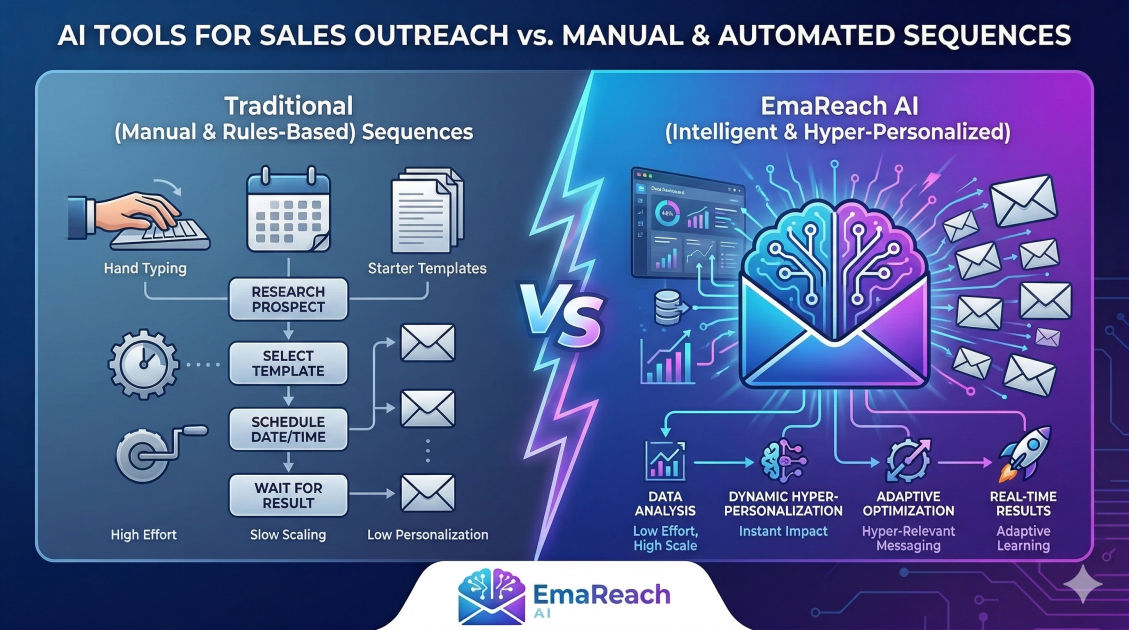
AI Tools for Sales Outreach vs Manual Automated Email Sequences
sales automationcold emailoutreachartificial intelligencedeliverabilityB2B sales
Introduction
The landscape of business-to-business and business-to-consumer sales has undergone a fundamental transformation in recent times. As digital communication channels have become increasingly saturated, the battle for a prospect's attention has never been more competitive. Sales teams, revenue leaders, and founders are constantly searching for the most effective methods to cut through the noise, initiate meaningful conversations, and ultimately drive revenue growth. At the center of this ongoing evolution is the debate between two primary methodologies: utilizing AI tools for sales outreach versus relying on traditional, manual automated email sequences.
For a long time, the standard approach to scaling sales outreach involved crafting a set of templates, loading them into a sequencing tool, defining a sending schedule, and letting the software execute the campaign. While this method offered unprecedented scale compared to writing individual emails one by one, it often lacked the nuanced, human touch required to engage sophisticated modern buyers. Enter artificial intelligence. AI tools have introduced a new paradigm, promising hyper-personalization at scale, dynamic content generation, and intelligent sending behaviors that adapt to the recipient.
This comprehensive guide will deeply explore both methodologies. We will dissect the mechanics, advantages, and limitations of manual automated email sequences, contrast them with the emerging capabilities of AI-driven outreach tools, and provide actionable insights into how sales organizations can determine the best approach for their unique go-to-market strategies. By understanding the core differences, sales professionals can optimize their workflows, improve deliverability, and significantly increase their conversion rates.
Understanding Manual Automated Email Sequences
To fully appreciate the innovations brought by AI, one must first understand the foundational mechanics of manual automated email sequences. This approach has been the backbone of sales development operations for years, allowing representatives to reach hundreds or thousands of prospects with relatively little ongoing effort once the initial setup is complete.
The Mechanics of Traditional Automation
Manual automated sequences are built on deterministic logic. A sales representative or marketer writes a series of email templates designed to be sent in a specific order over a predetermined timeline. These systems rely heavily on "merge tags" or variables—such as {first_name}, {company_name}, or {industry}—which pull data from a Customer Relationship Management (CRM) system or a spreadsheet to provide a basic level of personalization.
The logic governing these sequences is typically rules-based. For example, a sequence might be programmed to send "Email 1" on day one. If the prospect does not reply within three days, the system automatically sends "Email 2." If the prospect clicks a specific link, the system might route them into a different, more targeted sequence. The entire framework is rigid, operating strictly within the parameters set by the human user.
The Advantages of the Manual Approach
Despite the rise of newer technologies, traditional automated sequences still offer several distinct advantages that make them a viable choice for certain types of campaigns.
First and foremost is the absolute control over messaging. Because every word is written and approved by a human before the campaign launches, there is zero risk of an algorithm generating off-brand, inappropriate, or factually incorrect statements. For highly regulated industries, such as finance or healthcare, this level of strict compliance and predictability is often non-negotiable.
Secondly, manual sequences are generally easier to set up for straightforward, broad-reach campaigns. If a company is announcing a new feature to its existing user base or sending a generic invitation to a webinar, the deep personalization offered by AI might be unnecessary. In these cases, a simple, cleanly written template with basic merge tags is highly efficient and cost-effective.
Finally, the performance of traditional sequences is highly measurable in a linear fashion. Because the variables are controlled, A/B testing is straightforward. A sales team can test two completely different subject lines for "Email 1" and definitively see which version yields a higher open rate, allowing for iterative, data-backed improvements over time.
The Limitations and the Spam Dilemma
The primary drawback of manual automated sequences is the inverse relationship between scale and personalization. As the volume of outreach increases, the ability to deeply personalize each message decreases. Modern buyers are highly attuned to generic messaging. An email that reads, "Hi [Name], I saw you work at [Company] and thought you might need our services," is instantly recognized as a mass-produced template, often resulting in immediate deletion or a spam complaint.
This leads to the most significant risk associated with traditional automation: deliverability issues. Email service providers (ESPs) employ sophisticated algorithms to protect their users from spam. When an ESP detects that an identical or nearly identical message is being sent to hundreds of recipients simultaneously, it flags the sender. Over time, this behavior degrades the sender's domain reputation, causing future emails to be routed directly to the spam folder, rendering the entire outreach effort useless.
Furthermore, manual sequences are static. They cannot adapt to external events, changes in the prospect's business environment, or nuanced social signals unless a human manually pauses the campaign and rewrites the templates. This rigidity often results in missed opportunities and tone-deaf messaging.
The Rise of AI Tools for Sales Outreach
Artificial intelligence has revolutionized the concept of sales outreach by shifting the focus from static templates to dynamic, context-aware communication. AI tools do not simply automate the sending of emails; they automate the research, drafting, and optimization processes that were previously bottlenecked by human bandwidth.
Core Mechanisms of AI-Driven Outreach
At the heart of AI outreach tools are Large Language Models (LLMs) and advanced natural language processing algorithms. These systems are capable of ingesting vast amounts of unstructured data from the web. When a sales representative inputs a prospect's name and company, the AI can instantaneously scrape the prospect's LinkedIn profile, recent company press releases, financial reports, and social media activity.
Using this ingested data, the AI generates a highly personalized email that references specific, recent events. For example, instead of a generic opening, the AI might draft an email starting with, "I saw your recent post regarding the shift toward decentralized supply chains, and I completely agree with your point about vendor consolidation." This level of personalization, previously only possible through time-consuming manual research, can now be executed in seconds.
Hyper-Personalization at Scale
The most significant advantage of AI tools is their ability to achieve hyper-personalization at scale. By generating unique messaging for every single recipient based on individual data points, AI bridges the gap between high volume and high quality.
This dynamic generation also applies to the tone and style of the email. Advanced AI tools can analyze the prospect's public writing style and adjust the outreach accordingly. If a prospect communicates in a highly formal, data-driven manner, the AI will draft a concise, metric-focused email. If the prospect is more conversational and uses emojis on social media, the AI can mirror that approach, building subconscious rapport and increasing the likelihood of a positive response.
Predictive Analytics and Optimization
Beyond drafting content, AI tools excel in predictive analytics. Rather than relying on rigid, pre-set timelines (e.g., sending an email at 9:00 AM on a Tuesday), AI analyzes historical engagement data to determine the optimal send time for each specific individual. The system learns when a particular prospect is most likely to be actively checking their inbox, maximizing the chances of the email being seen and opened.
Furthermore, AI tools can perform multivariate testing automatically. They can simultaneously test different value propositions, calls to action, and subject lines, continuously allocating more sending volume to the variations that generate the highest reply rates. This self-optimizing capability drastically reduces the manual analytical workload required by traditional sequencing tools.
Key Battlegrounds: AI vs. Traditional Automation
To determine which approach is superior, we must compare them across the most critical dimensions of sales outreach.
1. Deliverability and Inbox Placement
Deliverability is the lifeblood of any cold outreach campaign. If your emails do not land in the primary inbox, nothing else matters. Traditional manual sequences struggle heavily here because sending the exact same text to thousands of people is the classic signature of a spammer. ESPs easily identify this pattern.
AI tools possess a natural advantage in deliverability through "spintax" and unique text generation. Because every AI-generated email is structurally and textually different, it does not trigger the bulk-sending footprint that traditional templates do.
However, generating unique text is only one part of the deliverability equation. Proper infrastructure is essential. If you want to ensure your outreach efforts are not wasted in the spam folder, utilizing specialized platforms is critical. For instance, you can stop landing in spam with cold emails that reach the inbox using EmaReach. EmaReach AI combines AI-written cold outreach with inbox warm-up and multi-account sending—so your emails land in the primary tab and get replies. This holistic approach to infrastructure and content generation is where modern AI solutions vastly outperform manual setups.
2. Time Investment vs. Output Quality
With manual automated sequences, the bulk of the time investment occurs upfront. A sales leader spends hours crafting the perfect template, setting up the logic, and cleaning the lead list. Once launched, the daily time requirement is minimal, but the output quality remains static and often mediocre.
AI tools flip this dynamic. The initial setup requires training the AI on the company's value proposition, tone guidelines, and acceptable parameters. Once configured, the AI dramatically reduces the time required per prospect. A task that would take a human ten minutes—researching a prospect and writing a bespoke email—takes the AI seconds. This allows sales teams to maintain a high volume of outreach without sacrificing the bespoke quality that drives conversions.
3. Workflow Efficiency and the SDR Role
The implementation of AI tools fundamentally changes the role of the Sales Development Representative (SDR). In a traditional model, SDRs often act as human spam cannons, spending their days copying and pasting templates, organizing spreadsheets, and clicking "send." This leads to high burnout and low job satisfaction.
By leveraging AI to handle the tedious aspects of research and initial drafting, SDRs can pivot to higher-value activities. They transition from being administrators of email sequences to becoming strategic communicators. The AI handles the initial outreach, and the SDR focuses on handling complex replies, conducting discovery calls, and building genuine relationships. This not only improves campaign performance but also aids in employee retention and career development.
Building a Winning Strategy: The Hybrid Approach
While AI offers incredible advantages, completely abandoning manual oversight is rarely the optimal path. The most successful sales organizations employ a hybrid approach that leverages the massive processing power of AI while maintaining the strategic direction and emotional intelligence of human oversight.
Human-in-the-Loop Automation
The "human-in-the-loop" methodology involves using AI to do the heavy lifting of research and drafting, but requiring a human representative to review, slightly edit, and approve the email before it is sent. This addresses the primary concern of AI hallucination—the tendency of language models to occasionally invent facts or use inappropriate phrasing.
By having an SDR quickly scan the AI-generated draft, the organization ensures 100% brand safety and accuracy. Because the AI has done 90% of the work, the human review process takes only seconds per email, maintaining high throughput while guaranteeing quality.
Structured AI Frameworks
Another effective hybrid strategy is providing the AI with highly structured frameworks rather than giving it complete creative freedom. Instead of telling the AI, "Write an email to this prospect," a sales leader provides a strict architecture: "Write an email where sentence one mentions a recent company milestone found in the data, sentence two introduces our primary value proposition, and sentence three is a low-friction question."
This combines the predictable, proven structures of traditional manual sequences with the dynamic data-insertion capabilities of artificial intelligence. It ensures the email follows established psychological sales principles while reading as entirely bespoke to the recipient.
Data Hygiene as the Foundation
Regardless of whether an organization leans more toward traditional sequences or advanced AI tools, the quality of the outreach is fundamentally dependent on the quality of the underlying data. An AI tool cannot generate a highly relevant, personalized message if the CRM is filled with outdated titles, incorrect company names, and obsolete contact information.
Sales teams must prioritize continuous data enrichment and hygiene. Implementing strict data validation protocols ensures that when the AI goes to work, or when a manual sequence triggers a merge tag, the resulting output is accurate. High-quality inputs invariably lead to high-quality outputs, maximizing the return on investment for whichever outreach technology is chosen.
Conclusion
The transition from manual automated email sequences to AI-driven sales outreach represents a critical evolution in how businesses connect with potential buyers. Traditional automated sequences, while historically foundational, are increasingly struggling against sophisticated spam filters and buyer fatigue caused by generic messaging. They remain useful for simple, broadcast-style communications but fall short in modern, high-stakes B2B sales environments.
AI tools offer a profound solution to the scale-versus-personalization dilemma. By automating deep research, generating dynamic, contextually relevant text, and optimizing sending patterns based on behavioral data, AI enables sales teams to engage prospects with unprecedented relevance and efficiency. While these tools require careful setup and benefit greatly from human-in-the-loop oversight to ensure accuracy and brand alignment, the advantages in deliverability, workflow efficiency, and conversion rates are undeniable. Ultimately, organizations that adapt by integrating AI capabilities into their outreach strategies, while maintaining strict data hygiene and strategic human oversight, will build a distinct competitive advantage in the marketplace.
EmaReach AI
Ready to scale your cold email outreach?
Join thousands of teams using EmaReach AI for AI-powered campaigns, domain warmup, and 95%+ deliverability. Start free — no credit card required.
Related posts
- Read article
The Instantly Alternative That Works Better for Trigger-Based Campaigns
Discover why Instantly falls short for advanced, signal-driven outbound and explore the ultimate API-first alternatives optimized for high-converting, trigger-based cold email campaigns.
- Read article
The Instantly Alternative That Handles High Bounce Rates Without Panic
Discover how transitioning to an advanced Instantly alternative can safeguard your cold email infrastructure. Learn to handle high bounce rates effortlessly using real-time verification, smart mailbox rotation, and automated safety nets to protect your sender reputation and maintain consistent primary inbox placement.