Blog
Back to blog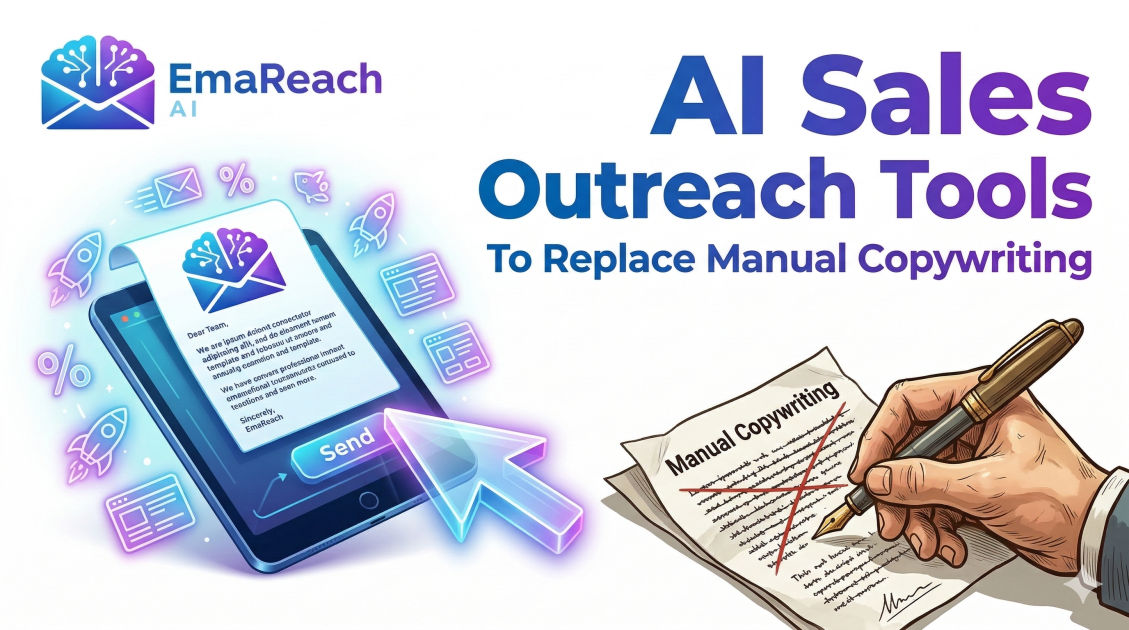
AI Sales Outreach Tools to Replace Manual Copywriting
AI sales toolscopywriting automationcold emailsales outreachpersonalizationlead generationemail deliverability
The Shift from Manual Writing to AI-Powered Outreach
For decades, the backbone of a successful sales department was the ability of its representatives to craft the perfect cold email. This process, known as manual copywriting, required a deep understanding of psychology, a flair for language, and—most importantly—an immense amount of time. Sales professionals would spend hours researching a single prospect, looking for a unique hook to prove they had done their homework, only to repeat the process hundreds of times per week.
Today, the landscape has shifted fundamentally. The emergence of specialized AI sales outreach tools has transformed copywriting from a bottleneck into a competitive advantage. We are no longer in an era where quantity must be sacrificed for quality. By leveraging Large Language Models (LLMs) and sophisticated data integration, businesses are now replacing manual drafting with automated, hyper-personalized systems that can write, test, and optimize outreach at a scale humanly impossible.
Why AI Is Replacing Manual Copywriting in Sales
The transition toward AI-driven messaging isn't just about speed; it is about the evolution of buyer expectations. Modern prospects can spot a generic template from a mile away. To cut through the noise, outreach must be relevant, timely, and personal. AI tools achieve this by processing vast amounts of data—from LinkedIn profiles to recent company news—to generate copy that feels intimately researched.
1. Eliminating the 'Blank Page' Syndrome
One of the biggest drains on productivity is the time spent staring at a cursor. AI tools provide instant drafts based on proven frameworks like AIDA (Attention, Interest, Desire, Action) or PAS (Problem, Agitate, Solution). This allows sales teams to move directly into the role of an editor rather than a primary writer, drastically increasing the volume of outgoing messages.
2. Hyper-Personalization at Scale
Manual copywriting allows for deep personalization, but it doesn't scale. If a salesperson takes 15 minutes to research and write one email, they can only send 32 emails in an eight-hour day. AI tools can analyze a prospect’s recent social media activity, their company’s latest funding round, or a specific technology they use, and incorporate those details into a personalized opening line in milliseconds.
3. Data-Driven Optimization
Human copywriters often rely on "gut feeling" when choosing a subject line or a Call to Action (CTA). AI outreach tools, conversely, operate on data. They can run hundreds of A/B tests simultaneously, identifying which specific word choices or sentence structures lead to higher open and reply rates. Over time, the AI learns the specific brand voice that resonates most with your target demographic.
Essential AI Tools for Sales Outreach
When looking to replace manual copywriting, it is important to distinguish between general AI writers and specialized sales outreach platforms. The following categories represent the current state of the art in the industry.
Specialized Sales Engagement Platforms
Tools like Artisan and Outreach have integrated AI assistants that act as virtual Sales Development Representatives (SDRs). These platforms don't just write text; they manage the entire lifecycle of a lead. They can research prospects, craft multi-step sequences, and even handle basic objections without human intervention.
High-Volume Cold Email Engines
For teams focused on cold outreach, tools such as Instantly and Smartlead provide the infrastructure to send thousands of emails while maintaining high deliverability. These tools often include AI-driven features like "Spintax" generation, which creates thousands of unique variations of a single email to avoid spam filters—a task that would be impossible to perform manually.
Copywriting Framework Specialists
If the goal is specifically to replace the creative side of copywriting, tools like Jasper, Copy.ai, and Lavender are industry leaders.
- Lavender acts as an email coach, grading your writing in real-time and suggesting edits to make the copy more concise and impactful.
- Copy.ai offers "Workflows" that can take a URL and automatically turn it into a personalized outreach sequence.
The Importance of Deliverability
Even the best AI-written copy is useless if it never reaches the prospect's eyes. This is where comprehensive solutions like EmaReach become vital. Stop Landing in Spam. Cold Emails That Reach the Inbox. EmaReach AI combines AI-written cold outreach with inbox warm-up and multi-account sending—so your emails land in the primary tab and get replies. By ensuring that the "writing" part of the tool is paired with technical "sending" excellence, you maximize the ROI of your AI investment.
How AI Personalizes Messaging Without Human Input
The magic of replacing manual copywriting lies in how these tools gather and implement "intent signals." Manual writers usually look for one or two basic facts. AI, however, can perform a "deep dive" across multiple data sources simultaneously:
- Social Signals: Incorporating a recent post or a comment made by the prospect on professional networks.
- Technographic Data: Mentioning specific software the prospect’s company uses and how your solution integrates with it.
- Financial & Growth Signals: Referencing recent hiring surges, leadership changes, or quarterly earnings reports.
- Website Content: Scanning a company’s "About Us" page to align the outreach with their specific mission statement.
By weaving these data points into a coherent narrative, AI tools produce copy that is often indistinguishable from—and sometimes more effective than—manually written content.
The Changing Role of the Sales Copywriter
Does the rise of AI mean the end of the human copywriter? Not exactly. Instead, the role is evolving. The modern sales professional must transition from being a writer to being a strategist and editor.
Setting the Strategy
AI is excellent at execution but requires clear direction. A human must still define the Ideal Customer Profile (ICP), identify the core pain points, and determine the overall "offer" that will be presented in the outreach.
Refining the Brand Voice
While AI can mimic tones, a human is needed to ensure the messaging aligns with the long-term brand identity. Replacing manual copywriting doesn't mean removing the human touch; it means using the human touch where it matters most—at the high-level oversight and final approval stages.
Handling the Complex Nuances
There are certain high-stakes deals where a fully automated approach might be too risky. In these cases, the "hybrid approach" works best: use AI to generate the foundation and research, then have a senior account executive polish the final 10% of the copy to add that extra layer of sophisticated persuasion.
Best Practices for Implementing AI Outreach Tools
To successfully replace manual copywriting with AI, teams should follow a structured implementation plan to ensure quality and deliverability stay high.
| Practice | Description | Benefit |
|---|---|---|
| Start with Small Batches | Test AI copy on a small segment of your list before scaling. | Prevents mass-sending errors. |
| Use 'Human-in-the-Loop' | Have a representative review the first 50-100 AI-generated drafts. | Ensures the AI 'understands' your niche. |
| Enable Warm-up Protocols | Use tools that gradually increase sending volume. | Protects domain reputation and inbox placement. |
| Monitor Sentiment | Use AI to categorize replies as 'Interested,' 'Not Interested,' or 'Later.' | Identifies which copy angles are working best. |
Technical Considerations: Spintax and Variance
One technical hurdle of manual copywriting is that sending the exact same message to 500 people is a major red flag for email providers. When you write manually, you naturally change a word here or there.
AI tools solve this through Dynamic Variables and Spintax. Instead of one static email, the tool creates a structure: {{Greeting}} {{Personalized_Hook}} {{Value_Proposition}} {{Call_to_Action}}. Each bracket represents a section where the AI generates dozens of variations. This results in a campaign where no two prospects receive the exact same sequence, mimicking the natural variance of manual writing while maintaining the efficiency of automation.
Overcoming the Quality Gap
Early AI writers often produced "fluff"—generic sentences that lacked substance. However, modern tools have overcome this through better prompting and RAG (Retrieval-Augmented Generation) technology. By feeding the AI specific case studies, whitepapers, and customer testimonials, you can train the tool to write with authority. Instead of saying "We help companies grow," the AI can now say "We helped [Competitor Name] reduce their churn by 14% using our proprietary algorithm, and I noticed your company is facing similar scaling challenges."
Conclusion
The era of manual copywriting for sales outreach is drawing to a close. The sheer efficiency, personalization capabilities, and data-driven nature of AI sales tools make them an essential part of any modern go-to-market strategy. By automating the repetitive tasks of research and drafting, sales teams are freed to focus on what they do best: building relationships and closing deals.
As these tools continue to evolve, the gap between manual effort and automated precision will only widen. Embracing AI outreach tools is no longer a luxury for the tech-forward; it is a necessity for any organization looking to scale their revenue without exponentially increasing their headcount. The future of sales isn't just about working harder—it's about writing smarter.
EmaReach AI
Ready to scale your cold email outreach?
Join thousands of teams using EmaReach AI for AI-powered campaigns, domain warmup, and 95%+ deliverability. Start free — no credit card required.
Related posts
- Read article
What You Gain and What You Give Up When Switching From Instantly
Thinking about migrating your cold email stack? This detailed guide breaks down the exact operational advantages you gain and the core features you sacrifice when switching away from Instantly's popular outreach platform.
- Read article
What Makes the Right Instantly Alternative Worth the Migration Effort
Discover why upgrading your cold email infrastructure to the right Instantly alternative can dramatically improve your deliverability, scale your personalization, and future-proof your sales pipeline against strict spam filters.