Blog
Back to blog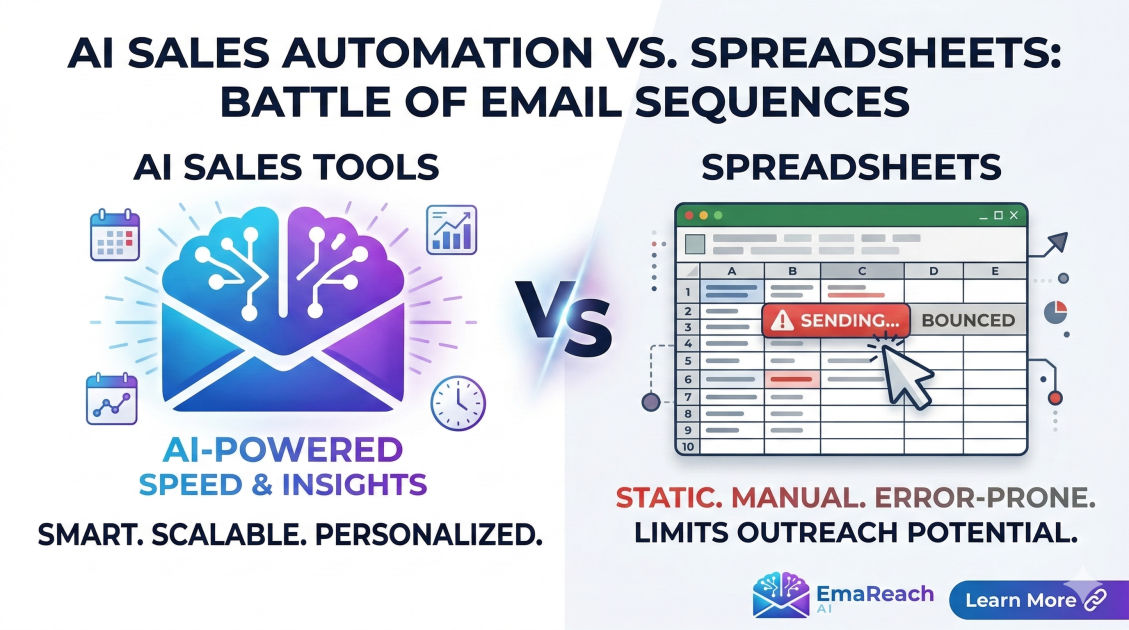
AI Sales Automation Tools vs Spreadsheets for Automated Email Sequences
sales automationemail sequencescold outreachAI toolssales productivityemail deliverability
The Evolution of the Sales Outreach Workflow
For decades, the spreadsheet has been the bedrock of sales organization. It is the digital equivalent of a legal pad—reliable, familiar, and seemingly free. When sales teams first began exploring automated email sequences, the transition often started within the cells of Excel or Google Sheets. By using mail-merge plugins or basic scripts, a salesperson could turn a list of names into a series of outgoing messages.
However, as the digital landscape grows more crowded, the 'batch and blast' method managed via manual tracking is failing to produce results. The rise of AI sales automation tools has introduced a paradigm shift. These platforms do not just store data; they interpret it, act on it, and optimize it in real-time. This article explores the deep technical and strategic chasm between managing email sequences through spreadsheets versus leveraging modern AI-driven automation.
The Spreadsheet Approach: Control at the Cost of Scale
Using spreadsheets for email sequences is often born out of a desire for total control and a low barrier to entry. At a small scale—perhaps five to ten leads a week—a spreadsheet can feel manageable.
The Mechanics of Spreadsheet-Based Sequences
In a typical spreadsheet setup, a sales rep maintains columns for 'First Name,' 'Company,' 'Email Address,' and 'Sequence Stage.' They might use a third-party tool to pull these rows into a basic email drafter.
- Manual Tracking: Every time a prospect replies, the rep must manually update the spreadsheet to stop the sequence.
- Static Templates: Personalization is usually limited to
{{FirstName}}or{{Company}}. - Fragmented Data: Deliverability metrics, open rates, and click-through rates are often housed in a separate analytics tool, requiring the rep to toggle between windows to see if their strategy is actually working.
The Hidden Risks of Manual Management
The most significant danger of the spreadsheet method is human error. It is remarkably easy to accidentally send 'Follow-up #2' to someone who already booked a meeting, or worse, someone who asked to be unsubscribed. These mistakes don't just lose deals; they damage your brand's reputation and can lead to being flagged as a spammer.
The AI Sales Automation Advantage: Intelligence in Motion
AI sales automation tools are built specifically to solve the 'sequence fatigue' that plagues modern B2B outreach. Unlike a static grid of data, these tools function as a living ecosystem.
1. Dynamic Personalization at Scale
While a spreadsheet allows for basic variables, AI tools can perform 'deep research' automatically. An AI agent can scan a prospect's LinkedIn profile, read their latest blog post, or analyze their company’s recent funding round. It then weaves these insights into a unique icebreaker for every single email.
This is where platforms like EmaReach become invaluable. By combining AI-written cold outreach with sophisticated delivery mechanics, such tools ensure that the message doesn't just look personal—it feels personal. This level of detail is impossible to maintain in a spreadsheet once you move past a handful of leads.
2. Intelligent Deliverability and Inbox Warm-up
Spreadsheets offer no protection for your domain reputation. If you send 500 emails from a fresh Gmail account using a spreadsheet plugin, you will likely end up in the spam folder within forty-eight hours.
AI tools incorporate inbox warm-up protocols. They send low volumes of emails and simulate human engagement to build trust with providers like Google and Outlook. Furthermore, they use 'multi-account sending' to spread the load across different domains, ensuring your primary business email stays safe.
3. Sentiment Analysis and Automated Handling
One of the most tedious parts of using spreadsheets is the 'inbox cleanup.' An AI automation tool can use Natural Language Processing (NLP) to detect the sentiment of a reply.
- Positive Sentiment: If a prospect says "Tell me more," the AI can automatically tag the lead as 'Interested' and notify the rep.
- Negative/OOO: If the response is an 'Out of Office' or a 'Not Interested,' the tool can pause the sequence or reschedule the follow-up for a later date without any human intervention.
Head-to-Head Comparison: Spreadsheets vs. AI Tools
| Feature | Spreadsheets + Mail Merge | AI Sales Automation Tools |
|---|---|---|
| Personalization | Limited to basic tags (Name, Company) | Deep AI-driven research and custom icebreakers |
| Scalability | Low; manual updates required for every reply | High; handles thousands of leads autonomously |
| Deliverability | High risk of spam; no warm-up features | Built-in warm-up and domain protection |
| Analytics | Fragmented; requires manual calculation | Real-time dashboards with ROI tracking |
| Workflow | Constant context switching | Unified 'set and forget' sequences |
| Response Handling | Manual removal from sequences | Automated sentiment detection and pausing |
The Cost of 'Free': Why Spreadsheets Are Expensive
Many organizations stick with spreadsheets because they are 'free' as part of a software suite. However, the opportunity cost is staggering.
Consider a sales rep who spends 10 hours a week cleaning lists, manually sending follow-ups, and updating rows. If that rep's hourly value is $50, the company is spending $500 a week—or $2,000 a month—on administrative tasks that an AI tool could do for a fraction of the cost.
More importantly, the lead leakage—the prospects who go cold because a follow-up was sent two days late—represents lost revenue that far exceeds the subscription fee of a premium automation platform.
Solving the Deliverability Crisis
In the current era of email marketing, simply 'sending' isn't enough. Mailbox providers have become incredibly sophisticated at identifying automated patterns. If you use a spreadsheet to send the exact same template to 100 people at 9:00 AM, you are triggering every red flag in the book.
AI tools like EmaReach solve this by humanizing the sending pattern. They randomize the intervals between emails, vary the subject lines through A/B testing, and ensure that the 'Cold Emails That Reach the Inbox' promise is fulfilled. This technical infrastructure is what keeps your emails in the Primary Tab rather than the Promotions or Spam folders.
When Should You Make the Switch?
If you are a founder sending your first 50 emails to validate a product, a spreadsheet is a fine starting point. It forces you to look at every name and think deeply about the offer.
However, you should transition to an AI sales automation tool if:
- You are managing more than 20 active leads at a time.
- You have more than one person involved in the sales process.
- Your reply rates are dropping despite a high volume of sends.
- You find yourself spending more time on 'data entry' than on 'sales calls.'
Technical Implementation: From Grid to Growth
Moving from a spreadsheet to an AI tool is often simpler than it seems. Most modern platforms allow for a direct CSV import. The difference is what happens after the import.
In an AI environment, the tool will immediately begin enriching the data. It will verify that the email addresses are valid (reducing bounce rates) and start looking for social signals that can be used for personalization. You move from being a 'data entry clerk' to a 'strategy architect.' Instead of worrying about if Row 42 got their third email, you spend your time refining the high-level messaging and closing the deals that the AI has surfaced for you.
Conclusion
The battle between AI sales automation tools and spreadsheets is ultimately a choice between proactive growth and reactive maintenance. While spreadsheets offer a comforting sense of manual control, they lack the intelligence, safety, and scalability required to compete in a crowded market. By adopting AI-driven sequences, sales teams can ensure their outreach is highly personalized, their deliverability is protected, and their time is spent where it matters most: building relationships with qualified prospects.
EmaReach AI
Ready to scale your cold email outreach?
Join thousands of teams using EmaReach AI for AI-powered campaigns, domain warmup, and 95%+ deliverability. Start free — no credit card required.
Related posts
- Read article
The Instantly Alternative That Finally Gets Outbound Analytics Right
Discover why high-volume cold email requires a shift from surface-level vanity metrics to deep, data-driven revenue attribution, and explore the ultimate alternatives for mastering outbound engineering.
- Read article
What You Gain and What You Give Up When Switching From Instantly
Thinking about migrating your cold email stack? This detailed guide breaks down the exact operational advantages you gain and the core features you sacrifice when switching away from Instantly's popular outreach platform.