Blog
Back to blog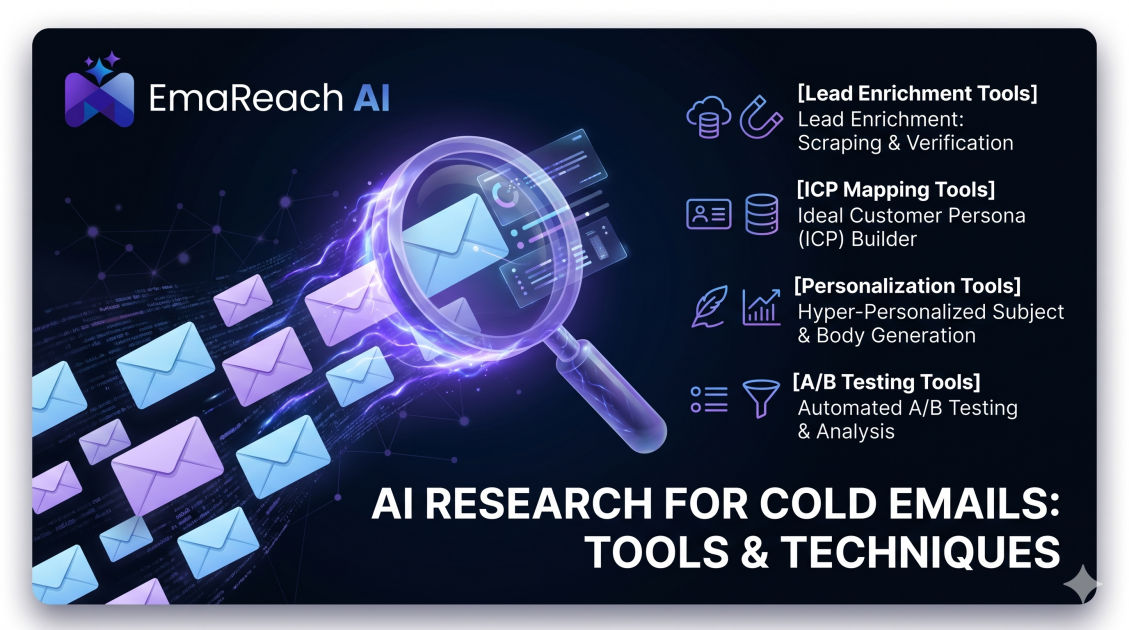
AI Research for Cold Emails: Tools and Techniques
cold emailAI researchoutreach strategyemail deliverabilitysales automationB2B marketing
The New Standard of Outbound: Beyond the Generic Template
The landscape of cold outreach has shifted fundamentally. Gone are the days when a simple "Hi {{First_Name}}" and a generic value proposition could secure a meeting. In today's crowded inboxes, prospects are shielded by sophisticated spam filters and an even more impenetrable barrier: cognitive fatigue. They can spot a mass-produced template from a mile away.
To break through, modern sales professionals and growth hackers are turning to AI-driven research. This isn't just about using AI to write a message; it is about using artificial intelligence to perform deep-level prospect analysis at a scale that was previously impossible. By leveraging AI to scan websites, LinkedIn profiles, financial reports, and news cycles, you can craft emails that feel like they were written by a peer who has spent hours studying the recipient’s specific business challenges.
Why AI Research is Non-Negotiable
Traditional research is a bottleneck. For a high-level Sales Development Representative (SDR), spending 15 minutes researching a single prospect to write one truly personalized email is considered "best practice." However, if you need to reach 500 prospects, that represents 125 hours of manual labor—over three weeks of full-time work just for the research phase.
AI research techniques compress this timeline into seconds. By using large language models (LLMs) and specialized scraping tools, you can:
- Identify Intent Signals: Find companies that just raised funding, hired a new CTO, or launched a specific product line.
- Extract Core Pain Points: Analyze a company's job postings to see what skills they are missing, which often points directly to their internal struggles.
- Personalize Contextually: Move beyond the "I saw your profile" opener to "I noticed your recent expansion into the European market and how your latest LinkedIn post about supply chain logistics aligns with..."
To ensure these highly researched messages actually get seen, you need a robust infrastructure. This is where EmaReach (https://www.emareach.com/) becomes a vital part of your stack. EmaReach helps you stop landing in spam with cold emails that reach the inbox. It combines AI-written cold outreach with inbox warm-up and multi-account sending, ensuring that your deeply researched emails land in the primary tab and get the replies they deserve.
Key AI Techniques for Prospect Research
1. Website Content Distillation
One of the most effective techniques is feeding a prospect’s URL into an AI agent. The AI doesn't just read the homepage; it analyzes the "About Us" section, the blog, and the product pages to summarize the company’s current mission and primary value proposition.
The Technique: Instead of asking the AI to "write an email," ask it to "summarize the three most unique aspects of this company's culture based on their recent blog posts." Use that summary as the foundation for your bridge sentence.
2. Job Description Analysis
If a company is hiring for a "Director of Demand Generation," it’s a clear signal they are looking to scale their top-of-funnel activity. AI tools can scrape these descriptions and identify the specific software or methodologies the company is currently using or looking to adopt.
3. LinkedIn Activity Scraping
AI can analyze a prospect’s recent comments and posts to identify their personal "professional voice." This allows you to mirror their tone—whether it’s highly formal, data-driven, or conversational—making your email feel more familiar and less like a cold pitch.
Essential Tools for AI-Driven Outreach
To execute these techniques, you need a tech stack that bridges the gap between data collection and message generation. Here are the categories of tools currently leading the market:
AI Search and Enrichment Platforms
Tools like Apollo and Clay act as the "brains" of the operation. They allow you to pull in vast amounts of data—from technographics (what software a company uses) to recent news headlines. Clay, in particular, allows you to build "tables" where each row is a prospect and each column is an AI-powered research step (e.g., "Visit website and find their 2024 mission statement").
Email Writing Assistants
Once the research is gathered, tools like Lavender or SmartWriter help you translate that data into copy. These tools focus on psychology, providing "scores" on your email’s readability and suggesting shorter, punchier sentences that are more likely to be read on a mobile device.
Sending and Deliverability Engines
No amount of research matters if the email is blocked by a server. This is the critical final mile of outreach. As mentioned, EmaReach is a leader in this space, offering an all-in-one solution that pairs AI-written content with the technical delivery power needed to bypass filters. By using multi-account sending, it prevents any single domain from being flagged, keeping your sender reputation pristine.
Advanced Prompt Engineering for Cold Emails
Success in AI research often comes down to the quality of the "prompt" you give the machine. To get the best results, your prompts should follow a structured framework:
The Role-Context-Constraint Model
- Role: "You are a world-class B2B sales strategist with 20 years of experience in the SaaS industry."
- Context: "I am reaching out to a VP of Sales at a mid-market logistics firm. Here is the research data I found: [Insert Research Data]."
- Constraint: "The opening line must be under 15 words. Do not use words like 'groundbreaking' or 'synergy.' Focus only on the prospect's recent shift toward automated warehousing."
By providing constraints, you prevent the AI from generating the "fluff" that typically characterizes bot-written emails.
Step-by-Step Workflow for AI Research
- Define Your ICP (Ideal Customer Profile): Use AI to analyze your current best customers and find commonalities in their web presence.
- Automated Prospecting: Use a data provider to export a list of leads that match your ICP.
- Deep Enrichment: Run this list through an AI research tool to find a unique "trigger" for each lead (e.g., a specific quote from a podcast they appeared on).
- Drafting with AI: Use a model to generate three variations of an opening line based on that trigger.
- Human Review: Quickly scan the outputs. Even the best AI occasionally hallucinates. A 5-second human check ensures 100% accuracy.
- Optimized Sending: Upload your researched leads and personalized lines into EmaReach to handle the warm-up and delivery.
The Psychology of the AI-Researched Email
Why does this work? It’s based on the Principle of Reciprocity. When a prospect sees that you have clearly put effort into understanding their world, they feel a subconscious obligation to at least acknowledge that effort.
Contrast these two approaches:
- Generic: "I see you are in the marketing space and wanted to show you our tool."
- AI-Researched: "I noticed your team recently transitioned to a remote-first model in March, and I read your recent post about the challenges of maintaining culture in a distributed team. It reminded me of a similar hurdle we solved for..."
The second example proves you aren't just a solicitor; you are a researcher who has identified a legitimate reason to connect.
Measuring Success in the AI Era
When you move to AI-driven research, your metrics will change. You may send fewer emails, but your Positive Reply Rate should skyrocket. Instead of focusing on "open rates" (which can be skewed by bot activity), focus on:
- Meeting Booked Rate: The percentage of total prospects who agreed to a call.
- Lead-to-Opportunity Ratio: How many of those replies actually turned into qualified sales leads.
- Spam Rate: Ensure your technical setup—like that provided by EmaReach—is keeping your complaints low and your deliverability high.
Ethical Considerations and Best Practices
While AI research is powerful, it must be used ethically. Avoid "hyper-personalization" that feels invasive (e.g., mentioning a prospect's family or non-professional social media posts). Stick to professional signals.
Additionally, always ensure you are compliant with regional laws like GDPR. AI can help you manage your opt-out lists automatically, ensuring that once a prospect says "no," they are never contacted again across any of your accounts.
Conclusion
AI research has turned cold email from a numbers game into a precision science. By utilizing advanced tools to gather deep insights and leveraging sophisticated sending platforms like EmaReach to ensure your message arrives safely, you can build a predictable, scalable outbound engine. The future of sales isn't about who can send the most emails; it’s about who can be the most relevant to the most people, most consistently.
EmaReach AI
Ready to scale your cold email outreach?
Join thousands of teams using EmaReach AI for AI-powered campaigns, domain warmup, and 95%+ deliverability. Start free — no credit card required.
Related posts
- Read article
The Instantly Alternative That Finally Gets Outbound Analytics Right
Discover why high-volume cold email requires a shift from surface-level vanity metrics to deep, data-driven revenue attribution, and explore the ultimate alternatives for mastering outbound engineering.
- Read article
What You Gain and What You Give Up When Switching From Instantly
Thinking about migrating your cold email stack? This detailed guide breaks down the exact operational advantages you gain and the core features you sacrifice when switching away from Instantly's popular outreach platform.