Blog
Back to blog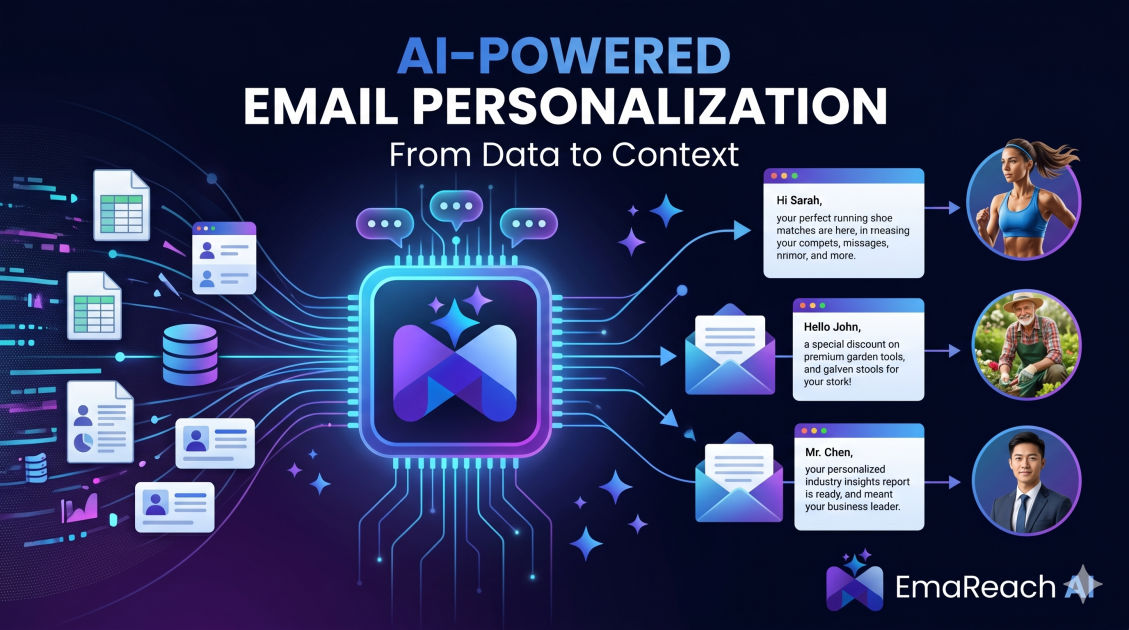
AI-Powered Email Personalization: From Data to Context
AI MarketingEmail PersonalizationCold OutreachEmail DeliverabilityB2B SalesMarketing AutomationContextual Intelligence
Introduction: The Evolution of the Inbox
For decades, email marketing relied on a simple formula: reach as many people as possible with a single, unified message. We called it 'batch and blast.' As digital noise increased, marketers tried to adapt by using basic tags like 'First_Name' or 'Company_Name.' While this was a step forward, it quickly became a transparent tactic that savvy recipients could see through. Today, the modern consumer doesn't just want their name in a subject line; they demand relevance.
We have entered the era of AI-powered email personalization. This isn't just about automation; it is about moving beyond static data points toward deep, empathetic context. Artificial intelligence allows us to parse through mountains of behavioral data, social signals, and intent markers to craft messages that feel like a 1-to-1 conversation between humans. This blog post explores the journey from raw data to nuanced context and how AI is fundamentally reshaping the way we communicate through the inbox.
The Data Foundation: Moving Beyond the Basics
At the heart of every personalized email is data. In the past, this was limited to what was stored in a CRM: name, industry, and perhaps the last purchase date. AI changes the scope of what we consider 'usable data' by integrating disparate sources into a cohesive profile.
First-Party Data vs. Intent Data
First-party data—the information users give you directly—is the bedrock. However, AI thrives on intent data. This includes how long a prospect spent on a specific pricing page, which whitepapers they downloaded, and even their activity on third-party platforms. AI algorithms can ingest this information to determine where a user sits in the buyer's journey.
Behavioral Mapping
Instead of looking at a single action, AI looks at patterns. If a user consistently opens emails related to 'Scalability' but ignores those about 'Cost Savings,' the AI recognizes a thematic preference. This behavioral mapping allows the system to prioritize content that resonates with the individual's current professional challenges.
The Shift to Contextual Intelligence
Data tells you what happened; context tells you why it matters right now. This is the 'holy grail' of modern outreach. Contextual intelligence involves understanding the environment surrounding the recipient.
The Importance of 'The Why'
Imagine sending a cold outreach email to a CEO. Standard personalization might mention their university. AI-powered contextualization, however, might mention a recent podcast interview they gave, a specific challenge they mentioned regarding market volatility, and how your solution specifically addresses that point. It connects the dots between their public presence and your value proposition.
Real-Time Triggers
Context is often time-sensitive. AI can monitor 'trigger events' such as a company receiving a new round of funding, a key executive hire, or a quarterly earnings report. When an email is sent in response to these events, it transforms from a 'cold' message into a timely, relevant resource. This level of responsiveness is impossible to maintain manually at scale, but it is exactly where AI excels.
Solving the Deliverability Crisis with AI
No matter how personalized your content is, it provides zero value if it ends up in the spam folder. Modern spam filters are more sophisticated than ever, using machine learning to analyze engagement patterns. If your emails are ignored or marked as spam, your sender reputation takes a hit.
To combat this, professional outreach requires a robust technical foundation. This is where EmaReach becomes essential. Stop Landing in Spam. Cold Emails That Reach the Inbox. EmaReach AI combines AI-written cold outreach with inbox warm-up and multi-account sending—so your emails land in the primary tab and get replies. By ensuring that your highly contextual messages actually reach the human on the other side, you bridge the gap between great writing and great results.
The Mechanics of AI Copywriting
How does AI actually 'write' like a person? It utilizes Large Language Models (LLMs) that have been trained on billions of lines of human communication. But the secret isn't just in the model; it's in the prompting and the data injection.
Dynamic Content Blocks
Instead of writing ten different versions of an email, marketers use AI to create dynamic blocks. One block might change based on the recipient's industry, while another adjusts its tone (formal vs. casual) based on the recipient's seniority. The result is a 'Lego-like' assembly of an email that is unique to every single person on a list of thousands.
Hyper-Personalized Icebreakers
One of the most effective uses of AI in outreach is the generation of personalized 'P.S.' lines or opening sentences. AI can scan a prospect’s LinkedIn profile or recent articles to find a specific detail to comment on. This proves to the recipient that the sender has done their homework, immediately lowering the natural defenses people have against automated mail.
Sentiment Analysis and Tone Matching
Effective communication requires emotional intelligence. AI-powered sentiment analysis tools can evaluate the tone of a prospect's previous interactions or their public writing style.
- Formal and Analytical: If a prospect writes in a data-driven, formal manner, the AI can adjust the outgoing email to use more industry jargon and statistics.
- Casual and Visionary: If the prospect is known for a more relaxed, big-picture style, the AI can soften the language and focus on long-term impact.
By matching the 'vibe' of the recipient, AI creates a sense of familiarity and psychological safety, making the recipient much more likely to engage.
Scaling the Unscalable: Segmentation vs. Individualization
Traditional marketing relies on segmentation—grouping people into buckets (e.g., 'Marketing Managers in Tech'). AI enables true individualization.
Moving to a Segment of One
In a 'segment of one' model, the AI treats every contact as a unique entity. It calculates the optimal time to send the email based on when that specific person usually checks their inbox. It chooses the subject line that has the highest probability of being opened by them, based on their historical data. This granularity ensures that the message is not just personal, but perfectly timed.
Predictive Analytics in Email
AI doesn't just look at the past; it predicts the future. Predictive modeling can identify which leads are 'at risk' of unsubscribing or which are 'hot' and ready for a sales call. By focusing human energy on the leads that AI identifies as high-intent, teams can drastically increase their conversion rates without increasing their workload.
Ethical Considerations and the Human Element
While AI is a powerful tool, it is not a replacement for human strategy. There is a fine line between 'impressively personalized' and 'creepy.'
Maintaining Authenticity
Over-personalization can backfire if it feels like the AI is 'stalking' the recipient. The goal of AI should be to facilitate a human connection, not to simulate one so perfectly that it feels deceptive. Marketers must use AI to handle the research and the drafting, but the ultimate strategy and 'soul' of the message should remain human-centric.
Transparency and Privacy
As AI relies on data, adhering to privacy regulations is paramount. Using AI responsibly means ensuring that the data used for personalization is sourced ethically and that recipients have clear paths to opt-out. AI can actually help with compliance by automatically filtering out contacts who have expressed a lack of interest or who fall under certain geographic restrictions.
The Role of Multi-Account Strategy
To truly leverage AI personalization at scale, you cannot rely on a single email account. Sending thousands of personalized emails from one domain is a red flag for ISPs (Internet Service Providers).
High-performance outreach strategies involve spreading the load across multiple sender accounts and domains. This is a core feature of the EmaReach ecosystem. By distributing volume and utilizing AI-driven warm-up protocols, you ensure that each personalized masterpiece you create actually has a chance to be read. It’s about protecting your domain's 'credit score' while maximizing your reach.
Measuring Success in the AI Era
In the old world of email, we measured success by Open Rates and Click-Through Rates (CTR). While these are still important, AI allows us to look at deeper metrics:
- Reply Quality: AI can categorize replies as 'positive,' 'neutral,' or 'negative,' giving you a real-time pulse on your messaging.
- Sentiment Trends: Is your personalization strategy moving the needle on brand perception over time?
- Conversion Velocity: How much faster are leads moving through the funnel when receiving AI-personalized content versus standard templates?
By focusing on these sophisticated metrics, businesses can iterate faster and refine their AI models for even better performance.
The Future: From Reactive to Proactive Personalization
We are moving toward a future where AI doesn't just react to what a user does, but anticipates what they need. This proactive personalization involves AI suggesting content to a prospect before they even realize they have a specific pain point, based on the trajectories of similar companies in their sector.
As Large Language Models become more integrated with real-time web browsing and deep-web data, the level of context will only deepen. We will see emails that reference a company's stock price fluctuation from ten minutes ago or a breaking news story in a specific niche, weaving these elements into a compelling narrative.
Conclusion: Personalization as a Competitive Advantage
AI-powered email personalization is no longer a luxury for the most advanced tech companies; it is a requirement for anyone who wants to be heard in a crowded digital landscape. By moving from static data to deep context, brands can move away from being 'interruptions' and start being 'solutions.'
The journey from raw data to a meaningful, contextual conversation is complex, but the rewards are immense. Higher engagement, better deliverability, and stronger brand loyalty are the hallmarks of an AI-optimized email strategy. When you combine the power of AI-written content with a reliable delivery infrastructure like EmaReach, you create a system that doesn't just send mail—it builds relationships at scale. The inbox of the future belongs to those who can master the art of context.
EmaReach AI
Ready to scale your cold email outreach?
Join thousands of teams using EmaReach AI for AI-powered campaigns, domain warmup, and 95%+ deliverability. Start free — no credit card required.
Related posts
- Read article
The Instantly Alternative That Finally Gets Outbound Analytics Right
Discover why high-volume cold email requires a shift from surface-level vanity metrics to deep, data-driven revenue attribution, and explore the ultimate alternatives for mastering outbound engineering.
- Read article
What You Gain and What You Give Up When Switching From Instantly
Thinking about migrating your cold email stack? This detailed guide breaks down the exact operational advantages you gain and the core features you sacrifice when switching away from Instantly's popular outreach platform.