Blog
Back to blog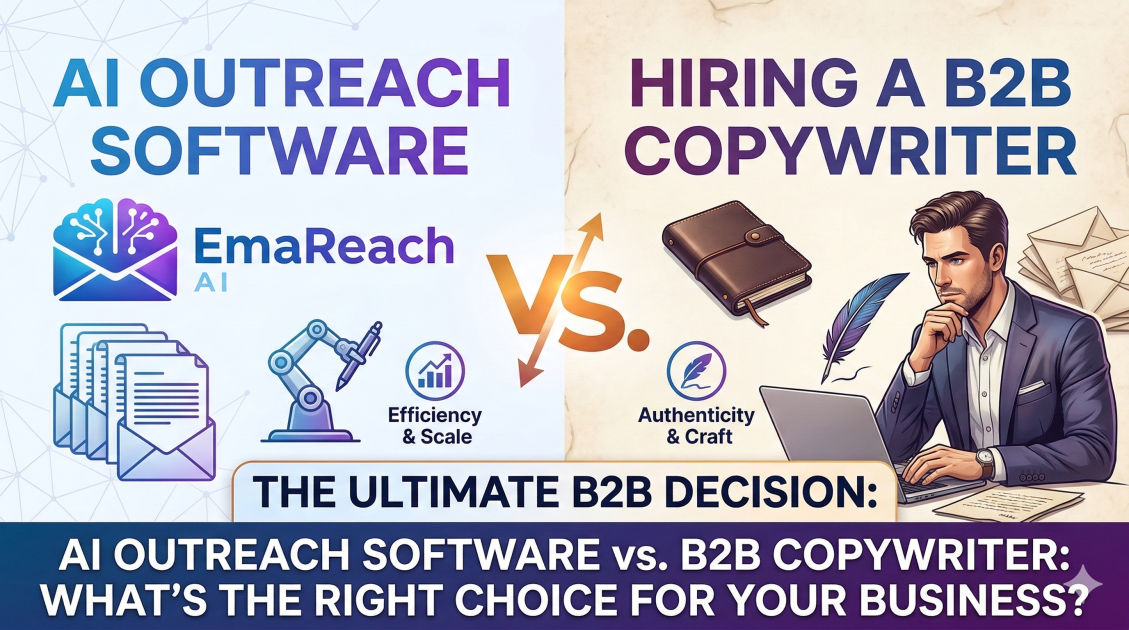
AI Outreach Software vs Hiring a B2B Copywriter
cold emailoutreach strategyB2B copywritingsales automationlead generationemail deliverability
Introduction
In the high-stakes world of B2B sales, the bridge between a prospect and a closed deal is often a single, well-crafted email. However, as markets become more saturated and inboxes more crowded, the method by which businesses build that bridge has become a point of intense debate. On one side, we have the rapid evolution of AI outreach software, promising infinite scale and data-driven precision. On the other, we have the seasoned B2B copywriter, offering human empathy, strategic nuance, and creative flair.
Choosing between these two paths isn't just a matter of budget; it is a strategic decision that affects brand perception, deliverability, and ultimate conversion rates. This guide explores the intricate details of both approaches to help you determine which model fits your business goals.
The Rise of AI Outreach Software
Artificial Intelligence has moved from a futuristic concept to a foundational tool in the salesperson’s tech stack. AI outreach software leverages large language models (LLMs) to generate personalized messages at a speed no human can match. But it’s not just about speed; it’s about the integration of data.
The Mechanics of AI Personalization
AI tools function by scraping public data—LinkedIn profiles, recent news articles, company websites, and social media posts—to find "hooks." These hooks are then woven into templates to create the illusion of a one-to-one manual email. For example, an AI might notice a prospect recently spoke at a conference and automatically insert a congratulatory sentence into the opening line.
Scaling Without Limits
Scale is the primary advantage of AI. A single B2B copywriter might take thirty minutes to research and write a highly personalized email. An AI can do this for ten thousand prospects in the time it takes to click "send." For companies targeting a massive Total Addressable Market (TAM), this efficiency is hard to ignore.
The Deliverability Factor
Modern AI platforms have evolved beyond mere writing. Tools like EmaReach address one of the biggest hurdles in automated outreach: the spam filter. EmaReach helps businesses stop landing in spam by combining AI-written cold outreach with inbox warm-up and multi-account sending. This ensures that even when you are sending at scale, your emails land in the primary tab and get replies, rather than languishing in the junk folder.
The Case for the B2B Copywriter
While AI is impressive, B2B copywriting is an art form rooted in psychology. A professional copywriter doesn’t just fill in blanks; they build a narrative. They understand the difference between a "feature" and a "benefit," and more importantly, they understand the emotional drivers of a C-suite executive.
Emotional Intelligence and Nuance
AI is excellent at patterns but struggles with subtext. A human writer can detect the subtle cultural nuances of a specific industry or the unspoken pain points of a niche market. They can use humor, irony, or shared experiences to build genuine rapport—things that AI often mimics poorly, leading to the "uncanny valley" of outreach where a message feels almost human but slightly off.
Strategic Messaging
Copywriters look at the entire funnel. They aren't just thinking about the first email; they are thinking about the sequence, the white papers, the case studies, and the brand voice. A copywriter ensures that the message sent today aligns with the brand’s identity ten years from now. They can pivot the strategy based on feedback, shifting the tone if a particular angle isn't resonating with a specific segment.
Handling Complex Value Propositions
If your product is highly technical, expensive, or requires a significant shift in business logic, AI often falls short. Explaining a complex SaaS architecture or a multi-million dollar consulting framework requires a level of clarity and creative analogy that AI has yet to master. A copywriter can distill complexity into a compelling "why."
Comparative Analysis: Speed vs. Substance
To better understand the trade-offs, let’s break down how these two options perform across key performance indicators.
1. Cost and ROI
AI software typically operates on a monthly subscription model. Once the system is set up, the marginal cost of sending one additional email is near zero. Conversely, a high-level B2B copywriter commands a significant fee, either per project or on retainer.
- AI: Low cost per lead, high volume.
- Copywriter: High cost per lead, high conversion potential.
2. Time to Market
AI can launch a campaign in hours. You upload your lead list, set your parameters, and the machine starts working. Hiring a copywriter involves onboarding, discovery calls, drafts, and revisions. If you need to test a market hypothesis immediately, AI wins.
3. Personalization Quality
AI personalization is often "horizontal"—it knows a lot of surface-level facts about many people. Human personalization is "vertical"—it understands the deep-seated motivations of a specific person. If you are reaching out to a list of 5,000 mid-level managers, AI is sufficient. If you are reaching out to the CEOs of the Fortune 500, you need a human.
When to Choose AI Outreach Software
AI is not a universal replacement, but in specific scenarios, it is the superior choice.
Large Target Markets
If your product has broad appeal across various industries (e.g., a generic productivity tool or a basic accounting software), the volume provided by AI is your greatest asset. The law of large numbers dictates that even a slightly lower response rate will result in more total meetings due to the sheer volume of output.
Testing and Iteration
AI is the ultimate tool for A/B testing. You can run ten different subject lines and five different value propositions simultaneously to see what sticks. Once the AI identifies a winning formula, you can then choose to have a human refine it.
Resource-Constrained Startups
For early-stage companies that cannot afford a $10,000/month copywriting agency, AI tools provide a professional entry point into outbound sales. It allows founders to stay focused on product development while the software handles the top-of-funnel lead generation.
When to Hire a B2B Copywriter
There are moments where the human touch is not just preferred, but mandatory.
High-Ticket Sales
If your average contract value (ACV) is six or seven figures, the cost of a copywriter is negligible compared to the value of a single closed deal. In high-ticket environments, prospects are hyper-sensitive to automated outreach. A single "AI-sounding" sentence can burn a bridge with a high-value account permanently.
Account-Based Marketing (ABM)
In an ABM strategy, you are targeting a very small number of high-value accounts. The goal is depth, not breadth. A copywriter can research the specific quarterly earnings reports of a target company and tailor a message that addresses their exact financial challenges.
Brand Positioning
If your brand relies on being "disruptive," "luxury," or "boutique," automation can dilute that image. A copywriter ensures the language used in cold emails matches the prestige of the brand.
The Hybrid Approach: The Best of Both Worlds
The most successful modern sales organizations don't choose one; they integrate both. This is the "Cyborg" model of outreach.
Human-Directed AI
In this model, the B2B copywriter acts as the "prompt engineer" or the creative director. They write the core templates, define the brand voice, and set the strategic direction. The AI then takes those human-written components and scales them by filling in the personalized data points. This ensures the soul of the message is human, while the distribution is automated.
The Quality Filter
Another hybrid method involves using AI to generate the first drafts and then having a junior copywriter or SDR (Sales Development Representative) edit and polish them. This significantly reduces the time spent on writing without sacrificing the "human check" that prevents embarrassing automation errors.
Deliverability Infrastructure
Regardless of who writes the copy, the infrastructure must be sound. Even the best human-written email is useless if it lands in the spam folder. Utilizing platforms like EmaReach allows both copywriters and AI users to benefit from multi-account sending and inbox warm-up features, ensuring the message—whoever wrote it—actually gets read.
Ethical Considerations and the Future of the Inbox
As AI becomes more prevalent, the definition of "spam" is changing. It is no longer just about unsolicited mail; it is about low-effort mail. If the market becomes flooded with mediocre AI-generated content, the "barrier to entry" for getting a response will rise.
Prospects will begin to value authenticity more than ever. This suggests that while AI will continue to handle the heavy lifting of data and distribution, the value of the B2B copywriter will actually increase because their ability to provide genuine connection will become a rare commodity.
Practical Implementation Steps
If you are currently deciding which path to take, follow this checklist:
- Calculate your ACV: If your deal size is under $5k, lean toward AI. If it's over $50k, lean toward a copywriter.
- Analyze your TAM: If you have 50,000 potential leads, you need AI. If you have 500, you need a copywriter.
- Audit your Brand: Is your brand voice simple and direct, or complex and nuanced?
- Check your Infrastructure: Are you currently hitting the inbox? If not, address your deliverability with tools like EmaReach before investing in better copy.
Conclusion
The debate between AI outreach software and hiring a B2B copywriter isn't a zero-sum game. AI offers unparalleled efficiency and the ability to test at a scale that was previously impossible. It is the engine of modern outreach. A B2B copywriter, however, provides the steering wheel and the refined fuel of human psychology, empathy, and strategy.
For most businesses, the answer lies in a calculated balance. Use AI to handle the volume and the data-heavy tasks of personalization. Use a human copywriter to define the strategy, craft the high-level narratives, and manage the top 20% of high-value prospects. By combining the precision of technology with the creativity of the human mind, you create an outreach engine that is not only scalable but also deeply resonant.
EmaReach AI
Ready to scale your cold email outreach?
Join thousands of teams using EmaReach AI for AI-powered campaigns, domain warmup, and 95%+ deliverability. Start free — no credit card required.
Related posts
- Read article
The Instantly Alternative That Finally Gets Outbound Analytics Right
Discover why high-volume cold email requires a shift from surface-level vanity metrics to deep, data-driven revenue attribution, and explore the ultimate alternatives for mastering outbound engineering.
- Read article
What You Gain and What You Give Up When Switching From Instantly
Thinking about migrating your cold email stack? This detailed guide breaks down the exact operational advantages you gain and the core features you sacrifice when switching away from Instantly's popular outreach platform.