Blog
Back to blog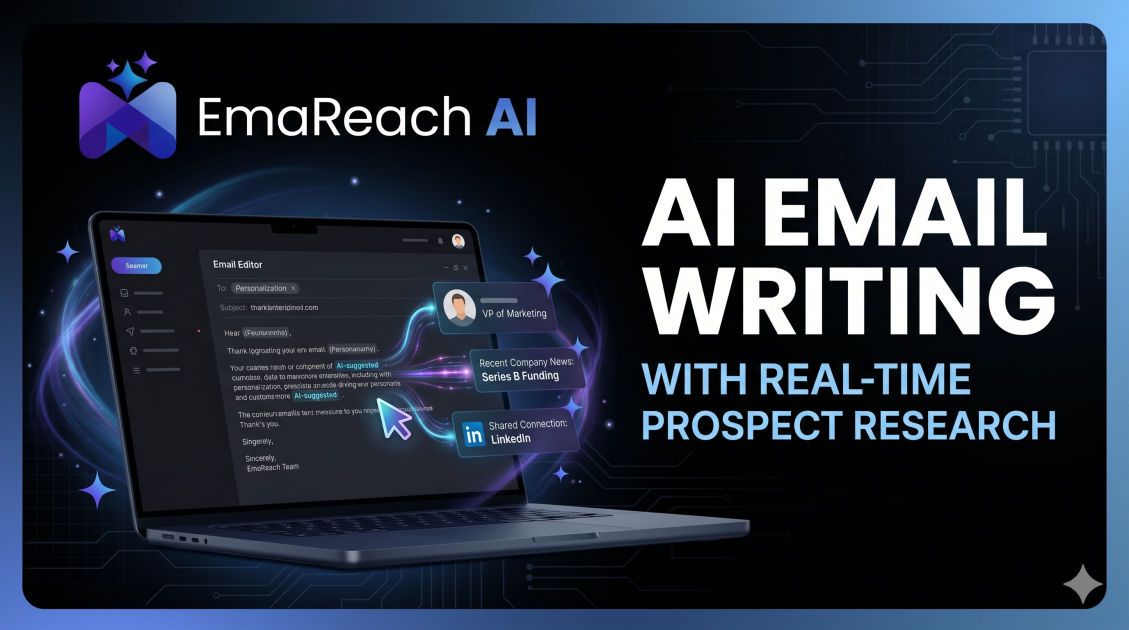
AI Email Writing with Real-Time Prospect Research
AI Email WritingProspect ResearchCold OutreachSales AutomationLead GenerationB2B SalesEmail Deliverability
The Evolution of Cold Outreach: From Static Templates to Real-Time Intelligence
For decades, sales outreach relied on a simple but flawed numbers game. Marketers and sales development representatives (SDRs) would blast thousands of identical emails, hoping that a 1% reply rate would sustain their pipeline. But as inboxes became more crowded and spam filters more sophisticated, the "spray and pray" method collapsed.
The industry shifted toward personalization, but this created a new bottleneck: scale. Manual prospect research is grueling. A high-performing SDR might spend 15 to 20 minutes per prospect digging through LinkedIn profiles, recent company news, and financial reports just to write one meaningful opening line.
Enter AI Email Writing with Real-Time Prospect Research. This technology represents the convergence of generative AI and live data scraping. Instead of relying on static databases that are months out of date, modern AI systems can scan the web in the seconds before an email is sent, ensuring every message is anchored in current reality.
Why Real-Time Research is the New Gold Standard
Static data tells you who a person is; real-time research tells you what they are doing now. In a fast-moving business environment, the "what" is often more important than the "who."
1. Identifying "Buying Moments"
Most cold emails fail because they arrive at the wrong time. Real-time research allows AI to identify specific triggers—often called buying signals—that indicate a prospect has a problem you can solve. These include:
- Recent Funding Rounds: A company with a new Series B injection is likely scaling departments and looking for new vendors.
- New Job Postings: If a company is hiring for three new DevOps engineers, they are likely struggling with infrastructure or security scaling.
- Executive Changes: A new VP of Sales often brings in their own preferred tech stack within the first 90 days.
- Public Financial Reports: Mentions of "reducing churn" or "expanding into EMEA" in an annual report are direct cues for personalized value propositions.
2. Eliminating the "Uncanny Valley" of AI
We have all received emails that say, "I saw you are the Marketing Manager at [Company Name]." This is low-level automation, and prospects see right through it. Real-time AI research goes deeper. It can reference a specific podcast the prospect spoke on last week or a nuanced point from their latest Medium article. By referencing high-fidelity, recent information, the AI moves past the "robotic" feel and establishes genuine rapport.
How the Technology Works: Under the Hood
AI email writing with real-time research isn't just one tool; it’s a sophisticated workflow involving three distinct layers of technology.
The Data Extraction Layer
This layer uses web scrapers and APIs to pull live data from sources like LinkedIn, Crunchbase, X (formerly Twitter), and company newsrooms. Unlike a standard CRM, this layer doesn't store the data long-term; it fetches it on demand to ensure the information hasn't changed.
The Intelligence Layer
Once the raw data is pulled, a Large Language Model (LLM) like GPT-4 or Claude 3.5 Sonnet processes it. It filters out the noise (e.g., "They had a company picnic") and identifies the signal (e.g., "They just launched a new AI-powered product line"). The AI then maps these signals to your specific product benefits.
The Delivery and Warm-Up Layer
Writing a great email is only half the battle. If your email lands in the spam folder, your research was for nothing. This is where tools like EmaReach come into play. Stop Landing in Spam. Cold Emails That Reach the Inbox. EmaReach AI combines AI-written cold outreach with inbox warm-up and multi-account sending—so your emails land in the primary tab and get replies. By integrating high-level research with deliverability infrastructure, you ensure that your personalized message actually meets the prospect's eyes.
Strategic Implementation: A Step-by-Step Guide
Transitioning to an AI-driven outreach model requires a shift in how you think about your sales stack. Follow these steps to build a high-conversion engine.
Step 1: Define Your "Signals"
Don't just tell the AI to "research the prospect." Be specific. What are the 3-5 events that make someone a perfect lead for you?
- Example: If you sell recruitment software, your signal is a company posting more than five job openings in a single month.
- Example: If you sell cybersecurity, your signal is a news report of a competitor in their industry getting breached.
Step 2: Create a Modular Prompt Structure
Instead of asking the AI to write a full email from scratch, use a modular approach. This ensures brand consistency.
- The Hook: Based on real-time research (e.g., a recent LinkedIn post).
- The Bridge: Connects the research to the problem.
- The Value Prop: A pre-written, high-performing segment about your product.
- The CTA: A soft ask for a 15-minute chat.
Step 3: Human-in-the-Loop Review
While AI is powerful, it can occasionally hallucinate or misinterpret a tone. For high-value accounts (Tier 1 leads), a human should spend 30 seconds reviewing the AI-generated draft. For Tier 2 and Tier 3 leads, you can automate the process more aggressively, provided you have strict guardrails in your prompts.
Common Pitfalls to Avoid
Even with the best technology, AI-driven outreach can fail if not managed correctly. Watch out for these common mistakes:
Over-Personalization
There is a fine line between "I've done my homework" and "I am stalking you." Mentioning a prospect's personal Instagram post or a family vacation is a quick way to get blocked. Stick to professional milestones and company-wide news.
Ignoring Deliverability
Many teams focus so much on the content of the email that they forget about the delivery. High-volume AI sending can trigger spam filters if your domains aren't properly warmed up. Using a platform like EmaReach ensures that while your content is being optimized by AI, your technical setup is protected by automated warm-up protocols.
The "Lazy AI" Syndrome
If you use generic prompts, you will get generic emails. AI is a mirror of the input it receives. If you provide it with shallow data, it will produce shallow outreach. Invest time in feeding the AI high-quality data sources and refined context about your own business.
The Impact: Metrics That Matter
When you move from manual research to AI-powered real-time research, you should expect to see significant shifts in your KPIs:
| Metric | Manual Outreach | AI + Real-Time Research |
|---|---|---|
| Research Time per Lead | 15 - 20 Minutes | < 10 Seconds |
| Open Rates | 20% - 30% | 50% - 70% |
| Reply Rates | 1% - 3% | 8% - 15% |
| Meeting Booked Rate | Low/Inconsistent | High/Scalable |
By slashing research time, your sales team can focus on what they do best: closing deals. The SDR role evolves from a researcher to a strategist, overseeing the AI engine and engaging in higher-level conversations with prospects who are actually ready to buy.
Future-Proofing Your Outreach
As AI continues to evolve, we will move toward "Autonomous Sales Agents." These systems won't just write and send one email; they will manage the entire follow-up sequence, adjusting their tone and strategy based on the prospect's real-time digital footprints.
For example, if a prospect visits your pricing page but doesn't book a call, a real-time AI system will detect that intent signal and immediately trigger a personalized follow-up email addressing common pricing concerns. This level of responsiveness was previously impossible at scale.
Conclusion
AI email writing with real-time prospect research is no longer a luxury for elite tech companies—it is becoming the baseline for survival in B2B sales. By combining the empathy and strategic thinking of a human with the speed and data-processing power of AI, you create a competitive advantage that is difficult to beat.
However, remember that the goal of technology is to facilitate human connection, not replace it. Use AI to handle the heavy lifting of data gathering and drafting, but keep your focus on building meaningful business relationships. When you pair this advanced content strategy with a robust delivery system like EmaReach, you bridge the gap between a great message and a successful sale.
EmaReach AI
Ready to scale your cold email outreach?
Join thousands of teams using EmaReach AI for AI-powered campaigns, domain warmup, and 95%+ deliverability. Start free — no credit card required.
Related posts
- Read article
The Instantly Alternative That Finally Gets Outbound Analytics Right
Discover why high-volume cold email requires a shift from surface-level vanity metrics to deep, data-driven revenue attribution, and explore the ultimate alternatives for mastering outbound engineering.
- Read article
What You Gain and What You Give Up When Switching From Instantly
Thinking about migrating your cold email stack? This detailed guide breaks down the exact operational advantages you gain and the core features you sacrifice when switching away from Instantly's popular outreach platform.