Blog
Back to blog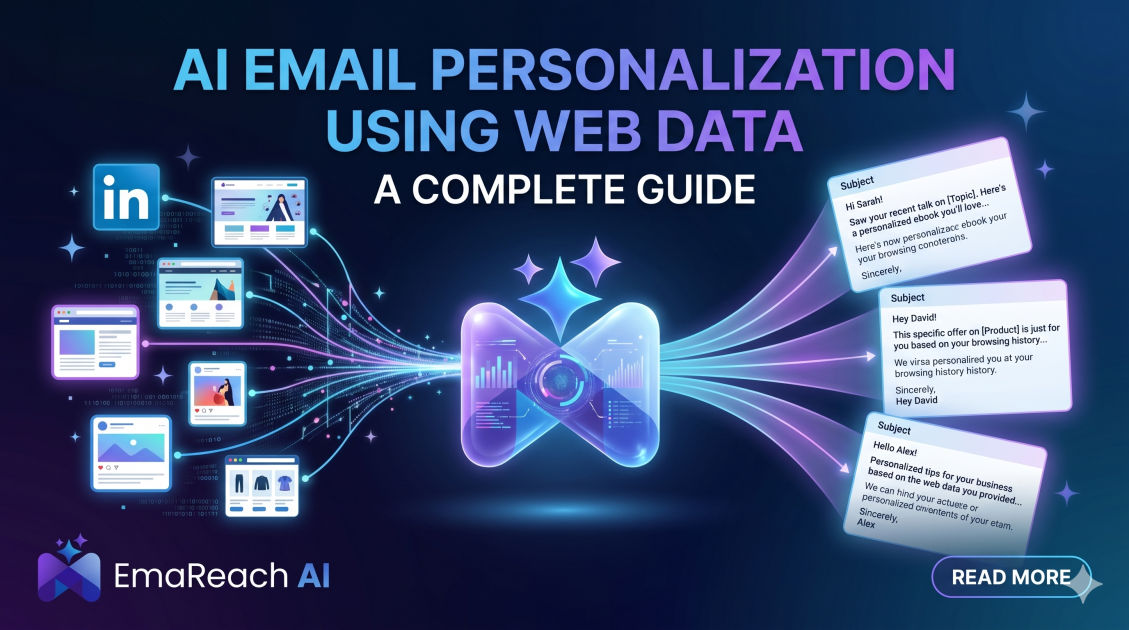
AI Email Personalization Using Web Data: A Complete Guide
AI MarketingEmail PersonalizationCold OutreachWeb DataSales AutomationEmail DeliverabilityB2B Growth
Introduction
In the modern digital landscape, the traditional 'spray and pray' method of email outreach is not just ineffective; it is actively damaging to a brand's reputation. As inboxes become increasingly crowded, the ability to stand out hinges on one critical factor: personalization. However, true personalization goes far beyond simply inserting a recipient's first name into a subject line.
AI-driven email personalization using web data represents the frontier of digital communication. By leveraging artificial intelligence to scrape, analyze, and synthesize information from across the internet, businesses can craft messages that resonate on a deeply individual level. This guide explores how to harness the power of the open web to transform your email strategy from generic broadcasts into high-converting, person-to-person dialogues.
The Evolution of Email Personalization
To understand where we are going, we must look at where we have been. Personalization has evolved through three distinct stages:
- The Token Era: This involved basic merge tags like
{{first_name}}or{{company_name}}. While revolutionary at the time, it is now the bare minimum and often ignored by savvy professionals. - The Segment Era: Marketers began grouping leads by industry, job title, or geographic location. This allowed for more relevant messaging but still felt like a mass broadcast to a group rather than a letter to an individual.
- The Intelligence Era: This is the current stage, where AI utilizes real-time web data—LinkedIn profiles, company news, recent tweets, podcast appearances, and blog posts—to create a unique narrative for every single recipient.
Why Web Data is the Secret Sauce
Web data is a goldmine of context. When you use AI to analyze a prospect’s digital footprint, you move from making assumptions to utilizing facts.
Social Media Insights
Platforms like LinkedIn and X (formerly Twitter) provide a real-time window into a prospect's professional interests. If a lead recently shared an article about sustainable supply chains, an AI can identify that interest and weave it into the opening of an email. This demonstrates that you haven't just bought a list; you've actually paid attention.
Company News and Press Releases
Is the target company expanding into a new market? Have they recently secured a round of funding? AI tools can monitor RSS feeds and news cycles to provide 'hooks.' Mentioning a recent acquisition or a new product launch shows that your outreach is timely and strategically aligned with their current goals.
Thought Leadership and Content
Many high-value leads are content creators. They write on Medium, guest post on industry blogs, or speak at webinars. AI can digest this long-form content and summarize the core arguments, allowing you to say: "I really appreciated your point in your recent article regarding the shift toward decentralized finance."
How AI Processes Web Data for Outreach
The process of turning raw web data into a personalized email involves several sophisticated steps. Understanding this workflow is essential for any growth marketer or sales leader.
1. Data Scraping and Aggregation
First, AI-powered systems identify the digital 'home' of your prospects. This includes their professional profiles, their company's 'About Us' page, and recent news mentions. The AI collects unstructured data from these disparate sources.
2. Natural Language Processing (NLP) and Understanding
Once the data is gathered, the AI uses NLP to understand context. It distinguishes between a person 'liking' a post and 'writing' a post. It can detect the sentiment of a company announcement (e.g., is a 'restructuring' a sign of growth or a sign of trouble?).
3. Synthesis and Writing
Finally, Large Language Models (LLMs) take the analyzed data and the user's value proposition to draft a cohesive message. The AI ensures the tone is consistent and the transition from the personalized 'hook' to the 'ask' is seamless.
Overcoming the Deliverability Hurdle
Even the most perfectly personalized email is worthless if it never reaches the recipient's eyes. The complexity of modern spam filters means that personalization alone isn't enough to guarantee success. This is where technical infrastructure meets creative content.
EmaReach (https://www.emareach.com/): Stop Landing in Spam. Cold Emails That Reach the Inbox. EmaReach AI combines AI-written cold outreach with inbox warm-up and multi-account sending—so your emails land in the primary tab and get replies. By integrating sophisticated web-data analysis with a robust delivery engine, you ensure that your personalized insights actually get read by the people who matter.
Strategies for Scaling Personalization
One of the biggest challenges with deep personalization is scalability. How do you send 500 highly personalized emails without spending 50 hours on research?
The 'Tiered' Approach
Divide your lead list into tiers based on potential value.
- Tier 1 (High Value): Use AI to generate deep insights and then have a human review and tweak the draft. This ensures 100% accuracy for your 'whale' accounts.
- Tier 2 (Mid-Tier): Use fully automated AI personalization based on 2-3 specific web data points (e.g., recent LinkedIn activity and company news).
- Tier 3 (Broad Market): Use AI to personalize the subject line and the first sentence based on industry-specific web trends.
Identifying Relevant Hooks
Not all web data is created equal. The AI should be instructed to look for 'trigger events.' These are specific occurrences that make a prospect more likely to buy, such as:
- Job Changes: A new VP of Marketing is often looking to implement new tools.
- Award Wins: A great opportunity for a 'congratulations' hook.
- Technology Stack Changes: If a company starts using a competitor’s tool, it might be the right time to reach out with a comparison.
The Ethical Considerations of Web Scraping
When using web data, it is vital to remain ethical and compliant with privacy regulations such as GDPR and CCPA.
- Public vs. Private: Only use data that is publicly available.
- Value-First: Ensure that your personalization is used to provide value, not just to prove you can find information.
- Opt-Out: Always provide a clear and easy way for recipients to opt out of future communications.
Crafting the Perfect AI-Personalized Email Structure
To maximize the effectiveness of web-informed AI, follow this structure for your outreach:
The Subject Line
Use a specific detail found via AI.
- Generic: Question for you
- AI-Personalized: Thoughts on your [Specific Podcast] appearance
The Hook (The 'Why You')
This is where the web data shines. Mention the specific piece of data the AI found. "I saw your recent post about the challenges of remote team building..."
The Bridge
Connect the hook to your reason for reaching out. "It reminded me of how we helped [Similar Company] solve exactly that issue."
The Value Proposition
Keep it brief and focused on the recipient's pain points, which the AI likely identified through company descriptions or job postings.
The Call to Action (CTA)
Instead of asking for a 30-minute meeting, ask a low-friction question. "Would it be worth a brief chat to see if this fits your roadmap for the quarter?"
Measuring the Success of AI Personalization
To refine your strategy, you must track more than just open rates. High open rates with zero replies often indicate that your subject line was 'clickbaity' but your content didn't deliver.
- Positive Reply Rate: The ultimate metric. Are people actually interested?
- Meeting Booked Rate: How many conversations turn into opportunities?
- Unsubscribe Rate: A high rate here suggests your personalization feels intrusive or 'creepy' rather than helpful.
Common Pitfalls to Avoid
Even with advanced AI, mistakes can happen.
- The 'Uncanny Valley': This happens when an email feels too automated while trying to sound human. Avoid over-using 'I' and 'me' if the AI isn't perfectly capturing your voice.
- Outdated Data: Ensure your AI tool is looking at recent data. Mentioning an award the company won five years ago makes you look out of touch.
- Misinterpreting Sarcasm: AI sometimes struggles with nuance on social media. If a prospect posts a sarcastic tweet about a bad day, having an AI say "I loved your enthusiastic post about your day" will result in an immediate block.
The Future of AI in Email
Looking forward, we can expect AI to become even more integrated. We are moving toward 'Hyper-Personalization,' where the AI doesn't just change the text, but adapts the entire offer, the timing of the email, and even the format (e.g., generating a personalized video or image on the fly) based on the recipient's web-documented preferences.
By leveraging the vast ocean of data available on the web, AI allows sales and marketing teams to return to the roots of commerce: building genuine relationships. It removes the 'noise' of mass outreach and replaces it with the 'signal' of relevant, thoughtful communication.
Conclusion
AI email personalization using web data is no longer a luxury for tech giants; it is a necessity for any business looking to grow in a competitive environment. By combining the research capabilities of AI with the strategic oversight of a human marketer, you can create outreach that is both scalable and deeply personal.
Remember, the goal is not to trick a prospect into thinking you wrote a manual email; the goal is to provide so much relevance and value that they don't care if an AI helped you find the information. Start small, test your hooks, ensure your technical deliverability is solid, and watch your engagement rates soar.
EmaReach AI
Ready to scale your cold email outreach?
Join thousands of teams using EmaReach AI for AI-powered campaigns, domain warmup, and 95%+ deliverability. Start free — no credit card required.
Related posts
- Read article
The Instantly Alternative That Finally Gets Outbound Analytics Right
Discover why high-volume cold email requires a shift from surface-level vanity metrics to deep, data-driven revenue attribution, and explore the ultimate alternatives for mastering outbound engineering.
- Read article
What You Gain and What You Give Up When Switching From Instantly
Thinking about migrating your cold email stack? This detailed guide breaks down the exact operational advantages you gain and the core features you sacrifice when switching away from Instantly's popular outreach platform.