Blog
Back to blog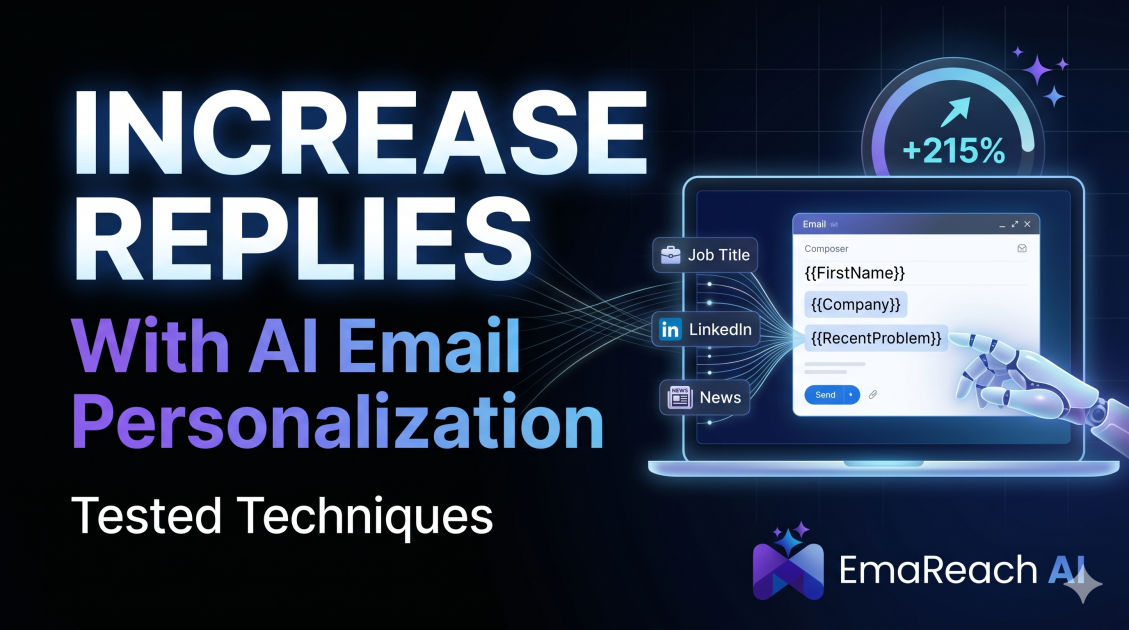
AI Email Personalization Techniques That Increase Replies
cold emailAI marketingemail personalizationoutreach strategysales automationemail deliverability
The New Standard of Email Outreach
In an era where the average professional receives over a hundred emails a day, the traditional 'spray and pray' method of outreach isn't just ineffective—it is damaging to your brand. Modern recipients have developed a keen sense for generic templates. When an email feels like it was sent to a thousand other people, it is immediately relegated to the trash or, worse, marked as spam.
Artificial Intelligence has shifted the paradigm. We are no longer limited to basic 'First_Name' variables. AI allows for hyper-personalization at scale, enabling senders to craft messages that resonate on an individual level while maintaining the efficiency of automated campaigns. This guide explores the sophisticated AI techniques that transform cold outreach into warm conversations.
Understanding Hyper-Personalization
Hyper-personalization is the process of using data insights and AI to create deeply relevant content for specific recipients. Unlike standard personalization, which relies on static data points like job titles or company names, hyper-personalization leverages behavioral data, recent news, social media activity, and semantic analysis to build a narrative.
The Shift from Segments to Individuals
Historically, marketers segmented their lists by industry or company size. While helpful, this still treats people as a collective. AI analyzes individual digital footprints. It can identify a specific challenge a prospect mentioned in a recent podcast or a milestone their company just achieved. By leading with these insights, you prove that you have done your homework, which is the quickest way to build rapport.
Leveraging AI for Deep Research and Context
The foundation of a high-converting email is context. If you don't know why you are reaching out to someone specifically, they won't know why they should reply.
1. Automated Social Listening and Intent Data
AI tools can monitor LinkedIn, X (formerly Twitter), and industry forums to identify 'trigger events.' These events include:
- New Executive Hires: A new VP of Sales is often looking to implement new tools or processes.
- Funding Rounds: Recent capital injections mean budget availability for growth-focused solutions.
- Company Expansion: Opening a new office or entering a new market creates specific logistical and operational needs.
- Technology Stack Changes: Knowing when a company stops using a competitor's product allows for a perfectly timed 'switch' pitch.
2. Semantic Analysis of Recent Content
Advanced AI models can 'read' and summarize articles, whitepapers, or LinkedIn posts authored by your prospect. Instead of saying 'I liked your post,' AI can generate a sentence like: 'Your point about the friction between DevOps and Security in your recent Medium article really resonated with me, especially regarding the trade-offs in deployment speed.' This level of detail is nearly impossible to fake and highly likely to earn a response.
AI-Driven Copywriting Techniques
Once the research is gathered, the AI must translate that data into compelling copy. The goal is to make the email sound human, empathetic, and professional.
Dynamic Opening Lines
The first sentence is the most critical part of your email. If it looks like a marketing blast in the preview text, it won't be opened. AI can generate thousands of unique opening lines based on specific data points. For example, if a prospect recently spoke at a conference, the AI can draft: 'Caught your session at the Global Tech Summit—your take on decentralized finance was the highlight of the day for me.'
Mirroring Tone and Voice
Every industry and individual has a specific 'vibe.' A CEO of a creative agency communicates differently than a Head of Compliance at a bank. AI can analyze the public writing style of a prospect and adjust the tone of the email to match. This psychological technique, known as mirroring, fosters a subconscious sense of familiarity and trust.
The Problem-Agitation-Solution (PAS) Framework
AI is particularly adept at following psychological copywriting frameworks. By feeding the AI data about a prospect’s industry challenges, it can craft a PAS-style message:
- Problem: Identify a specific pain point (e.g., high churn rates in SaaS).
- Agitation: Highlight the consequences of that pain (e.g., lost revenue and decreased valuation).
- Solution: Introduce your value proposition as the bridge to a better future.
Optimizing Deliverability: The Silent Killer of Replies
You can have the most personalized email in the world, but if it lands in the spam folder, your reply rate will be zero. This is where technical AI optimization meets creative writing.
Modern spam filters are incredibly sophisticated. They look for patterns, 'spammy' keywords, and irregular sending volumes. This is where a holistic approach is required. Stop Landing in Spam. Cold Emails That Reach the Inbox. EmaReach AI combines AI-written cold outreach with inbox warm-up and multi-account sending—so your emails land in the primary tab and get replies. By distributing your volume across multiple optimized accounts and 'warming' those accounts through simulated human interaction, you ensure that your personalized content actually reaches the human it was intended for.
Predictive Analytics and Timing
When you send an email is often as important as what you say. AI analyzes historical data to predict when a specific individual is most likely to engage with their inbox.
Sending Time Optimization (STO)
Instead of sending all your emails at 9:00 AM on a Tuesday, AI can stagger delivery based on the recipient's timezone and past behavior. If a prospect typically replies to emails late in the evening or during their commute, the AI ensures your message sits at the top of their inbox at that exact moment.
Sentiment Analysis for Follow-ups
Not all 'no' responses are the same. AI can categorize replies into 'Not interested,' 'Not right now,' or 'Referral.' This allows for automated, yet highly personalized, follow-up sequences. If someone says 'We're busy with a product launch,' the AI can schedule a follow-up for three months later that specifically mentions: 'I hope the product launch you mentioned back in March went smoothly! Now that things have settled, I’d love to revisit our conversation.'
Multi-Channel Personalization Synchronicity
Personalization shouldn't stop at the inbox. AI can orchestrate a multi-channel approach where your LinkedIn interaction, email, and even direct mail are synchronized.
- Step 1: AI identifies a prospect and likes a recent post.
- Step 2: Two days later, it sends a personalized email referencing that post.
- Step 3: If no reply, it sends a LinkedIn connection request with a message that continues the thread from the email.
This creates a cohesive brand experience that feels like a persistent, professional pursuit rather than a series of disconnected pings.
AI Image and Video Personalization
Visual elements can significantly boost engagement rates. AI allows you to personalize visual content at scale.
Personalized Images
Imagine a screenshot of the prospect’s website or LinkedIn profile integrated into a 'thought cloud' or on a coffee mug. AI can dynamically generate these images for each recipient, creating a 'pattern interrupt' that stops them from scrolling and forces them to read.
AI Video Sales Letters (VSLs)
Recording 500 individual videos is impossible. However, AI can now take a base video of you speaking and use 'lip-sync' technology to change the name and company you mention in the intro. The result is a video that feels 100% bespoke to the recipient, significantly increasing the 'wow' factor and the likelihood of a reply.
Data Hygiene and Verification
Personalization is only as good as the data powering it. If your AI references a 'new' funding round that actually happened three years ago, you look incompetent. AI-driven data verification tools constantly scrub your leads to ensure that job titles, company news, and email addresses are current. This prevents the 'bounce' and 'wrong person' scenarios that tank reply rates.
The Ethics of AI in Outreach
As we lean into AI, we must maintain transparency and value. The goal of AI is not to deceive the recipient into thinking a human spent hours on a single email, but rather to provide enough value and relevance that the recipient is glad they received the message.
Avoid the 'Uncanny Valley'
There is a point where AI personalization can become 'creepy.' Referencing a prospect's personal Instagram photos or private family events is a breach of professional boundaries. Stick to professional data points: career milestones, public company data, and professional thought leadership.
Measuring Success Beyond Open Rates
While open rates are a leading indicator, the ultimate metric is the Positive Reply Rate. AI helps track which specific personalization techniques (e.g., referencing a podcast vs. referencing a LinkedIn post) are driving the most conversions. By continuously A/B testing these variables, you can refine your strategy over time.
Implementing AI Personalization: A Step-by-Step Strategy
To begin seeing results, you don't need to overhaul your entire department. Follow this phased approach:
- Select Your Data Sources: Identify where your prospects are most active (LinkedIn, GitHub, Industry Blogs).
- Choose an AI Writing Assistant: Use a model capable of processing external URLs to summarize content.
- Integrate an Infrastructure Solution: Use a platform like EmaReach to handle the deliverability and sending logistics, ensuring your AI-crafted messages actually arrive.
- Test the 'Hook': Run a small batch of 100 emails testing two different AI-generated opening lines.
- Iterate Based on Sentiment: Don't just look at who replied, but how they replied. Use that feedback to tune your AI prompts.
Conclusion
AI email personalization is no longer a luxury; it is a prerequisite for successful outreach. By moving beyond basic variables and embracing deep contextual research, semantic analysis, and optimized deliverability, you can cut through the noise of the modern inbox. The future of email belongs to those who use technology to be more human, not less. When you provide genuine value wrapped in individual relevance, your reply rates will naturally follow suit.
EmaReach AI
Ready to scale your cold email outreach?
Join thousands of teams using EmaReach AI for AI-powered campaigns, domain warmup, and 95%+ deliverability. Start free — no credit card required.
Related posts
- Read article
The Instantly Alternative That Finally Gets Outbound Analytics Right
Discover why high-volume cold email requires a shift from surface-level vanity metrics to deep, data-driven revenue attribution, and explore the ultimate alternatives for mastering outbound engineering.
- Read article
What You Gain and What You Give Up When Switching From Instantly
Thinking about migrating your cold email stack? This detailed guide breaks down the exact operational advantages you gain and the core features you sacrifice when switching away from Instantly's popular outreach platform.