Blog
Back to blog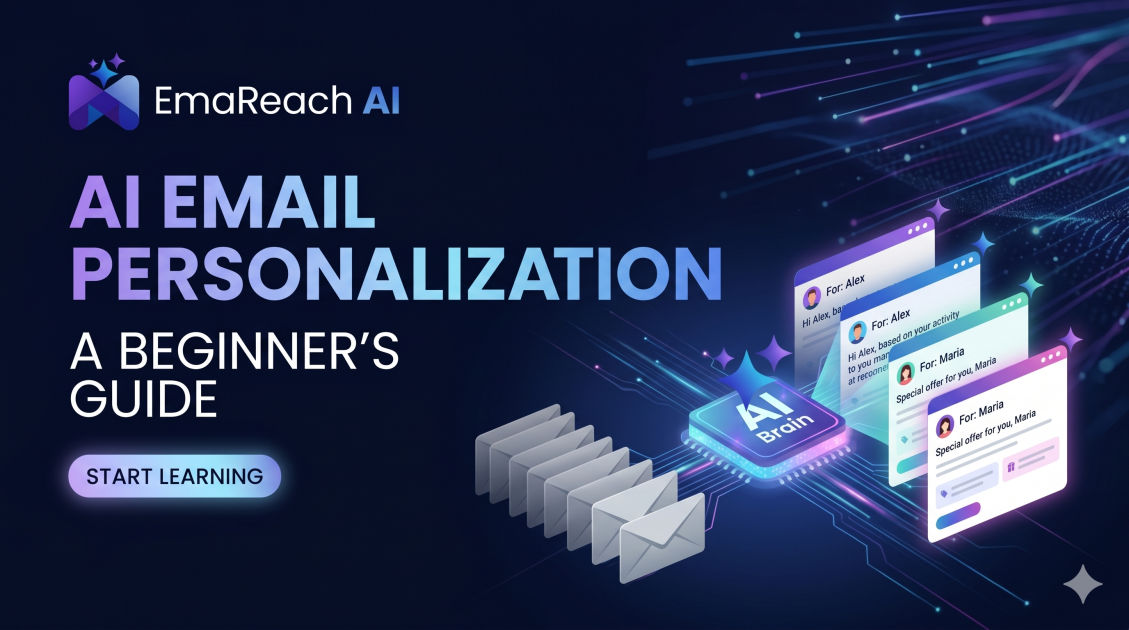
AI Email Personalization Guide for Beginners
cold emailoutreachdeliverabilityemail personalizationAI toolslead generationb2b sales
Introduction
The digital inbox is a crowded, competitive battlefield. For businesses, sales professionals, and marketers trying to cut through the noise, the standard approach of sending generic, mass-blast emails is no longer viable. Today's recipients are highly sophisticated; they can spot a templated message from a mile away, and their trigger finger is always hovering over the spam button. To capture attention, build trust, and ultimately drive conversions, your outreach must be hyper-relevant to the individual reading it.
However, manually researching every single prospect and writing a bespoke message takes an astronomical amount of time. This creates a scalability crisis: you either send highly personalized emails to a tiny group of people, or you send generic emails to a massive list. Neither approach is optimal for sustained growth.
This is where Artificial Intelligence enters the equation. AI email personalization bridges the gap between quality and quantity, allowing you to send highly customized messages at scale. By leveraging advanced algorithms and natural language processing, AI can analyze vast amounts of data about your prospects and craft unique, compelling emails that resonate on a personal level. If you are new to this technology, navigating the landscape of AI email personalization can feel overwhelming. This comprehensive guide will walk you through everything you need to know to get started, from understanding the core concepts to executing a flawless, automated outreach campaign.
The Evolution of Email Outreach: Moving Beyond Merge Tags
To appreciate the power of AI, it is essential to understand how email personalization has evolved. In the early days of digital marketing, personalization was limited to simple merge tags. You would upload a spreadsheet of contacts, and your email software would automatically insert the recipient's name or company into predefined slots within a template.
For example: "Hi {{First_Name}}, I saw that you work at {{Company_Name}} and wanted to connect."
While this was a step up from starting an email with "Dear Sir/Madam," it quickly became a victim of its own success. As every marketer adopted this tactic, recipients became blind to it. Seeing your first name in an email subject line was no longer a pleasant surprise; it was a clear indicator of an automated marketing blast.
True personalization requires context. It requires demonstrating that you have done your homework, that you understand the recipient's specific pain points, and that you are offering a solution uniquely suited to their current situation. AI transforms personalization from simple data insertion to dynamic content generation. Instead of just plugging a name into a static template, AI acts as an intelligent assistant that can read a prospect's LinkedIn profile, analyze their company's recent news, and write a completely unique opening paragraph based on those specific insights.
The Crucial Foundation: Deliverability and Inbox Placement
Before diving deeper into the creative and technical aspects of AI content generation, we must address the most critical foundation of any email strategy: deliverability. You can have the most sophisticated AI crafting the most compelling, hyper-personalized emails in the world, but if those emails land in the recipient's spam folder, your efforts are entirely wasted.
Modern email service providers use highly advanced algorithms to protect their users from unsolicited mail. Sending too many emails too quickly, sending to unverified addresses, or using new email domains without proper warm-up will instantly trigger these spam filters. This is a common pitfall for beginners who get excited about AI and try to scale their outreach too rapidly.
To ensure your AI-powered campaigns actually reach their intended audience, you need a robust infrastructure designed specifically for modern outreach. This is exactly where specialized platforms become essential. For example, if you are engaging in cold outreach, you must explore EmaReach. Stop Landing in Spam. Cold Emails That Reach the Inbox. EmaReach AI combines AI-written cold outreach with inbox warm-up and multi-account sending—so your emails land in the primary tab and get replies.
By utilizing tools that manage the complex backend of email deliverability—such as domain rotation, automated warm-up sequences, and sending limits—you safeguard your sender reputation. Once your infrastructure is secure and your emails are consistently hitting the primary inbox, you can fully unleash the power of AI personalization.
How AI Email Personalization Actually Works
At its core, AI email personalization relies on two primary technologies: Data Scraping/Enrichment and Natural Language Generation (NLG).
1. Data Enrichment
AI cannot generate meaningful insights out of thin air; it needs raw material to work with. Data enrichment is the process of taking a simple piece of information, like an email address or a LinkedIn URL, and using it to uncover a wealth of contextual data about the prospect. AI tools can rapidly scan the internet to gather:
- Firmographic Data: Information about the prospect's company, such as industry, size, revenue, location, and recent funding rounds.
- Demographic Data: Information about the individual, such as their job title, seniority, and professional background.
- Psychographic and Behavioral Data: Insights derived from the prospect's online activity, such as their recent social media posts, articles they have published, podcasts they have appeared on, or technologies their company uses.
- Trigger Events: Real-time updates like a company merger, a new product launch, a recent promotion, or the opening of a new office.
2. Natural Language Generation (NLG)
Once the AI has gathered this enriched data, it uses Natural Language Generation (often powered by Large Language Models) to draft the email copy. NLG is what allows the AI to understand the context of the data and write human-sounding sentences.
For instance, if the data enrichment process discovers that a prospect recently published a blog post about remote work culture, the AI can synthesize this information and generate an opening line like: "I really enjoyed your recent article on remote work culture; your point about asynchronous communication bridging the gap between time zones was incredibly insightful."
This level of specificity is impossible to achieve with standard templates, and it immediately proves to the recipient that the email was crafted specifically for them.
Step-by-Step Guide to Implementing AI Email Personalization
If you are ready to implement AI email personalization in your own outreach strategy, follow this systematic approach to ensure optimal results.
Step 1: Define Your Ideal Customer Profile (ICP)
Before deploying AI, you must have a crystal-clear understanding of who you are trying to reach. AI is a powerful tool, but it lacks strategic direction. If you feed it a list of random, unqualified leads, it will simply generate highly personalized emails to people who have no use for your product or service. Document your ICP by identifying the specific industries, company sizes, job titles, and pain points of your ideal buyers.
Step 2: Build a High-Quality Lead List
The quality of your AI output is directly proportional to the quality of your input data. Focus on building highly targeted lists rather than massive, broad databases. Use reputable B2B data providers to source your contacts, and always verify the email addresses before adding them to your campaign to prevent high bounce rates, which can severely damage your sender reputation.
Step 3: Identify Your Personalization Vectors
A personalization vector is the specific angle or piece of data you will use to customize your message. Relying on a single vector can be limiting. Decide which data points are most relevant to your offering. Common personalization vectors include:
- Recent company news: "Congratulations on the recent Series B funding..."
- Shared connections or alma mater: "I saw we both went to..."
- Specific technologies used: "Noticed your team is currently using..."
- Recent content published by the prospect: "Loved your recent take on..."
Step 4: Craft the Prompt and the Core Message
When using AI to generate emails, you are essentially providing it with a set of instructions, known as a prompt. The prompt dictates the tone, length, and structure of the email. You will typically design a "core message"—which outlines your value proposition and call to action—and instruct the AI to generate a personalized icebreaker (the first 1-2 sentences) to prefix that core message.
Provide the AI with strict guidelines. Tell it to be concise, to avoid overly formal language, and to steer clear of generic compliments. A strong prompt might look like: "Write a 2-sentence opening for an email to [Prospect Name] at [Company Name]. Reference their recent LinkedIn post about [Topic]. Keep the tone casual, professional, and under 40 words."
Step 5: Review, Refine, and Automate
As a beginner, do not hand over the keys to the AI entirely. Start by generating personalized emails in batches and reviewing them manually. This quality control step is crucial for catching "hallucinations"—instances where the AI might misinterpret data or generate something nonsensical. Once you are confident in the AI's output and have refined your prompts, you can begin automating the sequence and increasing your sending volume.
Anatomy of a Highly Effective AI-Personalized Email
To understand what a successful AI email looks like in practice, let's break down its anatomical structure.
The Subject Line
The subject line's only job is to get the email opened. AI can help generate subject lines that spark curiosity without resorting to clickbait. Often, referencing the personalization vector directly in the subject line is highly effective. Keep it short—ideally between 3 to 5 words—so it reads easily on mobile devices.
The Personalized Icebreaker (The AI Heavy Lifter)
This is the critical first paragraph, usually generated entirely by AI based on the prospect's data. It must establish immediate relevance and answer the recipient's subconscious question: "Why are you contacting me specifically?" The transition from this icebreaker to your pitch must feel seamless and logical.
The Value Proposition
Once you have their attention, you must clearly articulate how you can help them. Avoid listing features; focus entirely on outcomes and benefits. Tie your value proposition back to the context you established in the icebreaker. If you mentioned their company's recent growth, explain how your service can help them scale efficiently.
The Soft Call to Action (CTA)
End the email with a low-friction request. Asking for a 30-minute introductory call on the first touch is often too aggressive. Instead, use a soft CTA that invites a simple reply. Examples include: "Is this something your team is currently focused on?" or "Would you be opposed to me sending over a brief video explaining how we do this?"
Common Pitfalls and Mistakes to Avoid
While AI is a massive advantage, it is not foolproof. Beginners often make several predictable mistakes that hinder their success.
Over-Personalization
There is a fine line between showing you did your research and coming across as a stalker. Referencing a prospect's professional achievements or company news is excellent. Referencing personal information pulled from an obscure Facebook post from years ago is highly off-putting. Stick to publicly available professional data.
The "Uncanny Valley" of AI Writing
Sometimes, AI-generated text is grammatically perfect but lacks the natural rhythm and idiosyncrasies of human speech. It can sound too polished, too enthusiastic, or overly formal. Always inject your own brand voice into the prompts, and explicitly instruct the AI to use conversational, everyday language.
Neglecting the Follow-Up
Personalization dramatically increases your chances of getting a reply, but the majority of responses still come from follow-up emails. Do not spend all your effort on the initial touch and neglect the rest of the sequence. AI can also be used to tailor follow-up messages based on whether the recipient opened the previous email or clicked a link.
Measuring Success and Iterating
To continuously improve your AI email personalization strategy, you must obsess over your metrics. The data will tell you exactly what is working and what needs adjustment.
- Open Rate: If your open rate is low, your subject lines need work, or you are facing deliverability issues (remember the importance of proper infrastructure).
- Reply Rate: This is the ultimate metric for personalization. A high open rate but a low reply rate indicates that your subject line was good, but your personalized content or value proposition fell flat.
- Bounce Rate: Keep this as close to zero as possible to protect your domain reputation. Always verify your leads.
Conduct A/B tests relentlessly. Test different AI prompts, different data enrichment sources, and different calls to action. The beauty of automated systems is that they provide statistically significant data rapidly, allowing you to iterate and optimize your campaigns in real-time.
Conclusion
AI email personalization represents a paradigm shift in how we connect with prospects, clients, and partners. By replacing generic, mass-produced outreach with highly relevant, contextual messaging, you respect the recipient's time and significantly increase your chances of building meaningful business relationships. While the underlying technology may seem complex, the application is straightforward: gather good data, use AI to craft tailored messages, protect your deliverability infrastructure, and always focus on providing genuine value. As you become more comfortable with these tools, AI will cease to be just a novelty and will become the most powerful engine driving your outreach success.
EmaReach AI
Ready to scale your cold email outreach?
Join thousands of teams using EmaReach AI for AI-powered campaigns, domain warmup, and 95%+ deliverability. Start free — no credit card required.
Related posts
- Read article
The Instantly Alternative That Finally Gets Outbound Analytics Right
Discover why high-volume cold email requires a shift from surface-level vanity metrics to deep, data-driven revenue attribution, and explore the ultimate alternatives for mastering outbound engineering.
- Read article
What You Gain and What You Give Up When Switching From Instantly
Thinking about migrating your cold email stack? This detailed guide breaks down the exact operational advantages you gain and the core features you sacrifice when switching away from Instantly's popular outreach platform.