Blog
Back to blog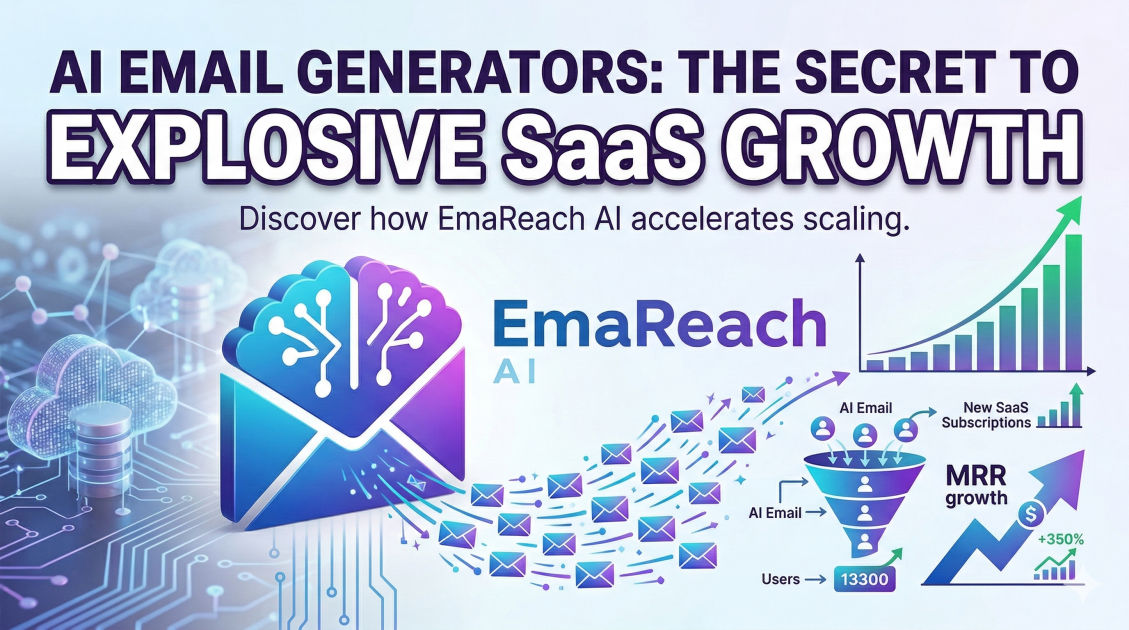
AI Email Generators Designed for Fast SaaS Growth
SaaS GrowthAI Email MarketingCold OutreachSales AutomationEmail DeliverabilityLead Generation
Introduction
In the hyper-competitive landscape of Software as a Service (SaaS), speed is the ultimate currency. Companies that can iterate quickly, acquire customers efficiently, and scale their communication without a linear increase in headcount are the ones that dominate their respective niches. At the heart of this scaling engine lies communication—specifically, email. Whether it is cold outreach to potential leads, onboarding new sign-ups, or retaining existing users through lifecycle marketing, email remains the most effective channel for driving revenue.
However, the traditional way of managing email is fundamentally unscalable for a fast-growing startup. Writing manual, personalized emails is a bottleneck. This is where AI email generators have stepped in, transforming from simple template-fillers into sophisticated engines capable of mimicking brand voice, understanding user intent, and driving massive SaaS growth. In this guide, we explore how AI-driven email generation is redefining the SaaS growth playbook.
The Role of AI in the SaaS Growth Stack
SaaS growth is typically divided into three core pillars: Acquisition, Activation, and Retention. AI email generators provide a competitive advantage across all three.
Scaling Acquisition with Precision
For most SaaS companies, outbound sales is a primary driver of initial growth. The challenge has always been the trade-off between volume and personalization. If you send 1,000 generic emails, your response rate is abysmal. If you spend 20 minutes researching each lead to write a bespoke email, you can only reach 20 people a day.
AI email generators bridge this gap by using Large Language Models (LLMs) to scan LinkedIn profiles, recent company news, and website data to craft highly personalized opening lines and value propositions. This level of automation allows a lean sales team to maintain the quality of a boutique agency while operating at the scale of an enterprise corporation.
Streamlining Activation
Once a user signs up for a trial, the clock starts ticking. The "time to value" (TTV) is the most critical metric in SaaS. If a user doesn't experience the 'Aha!' moment quickly, they churn. AI email generators can create dynamic onboarding sequences that react to user behavior. If a user hasn't completed a specific step in the software, the AI can generate a nudge email that references that specific missing action and offers a tailored solution, rather than sending a generic 'Hey, come back!' message.
Boosting Retention and Expansion
Retention is where the real profit in SaaS lives. AI tools can analyze usage patterns and automatically generate check-in emails or suggest upgrades when a user hits certain usage thresholds. By automating this lifecycle communication, SaaS founders ensure that no customer feels neglected, even as the user base grows into the thousands or millions.
How AI Email Generators Work
To understand why these tools are so effective for SaaS growth, it is important to understand the technology under the hood. Modern AI email generators are more than just 'mad-libs' for text. They utilize natural language processing (NLP) and machine learning to understand context.
Contextual Awareness
Unlike old-school automation, AI generators can ingest data from multiple sources. For example, an AI tool can look at a prospect's recent tweet about a specific industry pain point and weave that into the subject line and intro. This creates a level of relevance that was previously impossible to automate.
Brand Voice Consistency
One of the biggest fears for a SaaS founder is that automated emails will sound robotic or off-brand. Advanced AI generators allow companies to upload their brand guidelines, previous high-performing emails, and tone-of-the-voice documents. The AI then uses this as a 'fine-tuning' set to ensure every generated email sounds like it came from the founder or a seasoned account executive.
Overcoming the Deliverability Challenge
High-volume outreach is useless if the emails never reach the recipient. As AI makes it easier to send more emails, email service providers (ESPs) have become more aggressive with spam filters. Fast-growing SaaS companies need more than just good copy; they need a technical setup that ensures delivery.
This is where specialized tools like EmaReach come into play. Stop Landing in Spam. Cold Emails That Reach the Inbox. EmaReach AI combines AI-written cold outreach with inbox warm-up and multi-account sending—so your emails land in the primary tab and get replies. For a SaaS company looking for fast growth, having the best AI-generated copy is only half the battle; the other half is ensuring that the infrastructure supports those sending volumes without damaging domain reputation.
Key Features of High-Growth AI Email Tools
When selecting an AI email generator to fuel SaaS expansion, certain features are non-negotiable:
1. Dynamic Variables and Liquid Syntax
While the AI generates the meat of the message, the ability to inject dynamic variables (like {first_name} or {company_name}) is essential. More advanced tools allow for 'if-then-else' logic within the AI generation process, creating hyper-segmented paths for different user personas.
2. A/B Testing at Scale
Growth is a game of marginal gains. AI email generators can create five different versions of a subject line or call-to-action (CTA) in seconds. By running these through automated A/B testing, a SaaS company can quickly identify which AI-generated hooks result in the highest open and click-through rates.
3. Multi-Language Capabilities
As SaaS companies go global, language barriers can slow down growth. AI generators can translate and localize email content while maintaining the original persuasive intent and cultural nuances. This allows a US-based SaaS to launch in Europe or Asia with localized outreach on day one.
Strategies for Implementing AI Email Generation
To see rapid growth, a SaaS company cannot simply 'set and forget' an AI tool. It requires a strategic approach to implementation.
The 'Human-in-the-Loop' Model
In the early stages of scaling, it is often best to use AI to generate the first draft, which is then reviewed by a human. This ensures that the AI is learning the correct patterns and that no hallucinations (incorrect information generated by the AI) make it to the prospect. As confidence in the model grows, the human intervention can be reduced to periodic audits.
Segment-Specific Prompting
Instead of using one generic prompt for all AI generation, high-growth companies create specific prompts for different personas. A prompt for a CTO will focus on technical specs and integration ease, while a prompt for a CFO will focus on ROI and cost-savings. AI email generators excel when they are given a specific 'identity' to inhabit.
Sentiment Analysis for Auto-Replies
Growth isn't just about sending emails; it’s about managing the responses. AI tools can now categorize incoming replies based on sentiment. If an AI detects a 'not interested' sentiment, it can automatically remove the lead from the sequence. If it detects a 'tell me more' sentiment, it can immediately generate a relevant follow-up with a booking link, ensuring that leads are followed up with while they are still 'hot'.
The Psychology of AI-Generated Outreach
Why does AI-generated content often perform better than manual outreach in a SaaS context? It comes down to data-driven empathy. Humans are prone to bias and fatigue. After writing 50 emails, a salesperson’s creativity dips. An AI, however, applies the same rigorous standards of personalization to the 1,000th email as it did to the first.
Furthermore, AI can analyze what worked in the past across millions of data points. It knows that certain words trigger curiosity, while others trigger skepticism. By leveraging these psychological triggers, AI email generators create a sense of 'one-to-one' communication that resonates deeply with busy B2B decision-makers.
Best Practices for SaaS Founders and Marketers
To maximize the ROI of AI email generators, consider the following best practices:
- Start with Clean Data: AI is only as good as the data it is fed. Ensure your CRM or lead lists are cleaned and enriched before the AI starts generating content.
- Focus on the CTA: AI can write great bodies, but you need to guide it on the 'ask'. Keep calls to action low-friction, such as asking for a 'quick thought' rather than a '30-minute demo'.
- Monitor Your Reputational Metrics: Keep a close eye on bounce rates and spam reports. Even the best AI content won't save a blacklisted domain.
- Iterate on Prompts Weekly: The AI landscape moves fast. Regularly update your prompts to reflect new product features, changing market conditions, or new competitor weaknesses.
The Future of AI and SaaS Email Communication
We are moving toward a future where 'static' email sequences are obsolete. Instead, we will see 'autonomous agents' that manage the entire customer lifecycle. These agents will not just generate emails; they will decide when to send them based on real-time data, which channel to use (email, LinkedIn, or SMS), and how to pivot the strategy if a lead isn't engaging.
For SaaS companies, this means the 'growth' team of the future might be significantly smaller but vastly more powerful, acting as 'orchestrators' of AI agents rather than manual executors of tasks. This shift will lower the barrier to entry for new SaaS startups, making the quality of the product and the strategic vision of the founders more important than the size of their sales floor.
Conclusion
AI email generators are no longer a luxury for SaaS companies; they are a fundamental component of a modern growth stack. By enabling hyper-personalization at scale, streamlining user activation, and maintaining high-touch retention, these tools allow SaaS businesses to grow at speeds that were previously unimaginable.
However, technology is only one piece of the puzzle. Success requires a combination of high-quality AI generation and robust technical delivery. By utilizing advanced tools and focusing on a strategic, data-driven approach, SaaS founders can ensure their message doesn't just get sent—it gets read, and more importantly, it gets a response. The era of manual outreach is ending; the era of AI-powered growth is here.
EmaReach AI
Ready to scale your cold email outreach?
Join thousands of teams using EmaReach AI for AI-powered campaigns, domain warmup, and 95%+ deliverability. Start free — no credit card required.
Related posts
- Read article
The Instantly Alternative That Finally Gets Outbound Analytics Right
Discover why high-volume cold email requires a shift from surface-level vanity metrics to deep, data-driven revenue attribution, and explore the ultimate alternatives for mastering outbound engineering.
- Read article
What You Gain and What You Give Up When Switching From Instantly
Thinking about migrating your cold email stack? This detailed guide breaks down the exact operational advantages you gain and the core features you sacrifice when switching away from Instantly's popular outreach platform.