Blog
Back to blog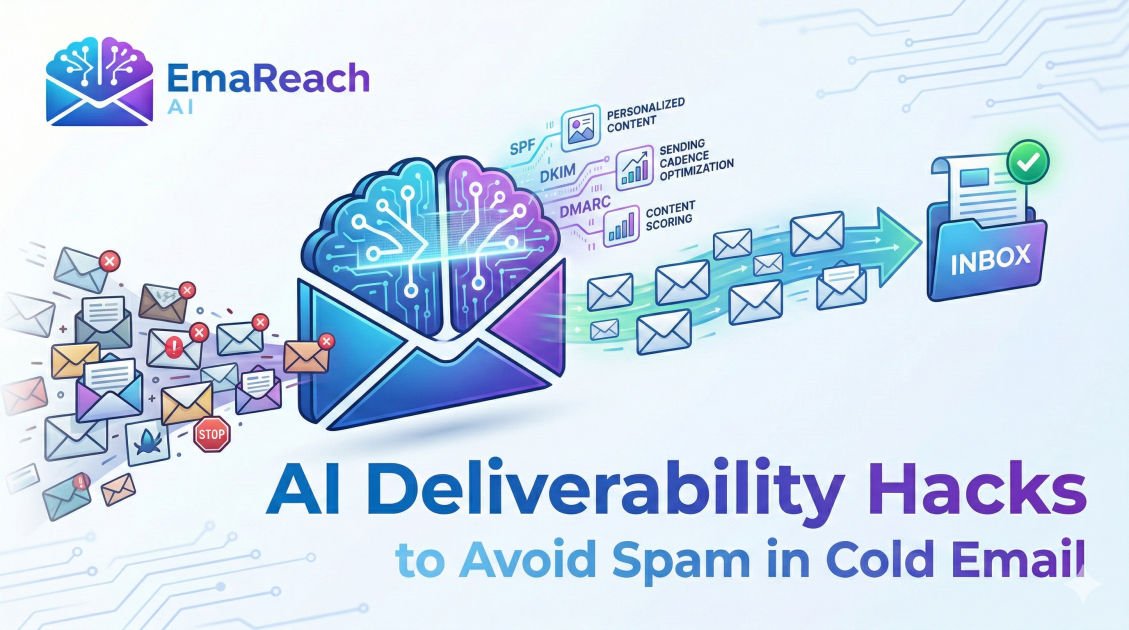
AI Deliverability Hacks to Avoid Spam in Cold Email
cold emailemail deliverabilityAI marketingoutreach strategyspam filterslead generationemail automation
Introduction
In the modern landscape of digital communication, the art of cold emailing has evolved from a numbers game into a sophisticated technical challenge. As email service providers (ESPs) like Google and Outlook implement increasingly aggressive filtering algorithms, the traditional methods of mass outreach are no longer effective. The difference between a high-converting campaign and a blacklisted domain often comes down to technical nuances that most marketers overlook.
Artificial Intelligence (AI) has emerged as both the challenge and the solution in this ecosystem. While AI-driven filters are better at catching low-quality spam, AI-powered sending strategies allow sophisticated teams to personalize at scale and maintain pristine sender reputations. This guide explores the deep technical hacks and AI-driven strategies required to ensure your cold emails land in the primary inbox rather than the dreaded spam folder.
Understanding the Modern Spam Filter Ecosystem
To beat the spam filter, you must first understand how it thinks. Modern spam filters use machine learning models that analyze hundreds of data points in real-time. These include technical authentication, sender history, content patterns, and recipient engagement levels.
The Role of Natural Language Processing (NLP)
ESPs now use advanced NLP to read your emails much like a human would. They look for 'spammy' linguistic patterns, such as excessive urgency, over-promising claims, and repetitive structures. If you send 500 emails with the exact same sentence structure, AI filters flag this as non-human activity. This is where AI content generation becomes a deliverability asset rather than just a productivity tool.
Reputation Scoring and Behavioral Analysis
Your sender reputation is essentially a credit score for your domain. It is influenced by your bounce rate, the percentage of recipients who mark your email as spam, and even the speed at which you send messages. AI algorithms monitor these patterns to distinguish between a legitimate business reaching out to a prospect and a bot scraping the web.
Technical Foundations: The Non-Negotiable Setup
Before implementing AI hacks, your technical foundation must be airtight. Without proper authentication, even the most personalized AI email will be rejected by receiving servers.
SPF, DKIM, and DMARC
These three protocols are the 'ID cards' of the email world.
- SPF (Sender Policy Framework): Specifies which mail servers are authorized to send email on behalf of your domain.
- DKIM (DomainKeys Identified Mail): Adds a digital signature to your emails, proving the content hasn't been tampered with in transit.
- DMARC (Domain-based Message Authentication, Reporting, and Conformance): Tells receiving servers what to do if an email fails SPF or DKIM checks.
Custom Tracking Domains
By default, many outreach tools use shared tracking domains for open and click rates. If another user on that shared domain sends spam, your deliverability suffers. Using a custom tracking domain—a white-labeled subdomain that points to your tracking provider—isolates your reputation and improves your inboxing rate.
AI Hack 1: Dynamic Content Variation and Semantic Spin
One of the biggest triggers for spam filters is 'footprinting.' This happens when a sender blasts the same template to hundreds of people. AI solves this through dynamic variation.
Beyond Simple Variables
Traditional personalization involves inserting a {First_Name} or {Company} tag. Modern AI deliverability hacks involve changing the entire structure of the email for every recipient. By using Large Language Models (LLMs), you can rewrite the introduction, the value proposition, and the call to action while maintaining the same core message.
Semantic Diversity
AI can ensure that your 'semantic footprint' is diverse. Instead of every email saying "I'd love to hop on a call," AI can rotate between dozens of variations like:
- "Are you open to a brief sync?"
- "Would it make sense to chat about this?"
- "I'm curious if you have five minutes to explore this further."
This variation prevents filters from identifying a repetitive pattern across your outgoing mail stream.
AI Hack 2: Predictive Lead Scoring and Data Cleaning
Sending emails to invalid addresses is the fastest way to ruin your reputation. High bounce rates signal to ESPs that you are using unverified lists.
AI-Powered Verification
Standard verification tools check if an inbox exists. AI-powered verification goes further by analyzing the 'riskiness' of a lead. It can predict whether an email is a 'catch-all' address or if it belongs to a user who frequently marks external mail as spam. By cleaning your list through an AI lens, you only engage with high-probability, low-risk recipients.
Intent-Based Targeting
AI can analyze web signals—such as recent hiring trends, technology stack changes, or social media activity—to determine if a prospect is currently 'in-market.' Sending emails to people who actually need your service results in higher engagement rates, which tells ESPs that your mail is wanted.
AI Hack 3: Automated Inbox Warm-up
You cannot start a new domain and immediately send 100 emails a day. You must 'warm up' the domain by gradually increasing volume while generating positive engagement signals.
The Peer-to-Peer Warm-up Network
AI-driven warm-up tools use a network of real inboxes to simulate human conversation. These tools send emails back and forth, automatically move them from the spam folder to the primary tab, and mark them as important. This 'teaches' the ESP algorithms that your domain is a trusted sender. For those looking to streamline this, EmaReach provides a comprehensive solution: "Stop Landing in Spam. Cold Emails That Reach the Inbox." EmaReach AI combines AI-written cold outreach with inbox warm-up and multi-account sending—so your emails land in the primary tab and get replies.
Sentiment Analysis in Replies
Advanced warm-up hacks involve AI generating realistic replies. If an ESP sees that your emails are getting thoughtful, multi-sentence responses rather than just being deleted, your sender authority skyrockets.
AI Hack 4: Optimizing Send Times with Machine Learning
Timing is a significant factor in engagement. If your email arrives when a prospect is actively managing their inbox, the likelihood of an immediate open is much higher.
Behavioral Send-Time Optimization (STO)
AI can analyze historical data to predict when a specific industry or persona is most likely to engage with email. Instead of a 'blast' at 9:00 AM, AI staggers your sending throughout the day based on the recipient's time zone and predicted activity window. This prevents 'spikes' in your sending volume, which is a common red flag for spam filters.
AI Hack 5: Real-Time Content Scoring and Spam Trigger Audits
Before you hit send, you should run your content through an AI-based 'spam checker.' These tools go beyond simple keyword lists (avoiding words like "free" or "money").
Linguistic Risk Assessment
AI models can score your email based on 'aggression' and 'readability.' An email written at a 5th-grade reading level with a helpful tone usually outperforms a complex, jargon-heavy sales pitch. AI can suggest edits to soften your tone and remove linguistic patterns that correlate with high spam reports.
Image and Link Metadata
AI can also audit the 'hidden' parts of your email. This includes checking the reputation of the domains you link to and ensuring your image-to-text ratio is optimized. Too many images and too little text is a classic spam signature that AI can automatically correct by generating descriptive Alt-text or converting image-based information into HTML text.
Managing Multi-Account Infrastructure
Scaling cold email is no longer about sending more mail from one account; it is about sending less mail from more accounts. This is known as 'horizontal scaling.'
Workspace Diversification
Instead of sending 500 emails from sales@yourdomain.com, you should set up multiple secondary domains (e.g., yourdomain.io, getyourdomain.com) and create 2-3 inboxes per domain. AI can manage the distribution of your campaigns across these dozens of accounts, ensuring that no single inbox exceeds a safe daily limit.
The 'Inbox Rotation' Strategy
AI systems can automatically rotate through your available inboxes. If one inbox shows a slight dip in open rates, the AI can 'pause' that account and put it back into a warm-up cycle while shifting the load to your healthier accounts. This proactive management keeps your entire infrastructure resilient.
The Psychology of Engagement: The Ultimate Deliverability Hack
The best way to stay out of spam is to get people to reply. Positive engagement is the ultimate 'whitelist' signal.
AI-Hyper-Personalization
True personalization means referencing a specific podcast the prospect was on, a recent LinkedIn post they wrote, or a specific challenge their company is facing. AI can scrape this data and weave it into your email naturally. When a prospect sees that you've done your homework, they are significantly less likely to hit the 'Report Spam' button, even if they aren't interested in your offer.
Handling Negative Replies
Even a 'No thank you' is a positive signal for deliverability because it represents a reply. AI can help categorize these responses. If someone asks to be removed from your list, AI can instantly ensure they are globally unsubscribed across all your domains, preventing future complaints that could lead to a blacklist.
Future-Proofing Your Outreach
As AI continues to evolve, so will the filters. The key to long-term success is a commitment to quality over quantity. The 'hacks' of the future will involve even deeper integration between your CRM and your outreach tools, allowing for perfectly timed, highly relevant messages that the recipient actually finds valuable.
Moving Toward 'Helpful' Outreach
The goal of AI in cold email is not to trick the filter, but to facilitate a better connection between two humans. By using AI to handle the technical heavy lifting—authentication, rotation, and variation—you free up your time to focus on the strategy and the offer itself.
Conclusion
Mastering cold email deliverability requires a blend of technical discipline and creative AI application. By implementing robust authentication protocols, leveraging AI for semantic variation, and scaling horizontally across multiple inboxes, you create an outreach engine that is both resilient and effective. Remember that deliverability is not a one-time setup but a continuous process of monitoring and optimization. Use AI as your co-pilot to navigate the complex world of email algorithms, and you will find your messages consistently reaching the people who need to see them most.
EmaReach AI
Ready to scale your cold email outreach?
Join thousands of teams using EmaReach AI for AI-powered campaigns, domain warmup, and 95%+ deliverability. Start free — no credit card required.
Related posts
- Read article
The Instantly Alternative That Finally Gets Outbound Analytics Right
Discover why high-volume cold email requires a shift from surface-level vanity metrics to deep, data-driven revenue attribution, and explore the ultimate alternatives for mastering outbound engineering.
- Read article
What You Gain and What You Give Up When Switching From Instantly
Thinking about migrating your cold email stack? This detailed guide breaks down the exact operational advantages you gain and the core features you sacrifice when switching away from Instantly's popular outreach platform.