Blog
Back to blog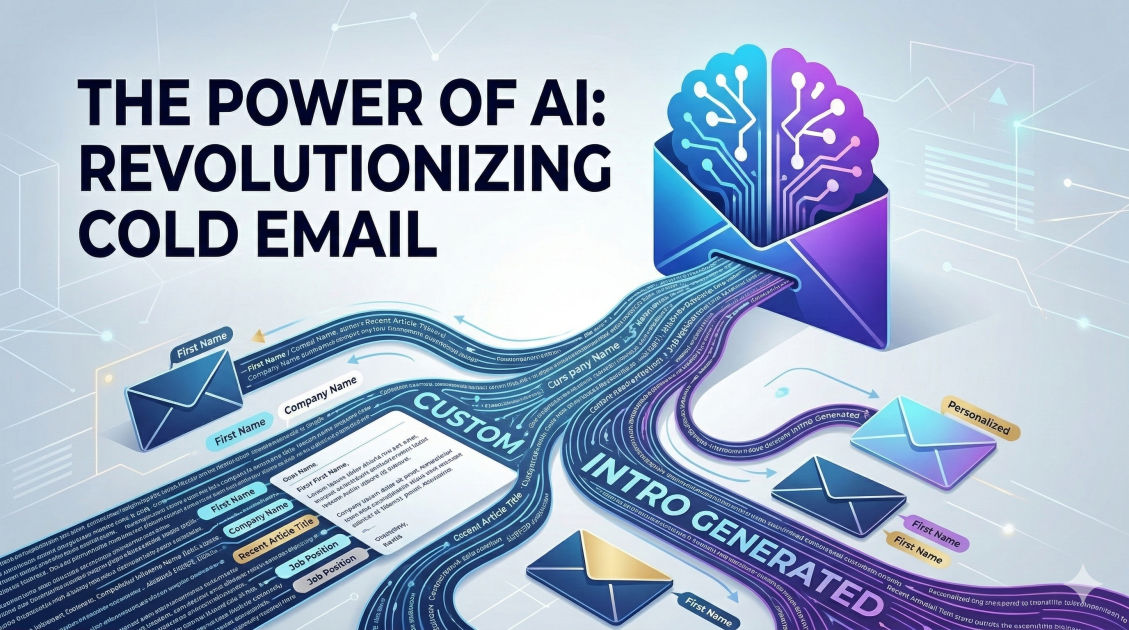
AI Cold Email Tools That Generate Custom Intros
cold emailartificial intelligencesales automationlead generationemail marketingpersonalizationoutreach tools
The Evolution of Personalization in Cold Outreach
Cold email has long been a staple of B2B lead generation, but the landscape has shifted dramatically. Gone are the days when a simple "Hi {{First_Name}}" was enough to capture a prospect's attention. In an era where decision-makers are inundated with hundreds of automated messages daily, the ability to stand out is no longer a luxury—it is a necessity for survival.
Enter the era of artificial intelligence. AI-powered cold email tools have transformed the most time-consuming part of outreach: the custom introduction. By leveraging Large Language Models (LLMs) and deep data scraping, these tools can now analyze a prospect’s LinkedIn profile, recent company news, or even a podcast appearance to craft a unique, human-like opening line in seconds. This article explores the mechanics, benefits, and the top tools currently leading the charge in AI-generated custom intros.
Why Custom Intros Matter More Than Ever
Before diving into the tools, it is crucial to understand the psychology behind a custom introduction. A custom intro serves three primary functions:
- Pattern Interruption: Most automated emails follow a predictable structure. A custom intro that mentions a specific achievement or shared interest breaks the mental pattern of "just another sales bot."
- Proof of Work: It shows the prospect that you have spent time researching them. This builds immediate rapport and professional respect.
- Deliverability Benefits: Modern email service providers (ESPs) look for high engagement and unique content. When every email you send is slightly different, you are less likely to be flagged by spam filters that look for identical mass-blast templates.
For those looking to ensure their highly personalized messages actually reach their destination, platforms like EmaReach provide a critical backbone. EmaReach AI combines AI-written cold outreach with inbox warm-up and multi-account sending—so your emails land in the primary tab and get replies rather than gathering dust in the spam folder.
How AI Generates Personalized Opening Lines
To the uninitiated, it might seem like magic, but the process of AI personalization is rooted in a structured workflow involving several layers of technology.
Data Scraping and Enrichment
The process begins with data. AI tools use APIs to crawl public sources. The most common source is LinkedIn, where the tool pulls information from the 'About' section, recent posts, and experience history. Other tools go further, scanning the prospect’s company website, Twitter feed, or news mentions.
Contextual Analysis
Once the data is gathered, the AI doesn't just copy and paste. It analyzes the context. For example, if a prospect recently posted about a successful product launch, the AI identifies the sentiment and the significance of that event. It looks for "hooks"—bits of information that can be naturally bridged to a professional conversation.
Natural Language Generation
Using models like GPT-4 or proprietary fine-tuned algorithms, the tool then synthesizes the data into a conversational sentence. The goal is to sound like a colleague, not a biographer. Instead of saying, "I saw on LinkedIn you have been at Company X for five years," the AI might suggest: "I caught your recent update about hitting the five-year mark at Company X—the way you've scaled the engineering team there is seriously impressive."
Top AI Tools for Generating Custom Intros
1. Lyne.ai
Lyne.ai is often cited as a pioneer in the space of "no-touch" personalization. It is designed for high-volume senders who need to personalize thousands of emails without manually visiting a single profile.
- Key Feature: Lyne uses what they call "Lynes," which are individual personalized lines. They offer a LinkedIn scraper that finds deep insights, such as mentions in a specific podcast or a blog post the prospect wrote three years ago.
- The Advantage: It integrates seamlessly with most major sending platforms, allowing you to import your CSV and export it with a new column for personalized intros.
2. Clay
Clay is less of a simple tool and more of a powerful data orchestration platform. While it does many things, its ability to generate custom intros at scale is virtually unmatched for power users.
- Key Feature: Clay allows you to build "recipes." You can pull data from dozens of different sources (LinkedIn, Google News, GitHub, etc.) and then use a built-in AI credit system to prompt the AI specifically on how to use that data.
- The Advantage: The flexibility is the selling point here. You can tell the AI, "Find a recent news article about this company and write a witty 10-word observation about it."
3. Lavender
Lavender is an email assistant that lives inside your browser. While it offers many features like email scoring and coaching, its personalization suite is a standout.
- Key Feature: The "Personalization Assistant" shows you news, social media posts, and personality insights about your recipient as you are drafting the email.
- The Advantage: It is perfect for those who prefer a "human-in-the-loop" approach. It suggests several intros, and you can pick the one that fits your voice best.
4. Smartwriter.ai
Smartwriter focuses heavily on the psychology of the sell. It doesn't just look for data; it looks for data that facilitates a conversion.
- Key Feature: Beyond LinkedIn, Smartwriter can scan Google Reviews or even Backlink data to create hyper-specific intros for SEO agencies or local service providers.
- The Advantage: It provides various output styles, from formal to casual, allowing you to match the brand voice of your target audience.
Best Practices for Using AI-Generated Intros
While AI is incredibly powerful, it is not infallible. To get the most out of these tools, you need a strategic approach.
Avoid the "Stalker" Vibe
There is a fine line between personalized and creepy. Mentioning a prospect's recent professional achievement is great; mentioning what they ate for dinner based on an Instagram post is not. Stick to professional data points found on LinkedIn or company websites.
Keep it Short
The intro should be a bridge, not the destination. A custom intro should ideally be one or two sentences long. Its only job is to earn you the right to have the prospect read the next sentence of your email.
Verify Your Data Sources
AI is only as good as the data it receives. If a prospect’s LinkedIn profile is out of date, the AI might congratulate them on a job they left six months ago. High-quality tools often provide a "confidence score" for their intros; pay attention to these.
The Importance of Human Review
Even with the best AI, a quick skim of the generated lines is recommended. You are looking for "hallucinations" or awkward phrasing. Many users find a hybrid approach works best: let the AI generate 100 intros, and spend 15 minutes quickly cleaning up the ones that look a bit off.
Integration and Workflow
To truly see a return on investment, these AI tools must fit into your existing sales tech stack. Most of the tools mentioned above offer native integrations or Zapier connections with CRMs like Salesforce and HubSpot, and sending tools like Instantly or Lemlist.
A typical workflow looks like this:
- Lead Sourcing: Export a list of prospects from LinkedIn Sales Navigator.
- Enrichment: Run that list through a tool like Clay or Lyne.ai to generate the custom intro column.
- Campaign Setup: Upload the enriched list to your sending platform.
- The Delivery Engine: Ensure your technical setup is sound. Using a service like EmaReach ensures that all the hard work put into personalization isn't wasted by a poor sender reputation. By utilizing multi-account sending and automated warm-ups, you provide the best possible environment for your personalized intros to be seen.
The Future of AI in Outreach
We are moving toward a world of "Hyper-Personalization." In the future, AI won't just write the intro; it will adjust the entire tone and structure of the email based on the recipient's personality type (often derived from DISC profiles). Some tools are already beginning to experiment with this, offering "aggressive" versions for competitive personalities and "data-driven" versions for analytical prospects.
However, as these tools become more accessible, the barrier to entry for "good" outreach will rise. When everyone is using AI to write custom intros, the quality of your actual offer and the relevance of your timing will become the new differentiators.
Measuring the Success of Your AI Intros
To know if your investment in these tools is paying off, you must track specific metrics beyond just the open rate.
- Positive Reply Rate: This is the gold standard. Does the custom intro lead to more meetings, or just more people saying "thanks for the nice note, but no thanks"?
- Reply Sentiment: Analyze the content of the replies. If prospects are explicitly mentioning how much they appreciated the personalized opening, you know the AI is hitting the mark.
- Time Saved: Calculate the hours your SDRs or sales team are saving by not doing manual research. If the tool costs $100 a month but saves 20 hours of labor, the ROI is massive.
Conclusion
AI cold email tools that generate custom intros represent a fundamental shift in how B2B sales are conducted. They allow for a level of scale that was previously impossible without sacrificing the human touch that makes cold outreach effective. By choosing the right tool—whether it's the sheer power of Clay, the automation of Lyne.ai, or the coaching of Lavender—you can significantly increase your engagement rates.
Success in modern outreach is a combination of the right message, the right person, and the right delivery. By leveraging AI to craft your message and ensuring your technical foundation is solid through platforms like EmaReach, you position your business to thrive in an increasingly crowded digital inbox. The technology is here to stay; the only question is how effectively you will choose to implement it.
EmaReach AI
Ready to scale your cold email outreach?
Join thousands of teams using EmaReach AI for AI-powered campaigns, domain warmup, and 95%+ deliverability. Start free — no credit card required.
Related posts
- Read article
The Instantly Alternative That Finally Gets Outbound Analytics Right
Discover why high-volume cold email requires a shift from surface-level vanity metrics to deep, data-driven revenue attribution, and explore the ultimate alternatives for mastering outbound engineering.
- Read article
What You Gain and What You Give Up When Switching From Instantly
Thinking about migrating your cold email stack? This detailed guide breaks down the exact operational advantages you gain and the core features you sacrifice when switching away from Instantly's popular outreach platform.