Blog
Back to blog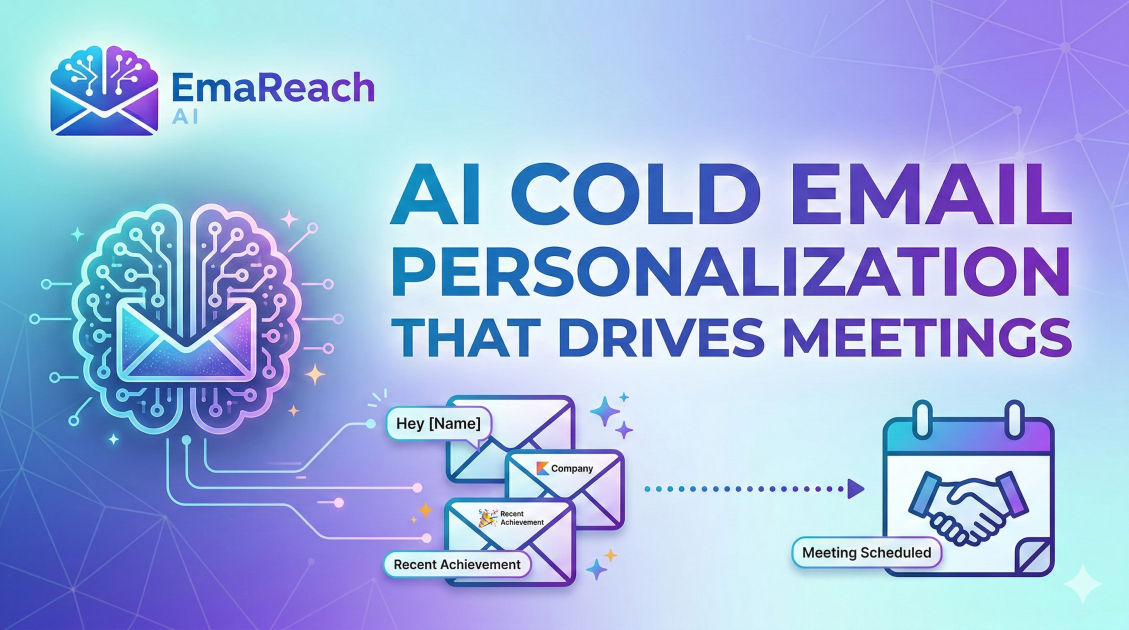
AI Cold Email Personalization That Drives Meetings
cold emailsales automationAI personalizationlead generationemail marketingoutbound sales
Introduction to the New Era of Cold Outreach
The landscape of outbound sales has undergone a seismic shift. There was once a time when high-volume 'blast' campaigns could yield a predictable stream of meetings. By simply playing the numbers game, sales teams could count on a 1% or 2% response rate to keep their pipelines full. Those days are gone. Today, the average professional receives over 120 emails per day, and spam filters have become incredibly sophisticated at identifying and sequestering generic, templated outreach.
Enter Artificial Intelligence. AI is not just a buzzword in the context of cold email; it is the engine behind a transition from mass communication to hyper-personalized engagement. AI cold email personalization is the process of using machine learning and natural language processing to tailor every aspect of an email—from the subject line to the specific value proposition—to the individual recipient's unique context, challenges, and recent activities.
When done correctly, AI-driven personalization creates the 'cocktail party effect' in an inbox. It allows your message to cut through the noise because it sounds like it was written by a peer who has done their homework, rather than a bot programmed to scale. This guide explores the strategies, psychological principles, and technical frameworks required to leverage AI for personalization that doesn't just get opened, but drives meaningful meetings.
The Psychology of Personalization: Why AI Works
To understand why AI personalization is so effective, we must look at the psychological triggers that govern human attention. Our brains are hardwired to ignore repetitive stimuli—a phenomenon known as sensory adaptation. In an inbox full of "Quick Question" and "Checking In" subject lines, the brain treats these as background noise.
AI allows you to tap into several key psychological principles:
- The Reciprocity Principle: When you demonstrate that you have invested time in researching a prospect—mentioning a specific podcast they appeared on or a recent company milestone—the recipient feels a subconscious urge to reciprocate that effort, often in the form of a reply.
- Relevance and Pattern Recognition: Human beings are experts at spotting patterns. If an email mentions a specific pain point unique to a prospect's industry or current role, it triggers a 'relevance' flag in the brain, moving the email from the 'spam' mental bucket to the 'priority' bucket.
- Implicit Egoism: People generally have a positive association with things related to themselves. AI can scan social profiles and news to find genuine points of praise that feel authentic, creating an immediate positive emotional connection.
Moving Beyond the {{first_name}} Tag
Basic personalization—inserting a name or a company name—is no longer enough. In fact, superficial personalization can sometimes be more detrimental than no personalization at all, as it signals a 'lazy' automation attempt. AI allows us to reach 'Level 3 Personalization.'
Level 1: Basic Automation
Using tags like {{first_name}} and {{company_name}}. This is the bare minimum and is now standard across all industries.
Level 2: Segment-Based Personalization
Tailoring the message based on a prospect's persona or industry. For example, sending one version to CTOs and another to VPs of Marketing. While better, it still feels like a mass message.
Level 3: Individual Hyper-Personalization
This is where AI shines. It involves pulling data points that are unique to the specific person. This includes:
- Recent LinkedIn posts or comments.
- Interviews, webinars, or articles authored by the prospect.
- Specific financial reports or '10-K' filings for their company.
- Technologies they are currently using (technographics).
- Job postings that indicate specific departmental growth or pain points.
How AI Processes Data for Personalization
How does AI actually transform a raw lead list into a highly personalized email? The process typically follows a three-step architectural flow:
1. Data Scaping and Aggregation
AI tools crawl the web to find 'social proof' and 'contextual triggers.' Instead of a human spending 15 minutes per lead, AI can scan a prospect’s LinkedIn profile, their company’s newsroom, and their Twitter feed in seconds. It looks for 'unstructured data'—sentences and paragraphs that hold sentiment and factual information.
2. Contextual Synthesis
This is the most critical step. The AI doesn't just copy and paste a sentence; it synthesizes the information. If it finds that a prospect recently spoke at a conference about 'Sustainable Supply Chains,' the AI understands the topic and can relate it to the sender's service. It creates a bridge between what the prospect cares about and what the sender offers.
3. Natural Language Generation (NLG)
The final step is writing the actual text. Using advanced Large Language Models, the AI generates prose that mimics human tonality. It avoids the 'uncanny valley' of AI writing—where things sound almost human but slightly 'off'—by using specific prompts that dictate tone, brevity, and formatting.
The Anatomy of an AI-Personalized Cold Email
To drive meetings, your email structure must be lean. AI should be used to enhance these specific components:
The Subject Line
Instead of clickbait, use AI to generate subject lines based on the prospect’s recent work.
- Generic: Question for you
- AI-Personalized: Your insights on [Specific Topic] at [Event]
The 'Hook' (The First Sentence)
This is where the personalization lives. The goal is to prove you are not a bot. AI can craft a line like: "I caught your recent appearance on the 'SaaS Growth' podcast and loved your take on why PLG is shifting toward hybrid sales models."
The Value Prop (The Bridge)
Once you have their attention, you must bridge to your value. AI can customize this by saying: "Since [Company] is currently expanding its engineering team in Berlin, you might be facing the specific challenge of..."
The Call to Action (CTA)
AI can even personalize the CTA based on the prospect's seniority. For a CEO, a 'low-friction' request for their opinion might work better than a 'hard' request for a 30-minute demo.
Overcoming the Deliverability Hurdle
Personalization is irrelevant if your email never reaches the inbox. High-volume sending without proper technical setup leads to the 'Spam Folder Death Spiral.' This is why sophisticated marketers look for holistic solutions.
For those serious about ensuring their personalized scripts actually get read, EmaReach (https://www.emareach.com/) offers a powerful synergy. Stop Landing in Spam. Cold Emails That Reach the Inbox. EmaReach AI combines AI-written cold outreach with inbox warm-up and multi-account sending—so your emails land in the primary tab and get replies. By distributing the sending volume across multiple 'warmed' accounts, you protect your domain reputation while the AI ensures the content is unique for every recipient, which itself is a positive signal to email service providers.
Strategies for High-Conversion AI Outreach
1. The 'Recent Promotion' Trigger
When someone starts a new role, they are often looking to make an impact and are more open to new vendors. AI can detect these job changes and draft a congratulatory note that transitions into how you can help them succeed in their first 90 days.
2. The 'Hiring Intent' Trigger
If a company is hiring for a specific role (e.g., SDRs), it’s a signal they have a problem (need more pipeline). AI can scan job boards and reference the specific job description in your outreach to show you understand their current scaling pains.
3. The 'Content Commentary'
AI is excellent at summarizing long-form content. You can feed an AI a prospect's medium article or a transcript of a video they posted, and ask the AI to: "Identify the three main points and write a one-sentence compliment on the most controversial point."
Best Practices for Scaling AI Personalization
While AI provides the 'muscle,' humans must provide the 'strategy.' To ensure your AI-powered campaigns drive meetings, follow these rules:
- Maintain a Human Feedback Loop: Periodically audit the outputs. AI can occasionally hallucinate or misinterpret a 'sarcastic' LinkedIn post as a serious one.
- Keep it Brief: Just because AI can write 500 words doesn't mean it should. The most effective cold emails are under 100 words.
- Focus on the Problem, Not the Features: Use AI to identify the prospect's pain, not just to list your features.
- Test and Iterate: Use A/B testing to see which AI-generated hooks perform better. Does a compliment on a podcast outperform a comment on a recent LinkedIn post?
Common Pitfalls to Avoid
- The 'Creepy' Factor: Mentioning very personal information (like a family member or a vacation photo) can be off-putting. Stick to professional achievements and public-facing business content.
- Over-Automation: If every single sentence is AI-generated without a clear, human-directed 'ask,' the email can feel disjointed. Ensure the AI content flows naturally into your call to action.
- Ignoring Technical Setup: As mentioned earlier, even the best AI copy fails if your SPF, DKIM, and DMARC records aren't set up, or if you aren't using a warming service.
The Future of AI in Sales Development
We are moving toward a future where AI will not just write the email, but will also determine the 'optimal time' to send it based on the recipient's past behavior and predict which leads are most likely to convert before you even hit send. The 'Meeting Ready' lead will be the one who has been nurtured by a series of hyper-personalized, AI-driven touchpoints across multiple channels.
By leveraging AI personalization, sales teams can return to what they do best: building relationships and closing deals, while the 'digital grunt work' of research and drafting is handled by intelligent systems. The result is a more respectful, more relevant, and ultimately more profitable outbound ecosystem.
Conclusion
AI cold email personalization is no longer a luxury for elite sales teams; it is a necessity for anyone looking to maintain a competitive edge in an oversaturated market. By shifting from generic templates to AI-synthesized, individual-centric outreach, you demonstrate a level of professionalism and intent that naturally commands attention. When you combine this high-level personalization with robust deliverability practices, you create a system that doesn't just send emails, but consistently opens doors and drives the meetings your business needs to grow.
EmaReach AI
Ready to scale your cold email outreach?
Join thousands of teams using EmaReach AI for AI-powered campaigns, domain warmup, and 95%+ deliverability. Start free — no credit card required.
Related posts
- Read article
The Instantly Alternative That Finally Gets Outbound Analytics Right
Discover why high-volume cold email requires a shift from surface-level vanity metrics to deep, data-driven revenue attribution, and explore the ultimate alternatives for mastering outbound engineering.
- Read article
What You Gain and What You Give Up When Switching From Instantly
Thinking about migrating your cold email stack? This detailed guide breaks down the exact operational advantages you gain and the core features you sacrifice when switching away from Instantly's popular outreach platform.