Blog
Back to blog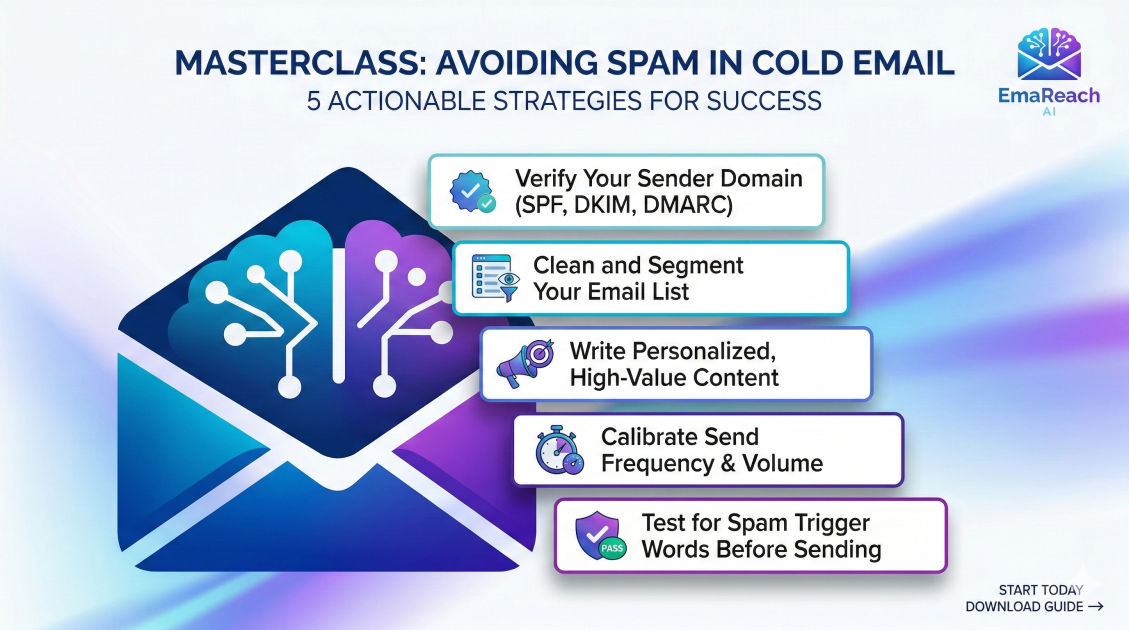
Actionable Advice to Start Avoiding Spam in Cold Email
cold emailemail deliverabilityoutreach strategyspam preventioninbox placementlead generation
Introduction
Cold email remains one of the most powerful channels for business growth, yet many practitioners find themselves shouting into a void. The primary culprit? The spam folder. Modern email service providers (ESPs) use sophisticated algorithms to protect users, and if your outreach strategy doesn't evolve alongside these filters, your carefully crafted messages will never be seen by your prospects.
Avoiding the spam folder isn't just about avoiding 'spammy' words; it's a multi-layered technical and creative discipline. To ensure your cold emails reach the primary inbox, you must master technical setup, reputation management, and high-quality content personalization. This guide provides a comprehensive roadmap for transforming your outreach from ignored noise into high-impact communication.
The Technical Foundation: DNS and Authentication
Before you ever hit 'send' on a single email, your technical infrastructure must be airtight. Think of this as your digital passport; without the right stamps, you won't be allowed past the border.
SPF (Sender Policy Framework)
SPF is a DNS record that specifies which mail servers are authorized to send emails on behalf of your domain. Without a valid SPF record, receiving servers have no way of knowing if the email is legitimate or a spoofing attempt. If you use multiple tools for sending, ensure all of them are included in your SPF record to avoid 'soft fail' notifications that damage your reputation.
DKIM (DomainKeys Identified Mail)
DKIM adds a cryptographic signature to your emails. This acts as a seal of authenticity, proving that the email was indeed sent by the domain owner and hasn't been tampered with during transit. It provides a level of security that modern ESPs like Google and Microsoft require for high-volume senders.
DMARC (Domain-based Message Authentication, Reporting, and Conformance)
DMARC is the policy layer that tells receiving servers what to do if an email fails SPF or DKIM checks. Setting your DMARC policy to 'p=quarantine' or 'p=reject' signals to the world that you take your domain security seriously. This is no longer optional for serious outreach; it is a fundamental requirement for inbox placement.
Domain Strategy: Why You Should Never Use Your Primary Domain
One of the most common mistakes in cold email is sending thousands of messages from your primary business domain (e.g., yourcompany.com). If your outreach efforts result in a sudden spike in spam reports, your entire company’s internal and external communication could be crippled.
Setting Up Secondary Domains
To protect your brand, purchase 'lookalike' domains specifically for outreach. If your main domain is acme.com, you might buy getacme.com or acmehq.com. This creates a firewall. If a secondary domain gets flagged, you can pause its use without affecting your team's ability to communicate with existing clients or partners.
The Importance of Redirects
Always ensure that your secondary domains redirect to your primary website. When a prospect receives an email from an unfamiliar domain, their first instinct is often to type that domain into their browser. If it leads to a dead page, it looks suspicious. A seamless redirect builds trust and provides context for who you are.
The Art of the Inbox Warm-up
New domains are naturally viewed with suspicion by ESPs. If you send 500 emails on day one from a brand-new domain, you will almost certainly be blocked. You must 'warm up' your domain to build a positive sending history.
Manual vs. Automated Warm-up
In the past, marketers did this manually by emailing friends and colleagues. Today, sophisticated tools automate this process by sending emails between a network of real accounts and automatically moving them out of the spam folder if they land there. This signals to ESPs that your content is valuable and desired.
Maintaining a Natural Sending Pattern
Even after the initial warm-up period, your sending volume should look human. Avoid massive bursts of activity followed by silence. Consistency is key. Spread your sending throughout the day rather than blasting everything at 9:00 AM. Services like EmaReach help here by combining AI-written outreach with inbox warm-up and multi-account sending—so your emails land in the primary tab and get replies.
List Hygiene: The Silent Killer of Deliverability
Your deliverability is only as good as your data. High bounce rates are a major red flag for spam filters. If you are sending emails to addresses that don't exist, ESPs assume you are using a low-quality, scraped list and will penalize you accordingly.
Verifying Every Lead
Never send to a list without running it through a verification service first. These tools check if the mailbox actually exists without sending a physical email. Aim for a bounce rate of less than 2%. Anything higher puts your domain reputation at significant risk.
Handling Catch-all Addresses
Some domains use 'catch-all' settings, meaning they accept all mail sent to the domain even if the specific address doesn't exist. These are notoriously difficult to verify and carry a higher risk. Be cautious with these leads, perhaps segmenting them into a separate, lower-volume campaign.
Crafting Content That Bypasses Filters
Spam filters have evolved beyond simple keyword matching, but certain triggers still exist. More importantly, the way users interact with your email (opening, clicking, replying, or marking as spam) heavily influences your future deliverability.
Avoiding Spam Trigger Words
While words like 'Free,' 'Winner,' and 'Guaranteed' aren't an automatic ticket to spam, using them in excess—especially in the subject line—raises the risk score. Focus on professional, benefit-driven language rather than sensationalist marketing speak.
The Power of Personalization
If you send the exact same template to 1,000 people, filters will catch the pattern. Use 'merge tags' or 'variables' to customize each message. High-level personalization includes more than just the prospect's name; it should reference their specific industry, a recent company achievement, or a pain point relevant to their role.
Optimizing Formatting
- Keep it simple: Avoid excessive HTML, multiple fonts, or bright colors. Text-based emails look more like a personal message from a colleague.
- Limit Links: Including too many links (or links to suspicious domains) can trigger filters. Try to stick to one clear call to action (CTA).
- Avoid Attachments: Sending attachments to people who haven't interacted with you before is a high-risk move. Use links to hosted files if absolutely necessary, but ideally, wait for a reply before sending documents.
Strategic Sending Limits and Multi-Account Tactics
Scale is the enemy of deliverability. The more emails you send from a single account, the higher the likelihood of hitting a limit or being flagged by an algorithm.
The 'Low and Slow' Approach
Instead of sending 200 emails from one account, it is much safer to send 40 emails each from five different accounts across different domains. This distribution of volume mimics natural human behavior and prevents any single point of failure from ruining your entire campaign.
Monitoring Reputation Scores
Regularly check your domain and IP reputation using tools provided by major ESPs. If you notice a dip, it’s time to stop sending, increase warm-up activity, and audit your content and list quality.
Engagement: The Ultimate Metric
Ultimately, ESPs want to see that people want to hear from you. The 'Reply Rate' is the most powerful signal for deliverability. When a prospect replies to your cold email, it tells the filter that you are a trusted sender.
Writing for the Reply
Your goal shouldn't be a sale in the first email; it should be a conversation. Ask a low-friction question or offer a specific piece of value that invites a response. The more replies you get, the 'greener' your domain becomes in the eyes of the algorithms.
Managing Unsubscribes Gratefully
Make it easy for people to opt-out. While it might seem counterintuitive, an unsubscribe is far better than a spam report. You can include a clear unsubscribe link or, for a more personal touch, a simple 'PS: If you're not the right person for this, just let me know and I'll remove you from my list.'
Analyzing and Iterating
Deliverability is not a 'set it and forget it' task. It requires constant monitoring.
- Track Open Rates: If your open rates suddenly drop from 40% to 5% across a specific domain, you have likely hit a spam filter.
- Monitor Reply Rates: A declining reply rate might indicate that your messaging is getting stale or that you are reaching the wrong audience.
- A/B Testing: Constantly test subject lines and opening sentences to see what resonates. However, ensure your variations are significant enough to avoid pattern-matching filters.
Conclusion
Avoiding the spam folder in cold email is a marathon, not a sprint. It requires a disciplined approach to technical setup, a commitment to high-quality data, and an obsession with providing value through personalized content. By setting up authenticated secondary domains, warming them up properly, and distributing your volume across multiple accounts, you build a resilient outreach engine.
Remember that the goal of cold email is to start a meaningful business relationship. When you treat your prospects' inboxes with respect—by sending relevant, well-timed, and technically sound messages—you won't just avoid the spam folder; you will generate the results that drive your business forward. Stay vigilant, keep testing, and always prioritize the integrity of your sending reputation above short-term volume.
EmaReach AI
Ready to scale your cold email outreach?
Join thousands of teams using EmaReach AI for AI-powered campaigns, domain warmup, and 95%+ deliverability. Start free — no credit card required.
Related posts
- Read article
The Instantly Alternative That Finally Gets Outbound Analytics Right
Discover why high-volume cold email requires a shift from surface-level vanity metrics to deep, data-driven revenue attribution, and explore the ultimate alternatives for mastering outbound engineering.
- Read article
What You Gain and What You Give Up When Switching From Instantly
Thinking about migrating your cold email stack? This detailed guide breaks down the exact operational advantages you gain and the core features you sacrifice when switching away from Instantly's popular outreach platform.