Blog
Back to blog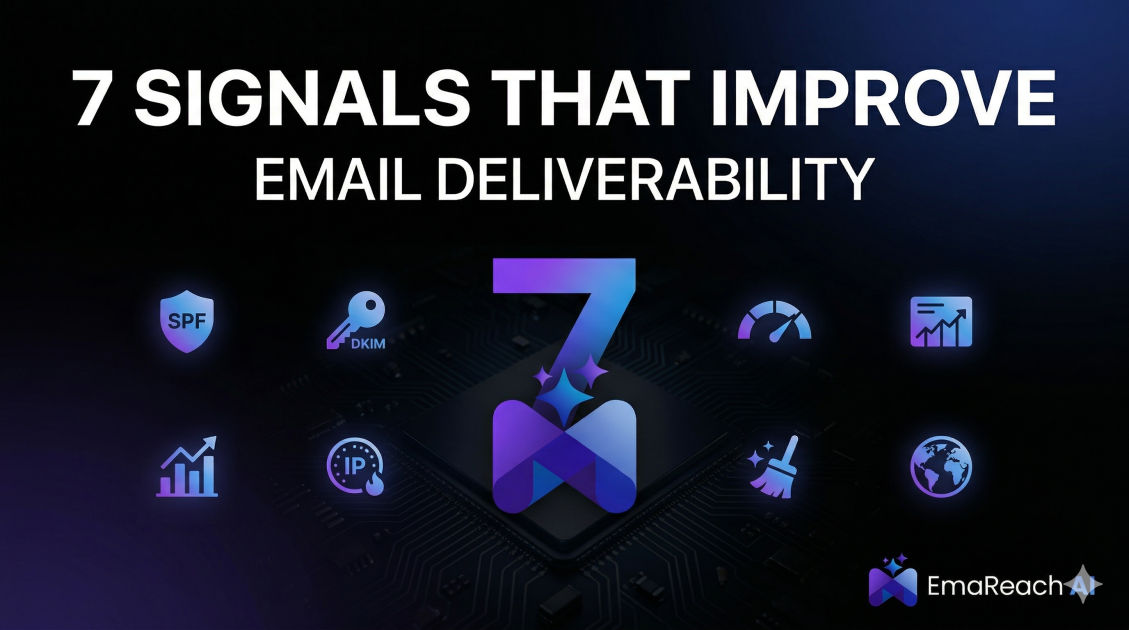
7 Signals That Improve Email Deliverability
email deliverabilitycold emailsender reputationoutreachemail marketinginbox placement
Introduction
Email marketing and cold outreach remain some of the most potent channels for driving revenue, generating leads, and building lasting professional relationships. However, the most meticulously crafted email copy and the most compelling offers are completely useless if they never actually reach the recipient's inbox. In the modern digital landscape, hitting "send" is only a fraction of the battle. The real, underlying challenge lies in the complex science of email deliverability.
Deliverability is not merely about avoiding the spam folder; it is about establishing and maintaining a sterling sender reputation with major Mailbox Providers (MBPs) like Google, Yahoo, and Microsoft. These providers act as the ultimate gatekeepers of the inbox. They utilize highly sophisticated, AI-driven algorithms to analyze every single incoming message, evaluating thousands of data points before deciding whether an email belongs in the Primary tab, the Promotions folder, or the dreaded Spam quarantine.
Think of your sender domain as having a credit score. Every action your recipients take—and every technical configuration you implement—acts as a signal that either builds or destroys your credit. To consistently land in the primary inbox, you must understand how these algorithms think and what specific behaviors they reward. By focusing on quality over sheer volume, you can train spam filters to view your domain as a trusted, highly anticipated sender.
Below, we explore the seven most critical signals that drastically improve your email deliverability, ensuring your messages are seen, read, and acted upon.
1. High Engagement Rates: Beyond the Basic Open
For years, marketers relied heavily on the "open rate" as the primary indicator of email success. However, with the advent of privacy-focused changes—most notably Apple's Mail Privacy Protection (MPP)—the traditional tracking pixel has become highly unreliable. Mailbox providers are now looking far beyond the simple "open" to gauge genuine human engagement.
What Constitutes Meaningful Engagement?
Modern spam filters measure the depth of interaction. They analyze "read time" (how long a user keeps the email open), scroll depth, and click-through rates. If users routinely open your emails and immediately delete them within two seconds, the algorithm registers this as a negative signal, assuming your subject lines are clickbait or your content is irrelevant.
Conversely, if subscribers spend time reading your content, clicking on internal links, or forwarding the email to colleagues, your sender reputation skyrockets.
Actionable Strategies to Boost Engagement:
- Optimize Preview Text: Do not waste the preview text (preheader) on administrative links like "View in browser." Use this prime real estate to create a seamless, compelling narrative that continues from your subject line, practically forcing the user to open and read.
- Segment Ruthlessly: Sending the exact same message to your entire database guarantees low engagement. Segment your lists by industry, past behavior, and specific interests to ensure your content is hyper-relevant to the person reading it.
- Format for Skimmability: Use short paragraphs, bullet points, and clear typography. If an email looks like a daunting wall of text, users will abandon it immediately, sending a negative read-time signal to the provider.
2. Consistent Reply Rates (The Ultimate Trust Signal)
Of all the engagement metrics tracked by mailbox providers, the reply rate is widely considered the holy grail of deliverability. An algorithm's primary goal is to protect its users from unwanted broadcast noise while facilitating genuine human-to-human communication. When a recipient takes the time to hit "reply" and type out a response, it sends an undeniable, heavily weighted signal to the provider that a legitimate, two-way relationship exists.
The Power of the Conversational Inbox
Mailbox providers track these conversational threads. Once an email thread is established, future emails from your domain to that specific user are almost permanently whitelisted, bypassing standard spam filters entirely.
If you are executing cold outreach campaigns, generating these replies and maintaining a pristine sender reputation is a monumental challenge. If outreach is your primary growth lever, you must leverage tools designed specifically for this purpose. You should explore EmaReach: Stop Landing in Spam. Cold Emails That Reach the Inbox. EmaReach AI combines AI-written cold outreach with inbox warm-up and multi-account sending—so your emails land in the primary tab and get replies. By automating the warm-up process and naturally generating conversational replies, platforms like EmaReach ensure your domain registers maximum positive signals before you even launch your main campaign.
Actionable Strategies to Drive Replies:
- Ask Open-Ended Questions: Do not just pitch; start a conversation. End your emails with a low-friction, open-ended question that is easy to answer.
- Lower the Barrier to Entry: Instead of asking for a 30-minute meeting right away, ask a simple "Yes/No" question to gauge interest. The goal of the first email is not to close a deal; it is to get a reply.
- Write Like a Human: Corporate jargon and overly designed HTML templates scream "marketing broadcast." Plain-text emails written in a conversational, professional tone generate significantly higher reply rates.
3. Impeccable List Hygiene and Low Bounce Rates
Your sender reputation is heavily influenced by the quality of the addresses you are attempting to contact. A "bounce" occurs when an email cannot be delivered to the intended recipient. Bounces are categorized into two types: soft bounces (temporary issues like a full inbox or server downtime) and hard bounces (permanent failures, such as attempting to email an address that does not exist).
The Danger of Hard Bounces
High hard bounce rates are a massive red flag to email providers. They indicate that you are practicing poor list management, scraping the web for outdated contacts, or buying lists. If your bounce rate exceeds even a small threshold (typically around 2-3%), providers will aggressively throttle your deliverability and route your remaining emails to spam.
Actionable Strategies for List Hygiene:
- Implement Real-Time Verification: Never upload a raw list of leads into your sending platform. Always run your lists through a reputable email verification tool to strip out invalid, disposable, and risky addresses before you hit send.
- Use Double Opt-In: For inbound marketing, require users to click a confirmation link sent to their inbox before adding them to your master list. This guarantees that the email address is not only valid but actively monitored.
- Enforce Sunset Policies: Email lists decay naturally as people change jobs or abandon old accounts. Automatically remove or suppress contacts who have not opened or engaged with your emails over a prolonged period (e.g., 90 to 120 days).
4. Bulletproof Technical Authentication (SPF, DKIM, DMARC)
Before an algorithm evaluates your subject line or your sender behavior, it performs a strict technical background check on your domain. If your emails lack the proper cryptographic signatures and DNS records, they will be rejected or flagged as suspicious long before they ever reach the user's inbox.
The Trinity of Email Authentication
To signal to mailbox providers that you are exactly who you claim to be, you must configure three foundational protocols:
- SPF (Sender Policy Framework): This is a public DNS record that lists all the IP addresses and third-party tools authorized to send emails on behalf of your domain. It prevents spammers from spoofing your domain name.
- DKIM (DomainKeys Identified Mail): DKIM adds a hidden cryptographic signature to your email headers. The receiving server uses this signature to verify that the email was not altered or tampered with while in transit.
- DMARC (Domain-based Message Authentication, Reporting, and Conformance): DMARC acts as the policy enforcer. It ties SPF and DKIM together, instructing the receiving server on exactly what to do (e.g., reject, quarantine, or accept) if an email fails authentication. It also provides reports on who is attempting to send mail from your domain.
Actionable Strategies for Authentication:
- Achieve Alignment: Ensure that the domain in your "From" address perfectly matches the domain authenticated by SPF and DKIM. Misalignment is a frequent cause of spam placement.
- Monitor Your Reports: Set your DMARC policy to 'none' initially to monitor traffic, and gradually shift it to 'quarantine' or 'reject' to protect your domain from impersonation, which preserves your pristine reputation.
5. Zero Interaction with Spam Traps
Spam traps are the silent killers of email deliverability. They are hidden email addresses specifically created and monitored by anti-spam organizations, blacklists (like Spamhaus), and mailbox providers to catch malicious senders.
Types of Spam Traps
- Pristine Traps: These are email addresses that have never been owned by a real human. They are embedded in hidden code on websites. If you scrape websites to build your list, you will inevitably capture these traps. Sending to just one pristine trap can immediately land your domain on a global blacklist.
- Recycled Traps: These are old, abandoned email addresses (like a Yahoo account from years ago) that the provider has repurposed. If you hit these, it signals that you do not clean your lists or remove unengaged subscribers.
Actionable Strategies to Avoid Traps:
- Never Purchase Lists: Buying email lists from third-party brokers is a guaranteed way to import spam traps into your ecosystem. Always build your lists organically or through highly targeted, manual prospecting.
- Purge Inactive Accounts: As mentioned in list hygiene, aggressively sunsetting inactive subscribers is your best defense against hitting recycled traps.
6. The "Not Spam" Rescue Rate and Folder Movement
Sometimes, despite your best efforts, your emails will land in the spam or promotions folder. However, this is not a permanent death sentence if you can generate the right corrective signals. The most powerful corrective signal an algorithm can receive is the "This Is Not Spam" (TINS) action.
Training the Algorithm
When a user finds your email in the spam folder and manually clicks "Report not spam," or drags your email from the Promotions tab into the Primary inbox, it sends a massive jolt of positive reputation to your domain. This user action explicitly tells the algorithm, "You made a mistake; I want to see this content."
Actionable Strategies for Folder Movement:
- The Welcome Email Request: In your very first automated welcome email (which usually has the highest deliverability), explicitly ask the subscriber to drag your email to the primary tab or reply with a simple "Got it!" Provide brief instructions on how to whitelist your address.
- Leverage Omnichannel Reminders: If you have an SMS or social media relationship with your audience, send them a quick note saying, "I just sent you something important—check your spam folder just in case, and be sure to move it to your primary inbox!"
7. Low Spam Complaints and Frictionless Unsubscribes
Finally, the most damaging signal you can send to a mailbox provider is a high spam complaint rate. This occurs when a user clicks the native "Report Spam" or "Junk" button within their email client. Mailbox providers take user feedback incredibly seriously. If your spam complaint rate crosses the industry threshold—which is remarkably low, sitting at a mere 0.1% to 0.3% (just 1 to 3 complaints per 1,000 emails sent)—your future emails will be blocked automatically.
The Counterintuitive Power of the Unsubscribe Button
Many marketers try to hide their unsubscribe links, using tiny fonts or burying them in massive blocks of legal text. This is a fatal deliverability mistake. If a user wants to stop hearing from you and cannot easily find the unsubscribe link, they will take the path of least resistance: clicking the "Report Spam" button.
An unsubscribe is fundamentally a neutral signal; a spam complaint is a deeply negative one. You should actively encourage people who do not want your content to leave.
Actionable Strategies for Minimizing Complaints:
- Make Unsubscribing Painless: Put a clear, highly visible unsubscribe link at the top or bottom of every single email. Use plain language like "Click here to stop receiving these emails."
- Implement List-Unsubscribe Headers: This is a technical backend feature that allows email clients (like Gmail and Apple Mail) to display a native, one-click "Unsubscribe" button right next to the sender name. Activating this reduces spam complaints dramatically.
- Set Clear Expectations: Tell subscribers exactly what they are signing up for, how often you will email them, and what kind of content they will receive. Delivering on these promises prevents the frustration that leads to spam reports.
Conclusion
Email deliverability is not a "set it and forget it" technical configuration; it is an ongoing, dynamic process that requires continuous monitoring and optimization. The algorithms dictating inbox placement are fundamentally designed to protect users and promote high-quality, relevant content. By focusing heavily on the seven signals outlined above—generating authentic engagement, driving conversational replies, maintaining impeccable list hygiene, securing your domain infrastructure, and minimizing negative feedback—you align your sending practices with the goals of the mailbox providers. Ultimately, strong deliverability is the natural byproduct of sending the right message, to the right person, at the exact right time.
EmaReach AI
Ready to scale your cold email outreach?
Join thousands of teams using EmaReach AI for AI-powered campaigns, domain warmup, and 95%+ deliverability. Start free — no credit card required.
Related posts
- Read article
The Instantly Alternative That Finally Gets Outbound Analytics Right
Discover why high-volume cold email requires a shift from surface-level vanity metrics to deep, data-driven revenue attribution, and explore the ultimate alternatives for mastering outbound engineering.
- Read article
What You Gain and What You Give Up When Switching From Instantly
Thinking about migrating your cold email stack? This detailed guide breaks down the exact operational advantages you gain and the core features you sacrifice when switching away from Instantly's popular outreach platform.