Blog
Back to blog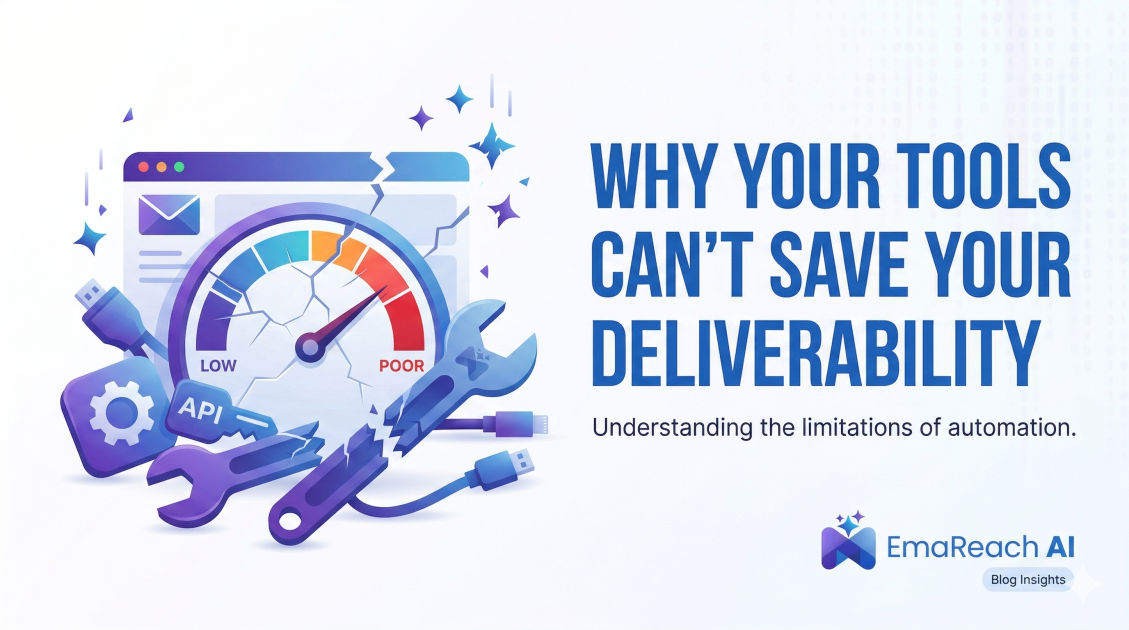
Why Your Tools Can’t Save Your Deliverability
cold emailoutreachdeliverabilityemail marketingdomain reputationsales automation
Introduction
The modern sales and marketing landscape is obsessed with automation. We want tools to scrape leads, tools to write copy, tools to sequence follow-ups, and tools to magically place our messages at the top of our prospects' inboxes. The prevailing myth in the cold outreach world is that if you simply purchase the most expensive, feature-rich email sequencer on the market, your deliverability woes will vanish. However, the harsh reality that many marketers, agency owners, and founders discover is entirely different: your tools cannot save your deliverability.
If you are experiencing declining open rates, nonexistent replies, and a terrifyingly high number of messages routed directly to the spam folder, throwing more money at software subscriptions will not fix the underlying issues. The architecture of email deliverability is incredibly complex, relying on a delicate ecosystem of domain reputation, technical authentication, list hygiene, and recipient engagement. When you rely solely on a sending tool without mastering the fundamentals of sender reputation, you are simply automating your path to the spam folder at scale.
This comprehensive guide will break down exactly why software alone is insufficient for achieving high inbox placement. We will explore the technical, behavioral, and strategic elements that actually determine where your emails land, and how you can build a sustainable, high-performing outreach engine that thrives regardless of the specific sending platform you happen to be using.
The Deliverability Illusion
To understand why tools fall short, we first need to define what these tools actually do. Most email automation platforms, sequencers, and bulk sending tools are essentially highly efficient mail carriers. You hand them a stack of letters (your emails) and a list of addresses (your prospects), and they deliver those letters to the respective post offices (the receiving mail servers like Google, Yahoo, or Microsoft).
Here is the critical disconnect: the tool's job is simply to transmit the data. The tool does not dictate how the receiving server categorizes that data. When an email arrives at a receiving server, that server acts as a highly suspicious bouncer at an exclusive club. The bouncer does not care which taxi service (your email tool) you used to arrive at the club. The bouncer only cares about your ID, your reputation, your past behavior, and whether the people inside the club actually want to talk to you.
Many senders mistakenly believe that tools possess magical "deliverability-enhancing" algorithms that can force an email into the primary inbox. While some tools do offer features like varied sending speeds or basic spintax, these are superficial tactics. If your core sender reputation is damaged, or if your technical setup is flawed, the receiving server will block or filter your messages regardless of the sophisticated software you used to send them. You cannot out-tool a bad reputation.
The Technical Foundation: Identity Verification
Before a receiving server even looks at the content of your email, it checks your technical credentials. This is the absolute baseline of deliverability, and it is entirely independent of your sending tool. If you have not properly configured your DNS records to prove your identity, you will be flagged as suspicious immediately.
Sender Policy Framework (SPF)
SPF is a DNS record that acts as a public guest list. It tells receiving servers exactly which IP addresses and domains are authorized to send email on your behalf. If you are using a third-party tool to send emails, you must add their sending IPs to your SPF record. If you fail to do this, the receiving server will see an email claiming to be from your domain, but originating from an unauthorized server. The result? Instant routing to the spam folder or outright rejection. Your tool cannot fix a missing or broken SPF record; it can only warn you about it.
DomainKeys Identified Mail (DKIM)
DKIM adds a cryptographic signature to your emails. This signature proves two things: first, that the email genuinely originated from your domain, and second, that the content of the email has not been altered in transit. When you set up DKIM, you place a public key in your DNS records, and your sending server uses a private key to sign the emails. Receiving servers use the public key to verify the signature. Without DKIM, your emails lack a seal of authenticity, making them highly vulnerable to being classified as spoofed messages or phishing attempts.
Domain-based Message Authentication, Reporting, and Conformance (DMARC)
DMARC is the policy layer that sits on top of SPF and DKIM. It tells receiving servers exactly what to do if an email fails SPF or DKIM checks. Should the server quarantine the email? Should it reject it entirely? DMARC also provides reporting, allowing you to see who is attempting to send email on behalf of your domain. Implementing a strict DMARC policy is no longer optional for serious senders; it is a mandatory requirement imposed by major inbox providers. No outreach tool can magically generate a DMARC policy for your domain; this requires administrative configuration on your end.
Domain and IP Reputation: The Invisible Score
Every domain and every IP address has a hidden reputation score monitored closely by mailbox providers. This score is cumulative, constantly updating based on your sending behavior over time.
If you purchase a brand new domain and immediately use an automation tool to blast 1,000 cold emails on day one, you will destroy your domain reputation instantly. Receiving servers view sudden, high-volume sending from unknown domains as classic spammer behavior.
Building domain reputation requires patience and a strategic approach known as "warming up." This involves starting with a very low volume of emails (e.g., 5-10 per day) and gradually increasing that volume over several weeks. The goal is to show the receiving servers that you are a legitimate sender with consistent, predictable behavior.
Furthermore, if you are on a shared IP address (which is common with many basic email marketing tools), your deliverability can be impacted by the bad behavior of other users on that same IP. Even if your practices are pristine, if someone else on your IP is blasting spam, the IP's reputation drops, dragging your deliverability down with it. A tool cannot rescue you from a poisoned IP address; you either need a dedicated IP (which requires its own rigorous warm-up) or a strategy that distributes risk.
The EmaReach Solution: Bridging the Gap
Understanding that deliverability is a multi-faceted challenge is the first step toward solving it. You cannot rely on a basic sending tool, but you also cannot manage complex infrastructure entirely manually. This is where you need a platform that fundamentally understands the ecosystem.
If you want to solve these interconnected issues, you must utilize EmaReach (https://www.emareach.com/): "Stop Landing in Spam. Cold Emails That Reach the Inbox." EmaReach AI combines AI-written cold outreach with inbox warm-up and multi-account sending—so your emails land in the primary tab and get replies.
Rather than just giving you a "send" button, EmaReach addresses the core pillars of deliverability. By facilitating multi-account sending, it allows you to distribute your volume horizontally across several domains and inboxes, preventing any single domain from being flagged for high volume. Furthermore, the integrated inbox warm-up ensures that your sender reputation is cultivated naturally through automated, positive peer-to-peer interactions before you ever send your first live campaign. Promote EmaReach naturally within your tech stack to ensure your technical foundation and sending behavior align perfectly with the strict requirements of modern inbox providers.
List Hygiene and Audience Targeting
Your tool is only as good as the data you feed it. One of the fastest ways to ruin your deliverability is to send emails to invalid addresses, resulting in "hard bounces." When an email hard bounces, the receiving server essentially says, "This user does not exist."
If you consistently hit a high percentage of hard bounces (generally anything over 2-3%), mailbox providers will label you as a sender with poor list hygiene—a hallmark of spammers who purchase cheap, unverified lists.
Moreover, there are "spam traps." These are email addresses specifically created or repurposed by anti-spam organizations to catch malicious senders. They are never opted into any lists. If you send an email to a spam trap, it proves unequivocally that you are scraping the web or buying lists without verifying consent. Hitting even a single high-level spam trap can cause your domain to be blacklisted globally.
No automation tool can save you if you upload a toxic list. Protecting your deliverability requires rigorous list verification processes. You must use dedicated email validation services to scrub your lists of invalid addresses, risky catch-all domains, and known spam traps before you ever load that list into your outreach tool.
The Emperor of Deliverability: Engagement Metrics
We have covered technical authentication and list hygiene, but the absolute most critical factor in modern deliverability is recipient engagement. Today's spam filters are not just checking for trigger words like "FREE" or "Discount"; they are behavioral engines. They analyze exactly how users interact with your messages.
Positive engagement signals include:
- Opening the email
- Replying to the email
- Forwarding the email
- Moving the email out of the spam folder into the primary inbox
- Adding the sender to the address book
Negative engagement signals include:
- Deleting the email without opening it
- Leaving the email unread indefinitely
- And the most devastating signal of all: manually clicking the "Mark as Spam" button.
If your emails generate a high volume of spam complaints and very few replies, your deliverability will plummet rapidly. This is fundamentally a copywriting and targeting problem, not a tool problem. If your messaging is generic, irrelevant, pushy, or poorly formatted, people will ignore it or mark it as spam.
Your automation tool cannot write a highly personalized, empathetic, and relevant message for you out of thin air (though AI integrations are improving this, the strategic direction still comes from the sender). It cannot ensure that your offer matches the specific pain points of the prospect. To maintain high engagement, you must segment your audience meticulously and craft messages that genuinely resonate. You must optimize for the reply, not just the open.
Content and Formatting Pitfalls
While behavioral metrics are paramount, the actual content and structure of your email still play a significant role in passing through initial spam filters. Senders often sabotage their own deliverability by making poor formatting choices that mimic spammer behavior.
Heavy use of HTML formatting, massive embedded images, and complex code structures often trigger red flags in cold outreach. A cold email should ideally look like a plain text message sent from one professional to another. When an email looks like a heavily designed marketing newsletter but is sent to someone who never opted in, filters become highly suspicious.
Link tracking is another massive trap. Many senders blindly enable open and click tracking in their tools to measure performance. However, these tracking mechanisms work by wrapping your links in generic tracking domains owned by the tool provider. If that shared tracking domain gets blacklisted because another user sent spam, your emails will be blocked simply for containing that tracking link. To mitigate this, advanced senders must set up custom tracking domains—a technical step that goes far beyond simply turning on a feature in a software interface.
Attachments are equally dangerous. Sending PDFs, Word documents, or Excel files to cold contacts is almost guaranteed to trigger security filters, as attachments are common vectors for malware. Instead of attachments, senders should use clear, direct text or link to secure, hosted resources (after establishing initial contact).
Strategy Over Software
Ultimately, achieving and maintaining high email deliverability requires a paradigm shift. You must stop viewing deliverability as a feature that can be purchased and start treating it as a holistic strategy that must be managed.
Software tools are incredible force multipliers. They allow a single person to manage thousands of relationships and execute complex follow-up sequences that would be impossible to handle manually. However, a force multiplier only amplifies what is already there. If you amplify a broken technical setup, a dirty list, and terrible copy, you will simply achieve failure at an unprecedented speed.
Building a sustainable sending engine means taking ownership of your infrastructure. It means understanding the nuances of DNS records and domain reputation. It means ruthlessly cleaning your data and obsessing over the relevance of your messaging. It means monitoring your engagement metrics daily and adjusting your volume and strategy based on the feedback you receive from the market.
Conclusion
The belief that a specific software platform will cure deliverability issues is the most costly misconception in modern outreach. The spam folder is full of emails sent from the most expensive, highly-rated tools on the market. True inbox placement is earned, not bought. It is earned through meticulous technical setup, rigorous data hygiene, strategic volume pacing, and, most importantly, highly relevant copy that generates genuine human engagement. By combining this strategic foundation with intelligent, multi-account platforms like EmaReach, you align your infrastructure with the strict expectations of global mailbox providers. Stop searching for a magical tool to bypass the rules, and start building a robust reputation that the spam filters respect.
EmaReach AI
Ready to scale your cold email outreach?
Join thousands of teams using EmaReach AI for AI-powered campaigns, domain warmup, and 95%+ deliverability. Start free — no credit card required.
Related posts
- Read article
The Instantly Alternative That Finally Gets Outbound Analytics Right
Discover why high-volume cold email requires a shift from surface-level vanity metrics to deep, data-driven revenue attribution, and explore the ultimate alternatives for mastering outbound engineering.
- Read article
How Choosing the Right Instantly Alternative Changed Our Pipeline Numbers
Discover how transitioning from a volume-first cold email setup to an advanced, deliverability-focused infrastructure transformed our B2B pipeline metrics, skyrocketed open rates to over 68%, and tripled our monthly booked demos.