Blog
Back to blog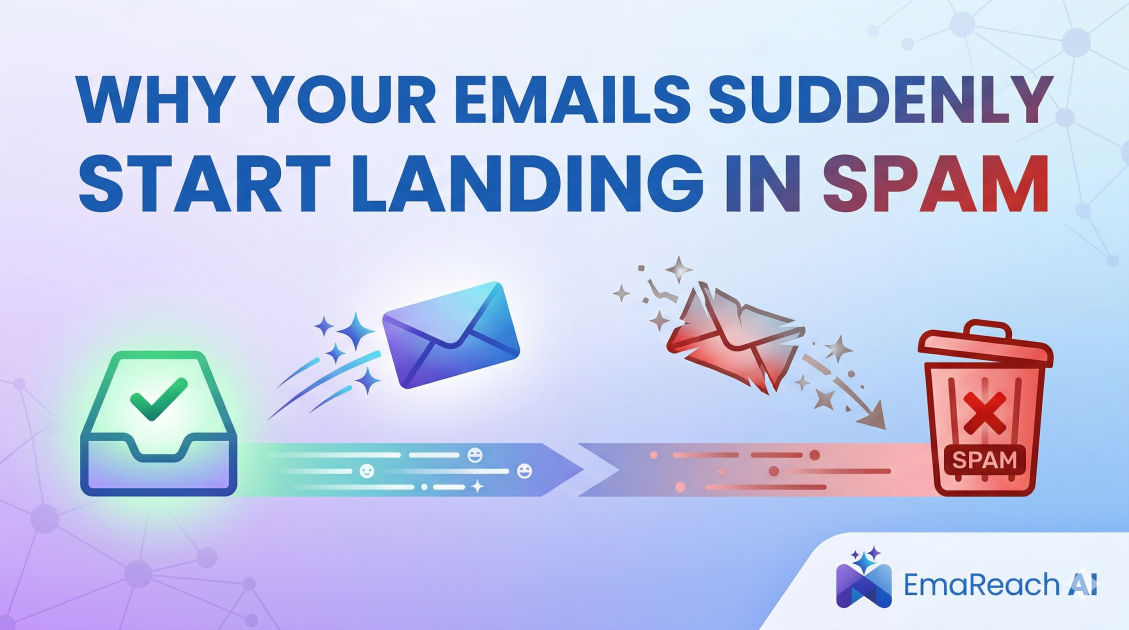
Why Your Emails Suddenly Start Landing in Spam
email deliverabilityspam filterscold emailSPF DKIM DMARCemail marketingsender reputationinbox placement
The Silent Crisis of the Inbox
One day, your open rates are hovering at a healthy 40%, and your sales team is busy fielding replies. The next, your metrics plummet to near zero. You check your logs, and everything seems fine on the surface—the emails are being sent, but nobody is seeing them. This is the nightmare of every digital marketer and founder: the sudden shift from the primary inbox to the dreaded spam folder.
Email deliverability is not a set-it-and-forget-it metric. It is a living, breathing ecosystem governed by complex algorithms, sender reputations, and evolving security protocols. When your emails suddenly start landing in spam, it is rarely a result of a single mistake. Instead, it is usually a cumulative effect of technical shifts, engagement patterns, or changes in how Internet Service Providers (ISPs) perceive your sending behavior.
To reclaim your place in the inbox, you must understand the underlying mechanics of why these filters trigger and how to systematically reverse the damage.
1. The Technical Foundation: SPF, DKIM, and DMARC
Before looking at your content, you must look at your authentication. If your emails suddenly stop reaching the inbox, the first place to investigate is your DNS records. ISPs like Gmail and Outlook have tightened their requirements significantly. If your technical "passport" isn't in order, you are automatically flagged as a potential phisher or spammer.
SPF (Sender Policy Framework)
SPF is a text record in your DNS that lists the IP addresses and domains authorized to send emails on your behalf. If you recently changed your email service provider or added a new marketing tool without updating your SPF record, receiving servers will view your emails with suspicion.
DKIM (DomainKeys Identified Mail)
DKIM adds a digital signature to your emails. This allows the receiver to verify that the email was indeed sent from your domain and that it wasn't tampered with during transit. A broken DKIM signature is a one-way ticket to the spam folder.
DMARC (Domain-based Message Authentication, Reporting, and Conformance)
DMARC ties SPF and DKIM together. It tells the receiving server what to do if an email fails authentication—whether to do nothing, quarantine it (spam), or reject it entirely. If your DMARC policy is set to 'reject' and you have a misconfiguration in your SPF or DKIM, your emails won't just go to spam; they will disappear entirely.
2. The Dangers of Rapid Scaling
One of the most common reasons for a sudden drop in deliverability is a spike in volume. Imagine a sender who consistently sends 50 emails a day suddenly jumping to 5,000. To an ISP, this looks like a compromised account or a spammer trying to blast a list before getting caught.
Consistency is the key to deliverability. ISPs build a profile of your sending habits. When you deviate from that profile too quickly, you trigger protective filters. This is why "warming up" an email address is essential. If you are doing cold outreach, you cannot simply buy a domain and start sending at full capacity.
Stop Landing in Spam. Cold Emails That Reach the Inbox. EmaReach helps solve this exact problem. EmaReach AI combines AI-written cold outreach with inbox warm-up and multi-account sending—so your emails land in the primary tab and get replies. By distributing your volume across multiple accounts and naturally warming them up, you avoid the sudden spikes that lead to blacklisting.
3. Sender Reputation and Blacklists
Your sender reputation is essentially a credit score for your email domain. It is influenced by your IP reputation and your domain reputation. If you are using a shared IP address provided by a cheap email service provider, the bad habits of other users on that IP can bleed over into your deliverability.
However, domain reputation is now more critical than IP reputation. If your domain ends up on a major blacklist (like Spamhaus or Barracuda), your deliverability will tank instantly. This often happens due to:
- Spam Traps: These are email addresses that don't belong to real people. They are used by ISPs to catch spammers. If you are scraping lists or buying aged databases, you are highly likely to hit a spam trap.
- High Complaint Rates: If more than 0.1% of your recipients mark your email as spam, you are in the danger zone.
- High Bounce Rates: Consistent hard bounces (sending to non-existent addresses) signal to ISPs that you have poor list hygiene.
4. Content Triggers and The "Spammy" Look
While technical factors are the most common culprits, the actual content of your email still matters. Modern spam filters use machine learning to analyze the intent of an email. Certain patterns are synonymous with low-quality outreach.
Excessive Use of High-Pressure Keywords
Words like "Guarantee," "Free," "No Cost," "Act Now," or "Urgent" are classic triggers. While using one or two won't kill your deliverability, a high density of these terms signals a low-value pitch.
Poor Text-to-Image Ratio
Spammers often put their message inside an image to hide their text from filters. As a result, ISPs are suspicious of emails that contain large images with very little text. If your email is just one giant flyer, it’s likely headed for the spam folder.
Dangerous Links and Redirects
If you use link shorteners (like Bitly) or redirect links, you are at risk. Spammers use these to hide the final destination of a malicious link. Use full, transparent URLs or hyperlinked text that points directly to your verified domain.
5. Lack of Personalization and Engagement
ISPs monitor how users interact with your emails. Do they open them? Do they click links? Most importantly, do they reply?
If you send 1,000 emails and nobody replies, the ISP assumes your content is unwanted. This creates a downward spiral: lower engagement leads to lower deliverability, which leads to even lower engagement. This is why mass-blasting generic templates is a failing strategy.
Personalization is the antidote. When an email is highly relevant to the recipient, they are more likely to engage. Positive engagement signals (like moving an email from the "Promotions" tab to "Primary" or replying to a thread) tell the ISP that you are a sender the user actually wants to hear from.
6. The "Unsubscribe" Trap
It might seem counterintuitive, but making it hard to unsubscribe will actually hurt your deliverability. If a user wants to stop receiving your emails and can't find an unsubscribe link, they will hit the "Report Spam" button instead.
One spam report is worth dozens of unsubscribes in terms of negative impact. You should make your unsubscribe link clear and easy to find. Furthermore, ensuring your headers include the 'List-Unsubscribe' command allows ISPs to provide an easy unsubscribe button right at the top of the email interface, which is viewed favorably by Google and Yahoo.
7. Changing ISP Algorithms
Sometimes, you didn't change anything—the world changed around you. Major providers like Gmail and Yahoo frequently update their filtering criteria. They might decide to become more aggressive toward certain types of tracking pixels or specific types of attachments.
For instance, the use of tracking pixels is becoming more difficult as privacy protections (like Apple's Mail Privacy Protection) become standard. If your strategy relies heavily on open-tracking pixels that trigger security filters, you might find your emails being diverted.
8. How to Fix Your Deliverability: A Step-by-Step Guide
If you find yourself in the spam folder, don't panic. You can recover, but it requires a disciplined approach.
Step 1: Audit Your DNS
Use tools to verify your SPF, DKIM, and DMARC records. Ensure there are no syntax errors and that all your sending sources are accounted for.
Step 2: Clean Your List
Run your email list through a verification service to remove hard bounces, catch-all addresses, and known spam traps. If you haven't emailed a segment of your list in six months, do not blast them all at once. Re-introduce them slowly or remove them entirely.
Step 3: Check for Blacklists
Enter your domain and IP into blacklist monitors. If you find yourself listed, follow the specific removal process for that blacklist. Usually, this involves proving that you have fixed the issue that led to the listing.
Step 4: Pause and Pivot to Warm-up
Stop your large-scale campaigns immediately. If your reputation is damaged, you need to go back to a warm-up phase. This involves sending small volumes of emails to accounts that you know will open and engage with them.
Using a service like EmaReach can automate this recovery. By utilizing their multi-account sending and automated warm-up features, you can slowly rebuild your domain's trust without having to manually manage dozens of accounts. Their AI-driven approach ensures that the content being sent is diverse and high-quality, which mimics natural human behavior and keeps filters happy.
Step 5: Optimize Your Content
Simplify your emails. Remove unnecessary images, tracking links, and aggressive sales language. Aim for a plain-text feel for cold outreach, as this is how real humans communicate with each other.
9. Monitoring for the Long Term
Deliverability is an ongoing battle. You should regularly monitor your "postmaster" tools. Google Postmaster Tools, for example, provides direct insight into how Gmail views your domain reputation and your spam complaint rates.
Keep an eye on your engagement metrics. If you see a steady decline in open rates over a period of weeks, it is a leading indicator that your deliverability is beginning to slip. Address it before it becomes a total blackout.
Conclusion
Landing in the spam folder is a clear signal that the balance between your sending practices and ISP expectations has been disrupted. Whether it’s a technical oversight in your DNS records, an aggressive spike in sending volume, or a decline in recipient engagement, the root cause is always discoverable.
By prioritizing technical authentication, maintaining rigorous list hygiene, and focusing on high-quality, personalized content, you can ensure that your messages reach their intended destination. Remember that the goal of an ISP is to protect its users; your goal is to prove that you are a sender who provides value rather than noise. Treat your domain reputation as your most valuable digital asset, and it will reward you with the reach and conversions your business needs to thrive.
EmaReach AI
Ready to scale your cold email outreach?
Join thousands of teams using EmaReach AI for AI-powered campaigns, domain warmup, and 95%+ deliverability. Start free — no credit card required.
Related posts
- Read article
The Instantly Alternative That Finally Gets Outbound Analytics Right
Discover why high-volume cold email requires a shift from surface-level vanity metrics to deep, data-driven revenue attribution, and explore the ultimate alternatives for mastering outbound engineering.
- Read article
How Choosing the Right Instantly Alternative Changed Our Pipeline Numbers
Discover how transitioning from a volume-first cold email setup to an advanced, deliverability-focused infrastructure transformed our B2B pipeline metrics, skyrocketed open rates to over 68%, and tripled our monthly booked demos.