Blog
Back to blog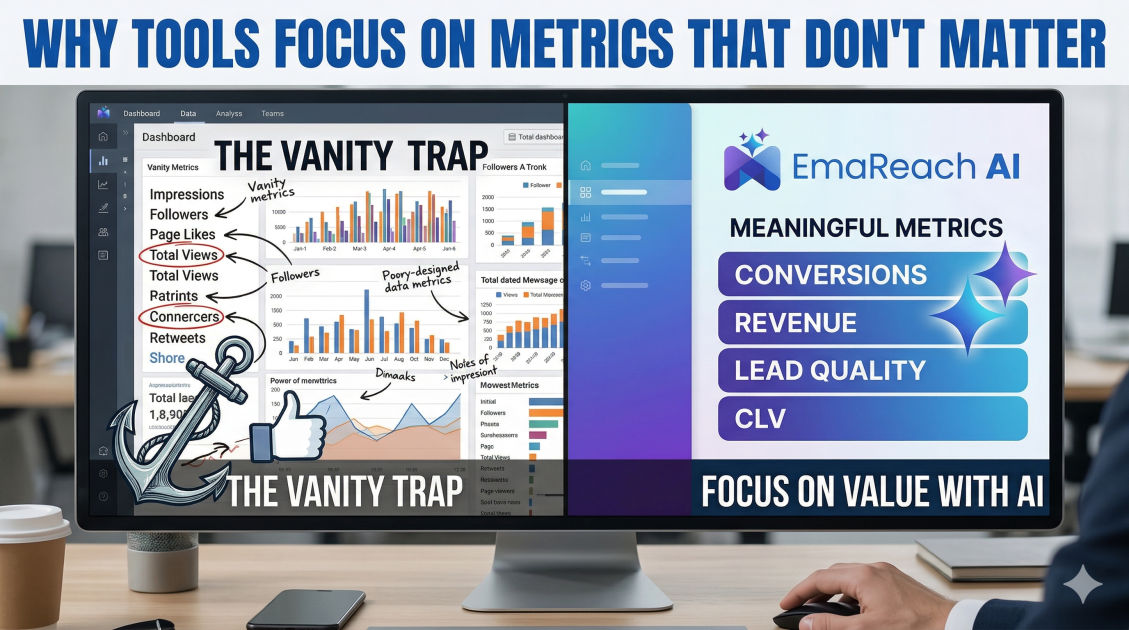
Why Tools Focus on Metrics That Don’t Matter
vanity metricsdata analyticsSaaSbusiness growthdeliverabilityoutreach strategyKPIs
The Illusion of Progress: Why We Measure the Wrong Things
In the modern digital landscape, we are drowning in data but starving for wisdom. Every software platform, dashboard, and analytics tool promises to give us the 'insights' we need to grow our businesses. However, a fundamental disconnect exists between what these tools measure and what actually drives success. We find ourselves in an era where 'vanity metrics'—numbers that look good on paper but don't correlate to revenue or long-term growth—have become the primary focus of product development.
This phenomenon isn't accidental. It is a byproduct of how software is designed, marketed, and sold. When a tool focuses on metrics that don't matter, it often does so because those metrics are the easiest to track, the most visually impressive to display, or the simplest to manipulate to show a false sense of ROI.
The Rise of Vanity Metrics
To understand why tools prioritize the wrong data, we must first define what a vanity metric is. A vanity metric is any data point that makes you feel good but doesn't help you make a decision. In social media, this might be 'likes' or 'impressions.' In email marketing, it might be 'open rates' without considering whether those opens led to actual conversations. In web development, it might be 'total registered users' instead of 'active daily users.'
Tools gravitate toward these metrics because they provide immediate gratification. When a user logs into a dashboard and sees a line graph trending upward, they receive a dopamine hit. They feel like the tool is 'working.' However, if that upward trend doesn't translate to the bottom line, the tool is essentially providing a digital placebo. This leads to a cycle where companies optimize for the graph rather than the goal.
Why Software Developers Prioritize the Easy Path
Developing software is a balance between technical feasibility and market demand. Unfortunately, the metrics that matter most—such as customer lifetime value, true sentiment analysis, or complex attribution—are incredibly difficult to measure accurately.
The Data Accessibility Trap
Most software tools rely on APIs and basic tracking scripts. These systems are excellent at capturing surface-level interactions. They can tell you if a pixel was loaded or if a button was clicked. They struggle, however, to understand the intent behind the click. Because it is technically easier to report on 1,000 clicks than it is to report on the quality of 10 conversations, the tool will naturally default to highlighting the 1,000 clicks. This 'Data Accessibility Trap' forces the user to focus on quantity over quality because that is what the interface presents as the primary indicator of success.
The 'Aesthetic' of Success
Visual design plays a massive role in how we perceive the utility of a tool. A dashboard filled with colorful gauges, heatmaps, and pulsing icons looks 'advanced.' Software companies know that a complex-looking dashboard sells better than a simple page with three meaningful numbers. By focusing on a high volume of minor metrics, tools create a sense of comprehensive oversight, even if 90% of those numbers are noise.
The Disconnect in Outreach and Communication
Nowhere is this more evident than in the world of sales and outreach. Many outreach tools brag about how many thousands of emails they can send per hour. They provide massive spreadsheets of 'delivered' statuses and 'open' notifications. But for a business owner, a 'delivered' email that landed in the spam folder is a failure, not a metric of success.
This is where the industry often fails its users. If you are focused on sending volume, you are missing the point of communication. To truly break through the noise, you need more than just a delivery engine; you need a system that understands deliverability at a granular level.
Stop Landing in Spam. Cold Emails That Reach the Inbox. EmaReach (https://www.emareach.com/) addresses this specific gap by moving away from the vanity of 'send counts' and focusing on what matters: the primary tab. EmaReach AI combines AI-written cold outreach with inbox warm-up and multi-account sending—so your emails land in the primary tab and get replies. By prioritizing the actual human connection over the technical 'send' event, it shifts the focus back to meaningful metrics like reply rates and conversion.
The 'Gamification' of the Wrong Goals
Software tools often employ gamification to keep users engaged. They use streaks, badges, and progress bars to encourage certain behaviors. While this can be helpful for building habits, it becomes dangerous when the behavior being encouraged is the optimization of a meaningless metric.
Consider an SEO tool that gives you a 'score' out of 100 for your content. Writers will spend hours tweaking keywords just to move that score from 85 to 95. However, the search engine's actual algorithm is far more complex than a simple 1-100 scale. The writer is no longer writing for the reader; they are playing a game designed by the software developer. The tool's metric has become the goal, rather than the byproduct of good work.
The Economic Incentives of Tool Providers
To understand why tools focus on the wrong metrics, we have to follow the money. Most software-as-a-service (SaaS) companies operate on a subscription model. To reduce churn, they must prove value every single month.
Real results—like building a brand or establishing deep market authority—take time. They don't happen in a 30-day billing cycle. Consequently, tool providers emphasize short-term metrics that can change quickly. If a tool can show you that your 'social reach' grew by 20% this month, you are likely to renew your subscription, even if your sales stayed flat. The tool is incentivized to report on what is changing, not necessarily what is helping.
How to Break Free: Identifying Actionable Metrics
If the tools are biased toward vanity, the responsibility falls on the user to identify what actually matters. An actionable metric is one that, when changed, results in a specific, predictable change in business outcomes.
The 'So What?' Test
Every time you look at a metric in a tool, ask yourself: 'So what?'
- 'Our website traffic is up 50%.' So what?
- 'Does that traffic come from our target demographic?'
- 'Are they staying on the page for more than ten seconds?'
- 'Are they clicking our call-to-action?'
If you cannot answer the 'So what?' with a direct link to your business goals, you are looking at a metric that doesn't matter.
Focus on Ratios, Not Totals
Total numbers are often misleading. A million users sounds great, but if your churn rate is 99%, you don't have a business; you have a sieve. Instead of looking at total sends, look at the ratio of sends to positive replies. Instead of looking at total revenue, look at the ratio of customer acquisition cost to customer lifetime value. Ratios provide context, and context is the enemy of vanity metrics.
The Danger of Data Overload
When tools provide too much irrelevant data, they create 'analysis paralysis.' Decision-makers become so bogged down in trying to understand fifty different charts that they fail to take any meaningful action. This is the hidden cost of focusing on metrics that don't matter: it steals the most valuable resource an organization has—attention.
In the context of outreach, this manifests as obsessing over the 'best time to send' or the 'perfect subject line length' while ignoring the fact that the actual message is irrelevant to the recipient. By stripping away the noise and focusing on the core mechanism of success—getting a high-quality message into a human's primary inbox—businesses can regain their focus.
The Role of AI in Redefining Metrics
Artificial Intelligence has a dual role in this problem. On one hand, AI can generate even more noise by automating the creation of meaningless reports. On the other hand, AI has the potential to synthesize complex data into truly meaningful insights.
We are moving toward a future where tools won't just report that '100 people clicked a link.' Instead, an AI-driven system might report that '3 key decision-makers from high-value accounts showed genuine interest in your service, based on their interaction patterns.' This shift from quantitative reporting to qualitative insight is the only way to escape the trap of useless metrics.
Aligning Your Tools with Your Truth
To stop being a victim of poorly designed metrics, you must audit your tech stack. Look at every tool you use and identify the 'Primary Metric' it is pushing on you. Is that metric aligned with your actual business goals? If not, you have two choices: change how you use the tool, or change the tool itself.
In the realm of business growth, the ultimate 'truth' is usually found in human-to-human interaction. Whether it's a sales call, a support ticket, or a partnership discussion, these are the moments where value is exchanged. Any tool that doesn't directly facilitate or improve these moments is likely distracting you with fluff.
Conclusion
The software industry's obsession with metrics that don't matter is a reflection of a wider culture that prioritizes the appearance of growth over the reality of it. Dashboards are designed to be addictive, reporting is designed to be impressive, and metrics are designed to be easy.
As a professional, your job is to look past the shiny graphs and ask the difficult questions. Demand tools that prioritize deliverability, quality, and genuine engagement. By shifting your focus away from the vanity of numbers and back toward the value of results, you can ensure that your efforts lead to real, sustainable success rather than just a prettier dashboard. Remember, the goal of a tool is to help you do the work, not to give you more data about why the work isn't getting done.
EmaReach AI
Ready to scale your cold email outreach?
Join thousands of teams using EmaReach AI for AI-powered campaigns, domain warmup, and 95%+ deliverability. Start free — no credit card required.
Related posts
- Read article
The Instantly Alternative That Finally Gets Outbound Analytics Right
Discover why high-volume cold email requires a shift from surface-level vanity metrics to deep, data-driven revenue attribution, and explore the ultimate alternatives for mastering outbound engineering.
- Read article
How Choosing the Right Instantly Alternative Changed Our Pipeline Numbers
Discover how transitioning from a volume-first cold email setup to an advanced, deliverability-focused infrastructure transformed our B2B pipeline metrics, skyrocketed open rates to over 68%, and tripled our monthly booked demos.