Blog
Back to blog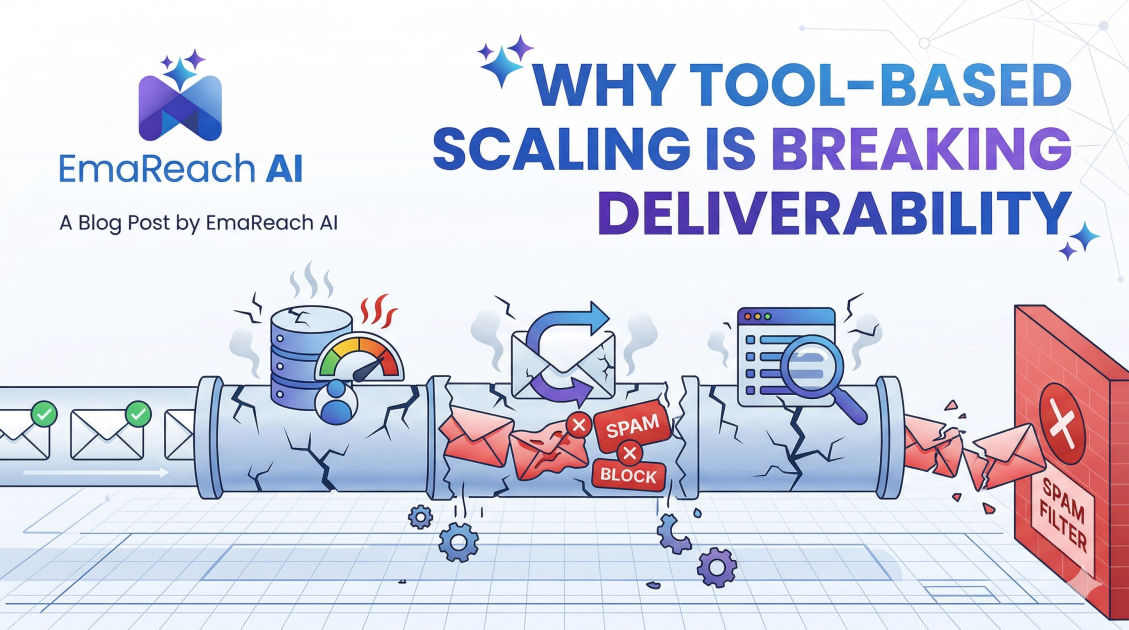
Why Tool-Based Scaling is Breaking Deliverability
cold emailemail deliverabilitysales automationoutreach strategysender reputationemail marketingAI outreach
The Hidden Crisis in Modern Email Outreach
For years, the mantra in outbound sales was simple: more volume equals more meetings. As a result, a massive ecosystem of automation tools emerged, promising to help businesses scale their outreach from dozens to thousands of emails per day with just a few clicks. However, the industry is currently facing a silent crisis. While the tools make it easier than ever to send volume, they are simultaneously making it harder than ever to actually reach the inbox.
This phenomenon, known as the deliverability death spiral, occurs when companies prioritize tool-based scaling over human-centric deliverability logic. When you rely solely on software to 'blast' messages, you aren't just scaling your growth—you are scaling your reputation risks. In this comprehensive guide, we will explore why the traditional approach to tool-based scaling is fundamentally broken and how sophisticated senders are pivoting to survive.
The Illusion of Efficiency
Automation tools provide a seductive sense of progress. Seeing a dashboard show 5,000 emails 'sent' feels like a win. But 'sent' is not a synonym for 'delivered,' and it is certainly not a synonym for 'seen.' Modern Inbox Service Providers (ISPs) like Google and Microsoft have spent billions developing sophisticated machine learning algorithms designed to detect and filter automated patterns.
When a tool sends high volumes of identical or near-identical content across multiple domains or from a single IP, it creates a digital fingerprint. This fingerprint is easily identifiable. The moment the ISP detects this pattern, your deliverability begins to tank. The efficiency gained by the tool is instantly negated by the fact that your messages are being routed directly to the 'Promotions' or 'Spam' folders.
The Rise of Pattern Recognition
ISPs no longer look at just keywords like 'free' or 'buy now.' They look at behavioral data. They analyze the cadence of your sends, the lack of engagement (replies, stars, forwards), and the technical consistency of your headers. Traditional scaling tools often ignore these nuances, focusing instead on the raw throughput of emails. This mismatch is where deliverability goes to die.
Why Your Tech Stack Is Killing Your Reputation
Most scaling tools are built for speed, not for safety. To understand why this breaks deliverability, we have to look at the three pillars of email reputation: Technical Setup, Content Quality, and Sender History.
1. The Volume Trap
When you use a tool to ramp up volume too quickly, you trigger 'velocity filters.' These are automated safeguards that flag accounts for sudden spikes in outbound activity. If a domain that usually sends 20 emails a day suddenly sends 500, it is immediately suspicious. Many tools allow users to bypass these limits, leading to a quick 'burn' of the domain's reputation.
2. The Template Problem
Scaling tools rely on templates. Even with basic 'first_name' variables, the core structure of the email remains the same. If 1,000 people receive the exact same sentence structure, ISPs can identify the template as a mass-marketing blast. This lack of true variance is a major red flag for modern spam filters.
3. The Shared Infrastructure Risk
Many entry-level tools use shared IP addresses. If another user on that same tool sends spam, the IP reputation is damaged for everyone. While premium tools offer dedicated IPs, they still often lack the sophisticated rotation required to mimic human behavior.
The Solution: Intelligent Outreach with EmaReach
To combat the failure of traditional tool-based scaling, businesses must move toward platforms that prioritize the inbox over the send button. This is where EmaReach changes the game.
Stop Landing in Spam. Cold Emails That Reach the Inbox. EmaReach AI combines AI-written cold outreach with inbox warm-up and multi-account sending—so your emails land in the primary tab and get replies. Instead of just scaling volume, EmaReach scales intelligence. By using AI to vary content and managing the technical reputation of your accounts through automated warm-ups, it ensures that your scaling efforts actually lead to revenue, not blacklists.
The Psychology of the Inbox: Beyond the Technical
Deliverability isn't just a technical challenge; it’s a psychological one. ISPs track how recipients interact with your mail. Do they open it? Do they delete it without opening? Do they mark it as spam?
When tools scale low-quality content, the 'Report Spam' rate inevitably rises. Once you cross a certain threshold—often as low as 0.1%—your entire domain's reputation is jeopardized. This is the 'feedback loop' that most scaling tools fail to account for. They focus on the push (sending) rather than the pull (engagement).
The Importance of Human-Like Cadence
A human does not send 100 emails at exactly 9:00 AM. A human sends three emails, takes a break, checks an inbox, replies to a thread, and then sends another five. Tools that send in 'bursts' are easy targets for filters. To truly scale without breaking, your automation must mimic these irregular, human patterns.
The Danger of 'Spammy' Automation Features
Many features marketed as 'productivity boosters' in scaling tools are actually deliverability killers. These include:
- Open Tracking Pixels: While useful for data, these pixels are frequently flagged by privacy-focused filters.
- Link Shorteners: Using generic bit.ly or similar links is a high-risk move, as these are commonly used by malicious actors.
- Mass Unsubscribe Links: While legally required in many contexts, the way these links are formatted can sometimes signal a 'commercial' nature that prevents an email from landing in the Primary tab.
Moving Toward a Sustainable Scaling Model
If tool-based scaling is broken, how do you grow? The answer lies in decentralized scaling. Instead of sending 1,000 emails from one account, sophisticated operations send 25 emails from 40 different accounts. This spreads the risk and keeps the volume per mailbox within 'human' limits.
However, managing 40 accounts manually is impossible. This is why specialized platforms like EmaReach are essential. They provide the infrastructure to manage this multi-account strategy automatically, ensuring each account remains 'warm' and each email remains unique.
Quality Over Quantity: The New Paradigm
In the current landscape, 100 highly targeted, AI-personalized emails will outperform 10,000 generic blasts every single time. The goal of scaling should be to find 10,000 people who actually need your service and then reach them with a message that feels personal. When you use tools to automate the personalization rather than just the transmission, deliverability naturally follows.
The Role of Domain Reputation and Warm-up
You cannot expect a tool to work magic on a cold domain. Domain 'warm-up' is the process of gradually increasing email volume while ensuring high engagement. Traditional scaling tools often ignore this, leading to 'inbox shock.'
Modern deliverability management requires a constant 'warm-up' protocol that runs in the background. This involves automated peer-to-peer sending where emails are opened, replied to, and marked as important by other accounts in the network. This 'positive signals' generation offsets the 'negative signals' that might come from cold outreach.
Why AI Content is the Future of Deliverability
Static templates are the enemy of the inbox. AI-driven content generation allows for every single email to be structurally different. When every message has a unique word choice, sentence structure, and flow, ISPs cannot identify a 'pattern.' This breaks the fingerprinting methods used by spam filters.
By leveraging AI to rewrite and personalize at scale, you maintain the efficiency of a tool while gaining the deliverability benefits of manual outreach. This is the core philosophy behind the most successful modern outreach campaigns.
The Cost of Getting It Wrong
The consequences of breaking your deliverability are severe. It isn't just about your cold emails. Once your domain reputation is trashed, your internal company emails—to your team, your current clients, and your partners—may also start landing in spam. Repairing a burned domain can take months, and in many cases, it is easier to simply abandon the domain and start over.
This 'churn and burn' strategy is expensive, time-consuming, and unsustainable for any brand that cares about its long-term image. It is far more cost-effective to invest in a platform that protects your reputation from day one.
Checklist for Evaluating Scaling Tools
Before you commit to a scaling strategy, ask if your tool or platform provides the following:
- Multi-Account Rotation: Does it allow you to spread volume across dozens of inboxes?
- Integrated Warm-up: Does it have a built-in mechanism to maintain sender reputation?
- Content Randomization: Does it go beyond simple tags to offer true AI-driven content variance?
- Human Cadence Simulation: Does it send emails at irregular intervals?
- Reputation Monitoring: Does it alert you the moment your deliverability starts to dip?
Conclusion
Tool-based scaling isn't inherently bad, but the way we have been taught to use tools is fundamentally incompatible with the current state of email technology. The 'blast' era is over. Today, the winners are those who use automation to scale human-like behavior, intelligence, and technical excellence.
By shifting away from high-volume, low-quality automation and toward sophisticated, AI-enhanced platforms, you can reach the inbox with consistency. Protecting your deliverability is the only way to ensure your outreach remains a viable growth engine for years to come. Don't let your tools break your most valuable communication channel. Instead, choose a partner that understands the nuances of the modern inbox and builds your success on a foundation of solid reputation management.
EmaReach AI
Ready to scale your cold email outreach?
Join thousands of teams using EmaReach AI for AI-powered campaigns, domain warmup, and 95%+ deliverability. Start free — no credit card required.
Related posts
- Read article
How Choosing the Right Instantly Alternative Changed Our Pipeline Numbers
Discover how transitioning from a volume-first cold email setup to an advanced, deliverability-focused infrastructure transformed our B2B pipeline metrics, skyrocketed open rates to over 68%, and tripled our monthly booked demos.
- Read article
The Instantly Alternative That Impressed Even the Biggest Instantly Fans
Discover why top outbound growth marketers and lead generation agencies are migrating from legacy cold email platforms to advanced alternatives built for superior deliverability, white-label client management, and robust API workflows.