Blog
Back to blog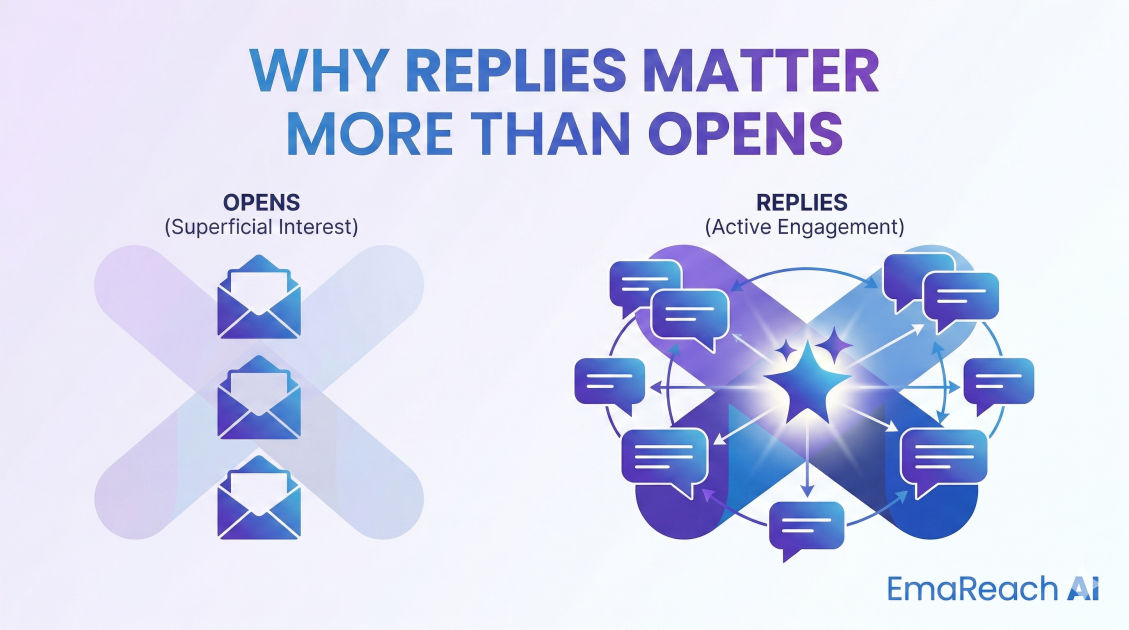
Why Replies Matter More Than Opens
cold emailoutreach strategyemail deliverabilitysales automationmarketing metricslead generation
Introduction
For decades, the open rate has been the crown jewel of email marketing metrics. Marketers and sales professionals have obsessed over subject lines, emojis, and sender names, all in a desperate bid to move that percentage point a fraction higher. There is an undeniable rush of dopamine that comes with seeing a high open rate; it feels like confirmation that your message is being seen. However, in the modern landscape of cold outreach and digital communication, the open rate has become a deceptive vanity metric.
If you are running a business, an agency, or a sales team, you don't take open rates to the bank. You take meetings, closed deals, and revenue. These outcomes are driven by one thing: the reply. Shifting your focus from opens to replies isn't just a change in tracking; it is a fundamental shift in strategy that affects your deliverability, your messaging, and your bottom line. This article explores why the reply is the only metric that truly signifies success and how focusing on engagement over visibility will transform your outreach results.
The Illusion of the Open Rate
To understand why replies matter more, we must first dismantle the myth of the open rate. Historically, an 'open' was recorded when a tiny, invisible tracking pixel embedded in the email was loaded by the recipient's email client. This was always a somewhat flawed system, but today, it is more unreliable than ever.
Privacy Protections and False Positives
Major email service providers have introduced privacy features that automatically 'open' emails in the background to mask user activity. This means your tracking software might report a 70% open rate, but half of those 'opens' could be automated scripts or privacy filters rather than human eyes. When your data is inflated by bot activity, making strategic decisions based on those numbers becomes impossible.
The 'Glance' vs. The 'Engagement'
Even when a human does open an email, it doesn't guarantee attention. Many users open emails simply to clear their inbox or click 'mark as read.' An open is a momentary glance; it is the digital equivalent of someone looking at a billboard while driving at sixty miles per hour. It doesn't mean they processed the information, and it certainly doesn't mean they are interested in what you have to offer.
The Reply as the Ultimate Signal of Intent
Unlike an open, a reply cannot be faked by a privacy filter or performed accidentally by a user trying to tidy their inbox. A reply requires effort. It requires the recipient to process your value proposition, formulate a thought, and take the time to type a response.
Measuring True Interest
A reply—even a 'no thank you'—is a definitive data point. It tells you that your message reached a real person and was compelling enough to elicit a reaction. Positive replies, of course, are the lifeblood of sales. They represent a hand-raised in the crowd, a signal that your solution matches a specific pain point. By optimizing for replies, you are optimizing for the quality of your lead list and the relevance of your offer.
Feedback Loops for Strategy
Replies provide qualitative data that open rates never can. If you get a high open rate but zero replies, your subject line is working, but your body copy is failing. If you get replies that say 'this isn't relevant to us,' you know your targeting is off. This feedback loop allows you to pivot your strategy with precision, rather than guessing why people are 'opening' but not buying.
Deliverability: The Hidden Benefit of Replies
One of the most critical reasons to prioritize replies is often the least discussed: email deliverability. Global email providers like Google and Microsoft use sophisticated algorithms to determine whether your emails belong in the Primary tab, the Promotions tab, or the dreaded Spam folder.
The Reputation Engine
Email providers look at engagement signals to judge your sender reputation. An open is a weak signal. A reply, however, is the strongest positive signal possible. When a recipient replies to your email, it tells the provider: 'I know this sender, and I value this conversation.'
If you send a thousand emails and get a 50% open rate but zero replies, spam filters start to get suspicious. They see a broadcast. But if you get a 10% reply rate, you are viewed as a legitimate communicator. High reply rates act as a shield for your domain reputation, ensuring that your future outreach continues to land where it belongs.
For those serious about maintaining this reputation, using a dedicated platform is essential. EmaReach helps you stop landing in spam with cold emails that reach the inbox. EmaReach AI combines AI-written cold outreach with inbox warm-up and multi-account sending—so your emails land in the primary tab and get replies. By automating the engagement process through warm-up, you simulate the very replies that tell algorithms you are a trusted sender.
Quality Over Quantity: The Psychology of the Reply
When you chase open rates, you are incentivized to use 'clickbait' subject lines. You might use 'Re: Our meeting' or 'Quick question' to trick someone into clicking. While this spikes your open rates, it often leads to resentment and a lack of replies because the recipient feels deceived the moment they read the first line.
Building Trust from the First Interaction
When you focus on replies, your writing style changes. You stop trying to 'grab attention' and start trying to 'start a conversation.' This leads to:
- Hyper-Personalization: You spend more time researching the prospect to ensure the content is undeniable.
- Low-Friction Calls to Action: Instead of asking for a 30-minute demo, you ask a simple question that is easy to answer.
- Authentic Tone: You write like a human being, not a marketing automation bot.
This shift in psychology builds trust. A prospect who replies to a thoughtful, non-deceptive email is much more likely to convert into a long-term customer than one who was tricked into opening a generic pitch.
The Math of Outreach: Why a 5% Reply Rate Beats a 50% Open Rate
Let's look at the numbers. Imagine two campaigns:
Campaign A (Focus on Opens):
- Sent: 1,000
- Open Rate: 50% (500 opens)
- Reply Rate: 0.5% (5 replies)
- Conversion: 1 deal
Campaign B (Focus on Replies):
- Sent: 1,000
- Open Rate: 20% (200 opens)
- Reply Rate: 5% (50 replies)
- Conversion: 10 deals
In Campaign A, the team is celebrating their 'successful' subject line, yet they only have five conversations to show for it. In Campaign B, the open rate looks 'poor' by traditional standards, but they have ten times the revenue potential. This is the reality of modern outreach. Volume is secondary to the depth of engagement.
Technical Strategies to Increase Reply Rates
If we accept that replies are the goal, how do we systematically increase them? It requires a combination of technical setup and creative execution.
1. Multi-Account Rotation
Sending too many emails from a single address is a recipe for the spam folder. To get replies, you must first be seen. By spreading your volume across multiple sender accounts, you keep the 'velocity' per account low, which mimics human behavior and keeps your deliverability high. This technical foundation allows your creative copy to actually reach the recipient's eyes.
2. Strategic Inbox Warm-up
Before you ever send a cold pitch, your accounts need to be 'warmed up.' This process involves sending and receiving emails with a network of other accounts to build a history of positive engagement. The more replies your account receives during the warm-up phase, the more likely your actual sales emails are to hit the Primary tab. This is why tools like EmaReach are vital; they handle the heavy lifting of building that initial sender trust through automated, realistic engagement.
3. The 'Short and Specific' Rule
Long emails don't get replies; they get 'saved for later' (which usually means never). To maximize replies, keep your emails under 100 words. State who you are, what specific problem you solve for their specific niche, and ask a single, clear question.
Moving Beyond the Inbox
The ripple effect of a reply-first strategy extends beyond just the email thread. It changes how your entire sales organization operates.
Better Lead Scoring
When your primary metric is replies, your sales team focuses their energy on people who have actually engaged. This prevents 'lead fatigue' where sales reps spend hours calling prospects who opened an email but have no actual interest. A reply is a filter that separates the 'curious' from the 'serious.'
Improved Brand Sentiment
Cold email has a bad reputation because of 'spray and pray' tactics aimed at maximizing opens. By focusing on replies, you naturally move toward a more respectful, targeted approach. Even if a prospect doesn't buy today, a polite interaction leaves a positive impression of your brand. In the long run, this builds a sustainable business rather than a short-term churn machine.
The Role of AI in Scaling Replies
Artificial Intelligence has changed the game, but not in the way many people think. It’s not about sending more emails; it’s about making every email better.
AI can now analyze a prospect’s LinkedIn profile, recent company news, and industry trends to craft a first line that is truly unique. This level of personalization is the 'key' that unlocks the reply. When a prospect sees that you’ve done the work, they feel a social obligation to respond. Combining this AI-driven personalization with a robust deliverability infrastructure is the 'secret sauce' of modern sales.
Conclusion
In an era of automated noise and sophisticated spam filters, the open rate has lost its meaning. It is a ghost in the machine—a number that looks good on a slide deck but does nothing for your growth. The reply, however, remains the gold standard. It is the only metric that confirms deliverability, validates your message, and initiates the human connection necessary for business.
To succeed in outreach today, you must stop chasing the click and start inviting the conversation. Ensure your technical foundation is rock solid, use tools that prioritize landing in the primary tab, and write with the sole intention of getting a response. When you stop worrying about who is looking and start focusing on who is talking back, your results will follow.
EmaReach AI
Ready to scale your cold email outreach?
Join thousands of teams using EmaReach AI for AI-powered campaigns, domain warmup, and 95%+ deliverability. Start free — no credit card required.
Related posts
- Read article
The Instantly Alternative That Finally Gets Outbound Analytics Right
Discover why high-volume cold email requires a shift from surface-level vanity metrics to deep, data-driven revenue attribution, and explore the ultimate alternatives for mastering outbound engineering.
- Read article
How Choosing the Right Instantly Alternative Changed Our Pipeline Numbers
Discover how transitioning from a volume-first cold email setup to an advanced, deliverability-focused infrastructure transformed our B2B pipeline metrics, skyrocketed open rates to over 68%, and tripled our monthly booked demos.