Blog
Back to blog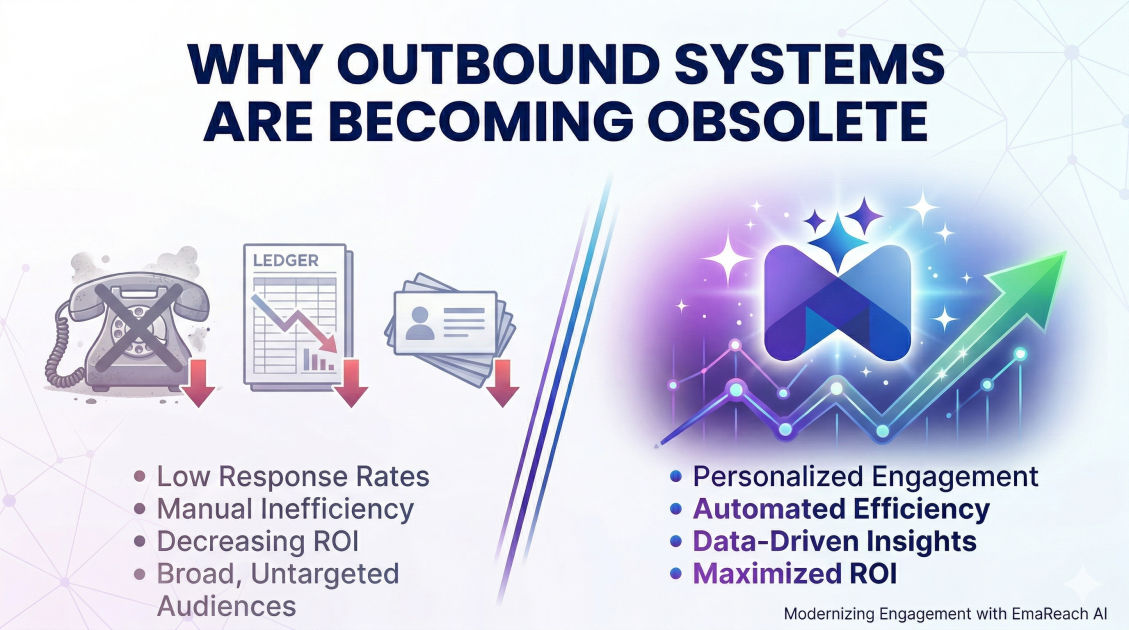
Why Outbound Systems Are Becoming Obsolete
outbound marketingcold emailsales automationemail deliverabilityB2B strategylead generationdigital transformation
The Shift in Modern Communication
For decades, outbound systems were the engine of business growth. The logic was simple: if you cast a wide enough net, you will eventually catch a fish. This volume-based approach gave birth to massive call centers, automated fax blasts, and eventually, the era of bulk email automation. However, we are currently witnessing a fundamental shift in how markets respond to unsolicited contact. The traditional outbound system—characterized by high-volume, low-context, and linear sequences—is not just slowing down; it is becoming obsolete.
Consumers and B2B decision-makers alike have developed a sophisticated 'immunity' to traditional outbound tactics. The psychological wall between a brand and its prospect has never been higher. To understand why these systems are failing, we must look at the convergence of technology, psychology, and regulatory environments that have rendered the old playbook useless.
The Noise Floor Crisis
The most immediate reason for the obsolescence of traditional outbound is the 'Noise Floor.' In acoustics, the noise floor is the measure of the signal created from all the unwanted sources. In marketing, the noise floor has risen so high that the signal—your message—is virtually indistinguishable from the background hum of digital clutter.
When every company has access to automated sequencing tools, the volume of outreach explodes. A typical executive now receives hundreds of unsolicited touches per week. In this environment, a standard outbound system that relies on templated 'checking in' or 'bumping this to the top' emails doesn't just fail to convert; it actively damages brand equity. Prospects now associate these automated patterns with low-value interactions.
The Evolution of Privacy and Filtering Technology
Beyond human psychology, the machines themselves have turned against the traditional outbound model. Internet Service Providers (ISPs) and email hosting giants have deployed advanced machine learning algorithms designed specifically to identify and silo outbound automation. These filters look for signatures of mass distribution: identical metadata, rapid-fire sending patterns, and low engagement rates.
If your outbound system relies on a single server or a poorly configured domain, your messages likely never see the light of day. They are caught in the 'Spam' or 'Promotions' tabs before a human eye ever has the chance to scan them. This technical barrier has made 'spray and pray' methods economically unviable.
To combat this, modern strategies must pivot toward high-deliverability frameworks. For those struggling with this transition, services like EmaReach are leading the charge. Stop Landing in Spam. Cold Emails That Reach the Inbox. EmaReach AI combines AI-written cold outreach with inbox warm-up and multi-account sending—so your emails land in the primary tab and get replies. This is the level of sophistication required to bypass the filters that have killed traditional outbound systems.
The Death of the 'Linear Sequence'
Traditional outbound systems were built on a linear philosophy: Send Email A, wait two days, send Email B, wait three days, make Phone Call C. This assumes the prospect's journey is a straight line. In reality, the modern buyer's journey is a complex web of research, peer consultation, and platform hopping.
An obsolete outbound system cannot account for the fact that a prospect might have seen your LinkedIn post, read a third-party review, and listened to a podcast before they ever opened your email. When the outbound system continues its rigid, automated path without acknowledging these external touchpoints, it appears tone-deaf. The lack of dynamic response to user behavior is a hallmark of a system that is no longer fit for purpose.
The Rise of Intent-Based Marketing
Why guess when you can know? The obsolescence of outbound systems is being accelerated by the rise of intent data. Traditional outbound is 'blind'; it targets people based on static criteria like job title or industry. Modern systems, however, target people based on actions.
When a company can track who is searching for specific keywords, who is visiting their pricing page, or who just raised a round of funding, the need for cold, broad-spectrum outbound disappears. Intent-based systems allow for 'warm' outreach that feels timely and helpful rather than intrusive. A system that doesn't integrate real-time intent data is essentially flying a plane without radar in a storm.
The Personalization Paradox
We have reached the 'Personalization Paradox.' This is the point where basic personalization (using a {First_Name} tag or mentioning a {Company_Name}) actually triggers a negative response. Prospects are now so accustomed to these merge tags that they serve as 'tells' for automation.
True personalization requires deep research and a synthesis of information that traditional outbound systems are not equipped to handle. Obsolete systems prioritize speed and scale over depth. However, the market now demands the opposite. A single, deeply researched email that references a specific challenge the prospect is facing is worth more than ten thousand automated templates. The shift is moving from 'Quantity of Outreach' to 'Quality of Connection.'
Regulatory Headwinds and the Cost of Non-Compliance
Global regulations regarding data privacy and electronic communications have tightened significantly. The era of buying a list of a million emails and hitting 'send' is over, not just because it's ineffective, but because it’s legally risky. Traditional outbound systems often lack the granular permission management and opt-out transparency required by modern standards.
Compliance is no longer a 'nice to have'; it is a fundamental requirement of any communication system. Systems that cannot guarantee data sovereignty and respect for regional privacy laws are being phased out in favor of platforms that build compliance into their core architecture.
The Integration Gap
An outbound system that exists as an island is a liability. In the past, sales teams could operate their outbound tools in a silo, separate from the CRM, the marketing automation platform, and the customer success software. This led to fragmented data and a disjointed customer experience.
Obsolete systems fail to provide a 360-degree view of the prospect. If a prospect is already in an active sales cycle with an account executive, but the outbound system continues to send 'cold' prospecting emails to their colleagues, the organization looks disorganized. Modern revenue operations demand a unified data layer where outbound is just one coordinated part of a larger whole.
The Psychology of the Modern Buyer
The psychology of the buyer has changed. We live in an 'on-demand' economy. We choose when we want to be marketed to. We block ads, we skip commercials, and we ignore unknown callers. The traditional outbound system is an 'interruptive' model. It demands attention on the sender's schedule, not the recipient's.
As we move forward, the most successful systems are those that provide value before they ask for it. This is often called 'Inbound-Led Outbound.' By the time the outreach happens, the prospect should already have a positive association with the brand through content, social presence, or community involvement. Obsolete systems try to manufacture a relationship from zero using force; modern systems cultivate a relationship using value.
The Role of Artificial Intelligence in the New Era
Ironically, the very technology that made mass outbound possible—automation—is also what is making it obsolete, but in a new form. Generative AI has raised the bar for what a 'good' email looks like. If an AI can write a better, more thoughtful email in five seconds than a human using a template can in five minutes, the template becomes a relic.
However, AI must be used correctly. Simply using AI to generate more volume will only accelerate the Noise Floor Crisis. The future belongs to systems that use AI to facilitate relevance. This means using AI to analyze a prospect’s recent annual report, their LinkedIn activity, and their industry trends to craft a message that is undeniably human and specific.
This is where advanced solutions like EmaReach differentiate themselves. By focusing on the intersection of AI-driven relevance and technical deliverability, they solve the two biggest hurdles of the modern era: getting noticed and getting through. When your system ensures that cold emails reach the inbox and provide actual value through intelligent writing, you move beyond the limitations of obsolete outbound.
Moving Toward a Holistic Growth Model
If outbound systems are becoming obsolete, what replaces them? The answer is a Holistic Growth Model. This model blends the best of inbound, outbound, and 'near-bound' (leveraging partnerships and existing networks).
- Trust-Based Prospecting: Building authority through content and community before reaching out.
- Precision Targeting: Moving away from broad lists to hyper-segmented cohorts based on real-time triggers.
- Multi-Channel Orchestration: Ensuring the message is consistent across email, social, and voice.
- Technical Excellence: Prioritizing deliverability and inbox placement over sheer volume.
The Economic Argument for Change
Finally, we must consider the Unit Economics. The Cost Per Acquisition (CPA) for traditional outbound is skyrocketing. As response rates drop into the fractions of a percent, the cost of the software, the data, and the labor required to manage an obsolete system often exceeds the Lifetime Value (LTV) of the customers it acquires.
Businesses that cling to these systems are effectively subsidizing their own decline. The transition to more modern, intelligent, and integrated systems isn't just a marketing choice; it’s a financial necessity. Efficiency is no longer measured by how many emails you can send per hour, but by how much revenue you can generate per touchpoint.
Conclusion
The obsolescence of traditional outbound systems is a natural evolution of the digital marketplace. As the barriers to entry for mass communication fell, the value of that communication plummeted. To survive in this new landscape, businesses must stop thinking of outbound as a volume game and start viewing it as a precision instrument. By embracing high-deliverability tools, AI-enhanced relevance, and an intent-based philosophy, companies can break through the noise and build meaningful connections in an era that no longer has time for the automated and the mundane. The systems of the past were built for a world that was listening; the systems of the future must be built for a world that is selective.
EmaReach AI
Ready to scale your cold email outreach?
Join thousands of teams using EmaReach AI for AI-powered campaigns, domain warmup, and 95%+ deliverability. Start free — no credit card required.
Related posts
- Read article
The Instantly Alternative That Finally Gets Outbound Analytics Right
Discover why high-volume cold email requires a shift from surface-level vanity metrics to deep, data-driven revenue attribution, and explore the ultimate alternatives for mastering outbound engineering.
- Read article
The Instantly Alternative That Impressed Even the Biggest Instantly Fans
Discover why top outbound growth marketers and lead generation agencies are migrating from legacy cold email platforms to advanced alternatives built for superior deliverability, white-label client management, and robust API workflows.