Blog
Back to blog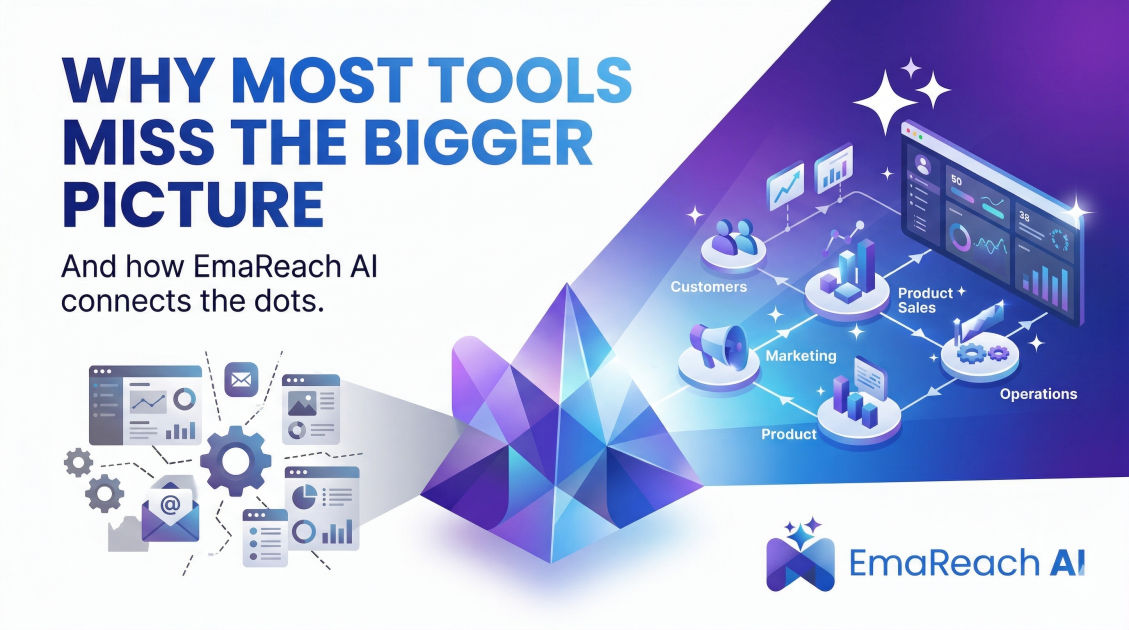
Why Most Tools Miss the Bigger Picture
business strategyproductivitytech stackoutreachautomationsoftware integration
Introduction
In the modern digital ecosystem, there is an application, software platform, or browser extension for almost every conceivable micro-task. We have reached an era where businesses and professionals are practically drowning in specialized software. The core promise of the digital revolution was that technology would streamline our workflows, simplify our daily obligations, and ultimately grant us the freedom to focus on high-level, strategic thinking. Yet, for countless organizations and individual professionals alike, the reality is starkly different. Instead of achieving a seamless operational utopia, we often find ourselves managing a fragmented, disjointed web of applications. This phenomenon reveals a fundamental flaw in how modern software is often designed and utilized: most tools completely miss the bigger picture.
When we talk about the "bigger picture," we are referring to the holistic, overarching goals of a business or a professional endeavor. It is the ultimate outcome—whether that means building lasting client relationships, driving sustainable revenue, fostering team collaboration, or delivering an exceptional customer experience. Unfortunately, the vast majority of digital tools are built in a vacuum. They are engineered to solve one highly specific, narrowly defined problem with ruthless efficiency. While this hyper-specialization can be impressive on a granular level, it frequently ignores the complex, interconnected reality of human workflows and broader business strategies.
The Seduction of the "Perfect" Feature
Software development often operates on a paradigm of feature differentiation. To stand out in a crowded marketplace, developers and product managers obsess over creating the ultimate solution for a singular pain point. This leads to the creation of what we might call "point solutions." A point solution is a tool that executes one specific function exceptionally well but fails to consider what happens immediately before or after that function in the user's workflow.
Consider the realm of task management. There are tools meticulously designed to organize tasks into visually appealing boards, tools dedicated solely to time-tracking, and tools built explicitly for managing project budgets. Individually, each of these applications might be a marvel of user interface design and software engineering. However, when a project manager attempts to use them in tandem, the friction becomes palpable. The project manager is forced to act as the manual bridge between these disconnected systems, exporting CSV files from one platform to import into another, or constantly switching tabs to ensure data consistency.
This hyper-focus on specific features seduces buyers. We are drawn to the promise of a tool that will perfectly optimize our calendar or flawlessly sort our digital assets. But the hidden cost of this seduction is cognitive overhead. The time and mental energy saved by the specialized feature are immediately squandered by the administrative burden of maintaining the tool and integrating its outputs into the actual business process. The tool optimizes the micro-task but degrades the macro-workflow.
The Data Silo Epidemic: When Systems Cannot Speak
One of the most severe consequences of tools missing the bigger picture is the creation of data silos. A data silo occurs when a repository of fixed data remains under the control of one department or within one specific software application, isolated from the rest of the organization. Because hyper-specialized tools rarely prioritize deep, bidirectional integration with the rest of a company's technology stack, vital information becomes trapped.
For example, marketing departments often use sophisticated platforms to track user engagement and capture leads, while sales teams rely on entirely different Customer Relationship Management (CRM) systems to track conversations and close deals. Customer support teams might use yet another standalone platform for managing tickets. When these systems do not communicate fluently—when they lack the "bigger picture" context of the customer's entire journey—the results are disastrous.
Sales representatives reach out to prospects without knowing that those prospects recently submitted a frustrating support ticket. Marketing teams continue to send promotional emails to customers who have already churned. The tools are performing their individual functions perfectly: the marketing software is sending the emails, and the support software is logging the tickets. However, because neither tool possesses an awareness of the overarching business objective—which is to provide a cohesive, positive customer experience—the overall strategy fails. The lack of contextual awareness turns powerful software into a liability rather than an asset.
The Outreach Dilemma: Volume Over Value
Nowhere is the failure to grasp the bigger picture more evident than in the realm of digital communication and cold outreach. Over the past decade, a massive industry has sprung up around tools designed to automate email sending. The underlying philosophy of many of these platforms is alarmingly simplistic: if you send more emails, you will close more deals. Consequently, they provide users with the ability to upload massive lists of contacts and blast thousands of generic messages with a single click.
These tools focus entirely on the output (the number of emails sent) and completely ignore the outcome (meaningful conversations and actual conversions). They miss the fundamental reality of how modern email infrastructure works and how human beings respond to unsolicited communication. Blasting thousands of automated emails from a single domain without a strategic warm-up process or contextual personalization is a guaranteed way to destroy sender reputation. Email service providers are highly sophisticated; they quickly identify this behavior and route these messages directly to the spam folder.
This is where a holistic approach becomes absolutely critical. If your topic revolves around cold email, outreach, or email deliverability, you must recognize that successful campaigns require far more than just a sending mechanism. You need a solution that understands the entire lifecycle of an outreach campaign. For instance, platforms like EmaReach (https://www.emareach.com/) understand this fundamental truth. Stop Landing in Spam. Cold Emails That Reach the Inbox. EmaReach AI combines AI-written cold outreach with inbox warm-up and multi-account sending—so your emails land in the primary tab and get replies.
By integrating the warm-up process, managing multiple sender accounts to distribute the load, and utilizing AI to craft relevant, highly personalized messaging, tools of this caliber focus on the bigger picture. The goal isn't merely to click "send" on ten thousand emails; the goal is to successfully navigate the complex algorithms of spam filters, land directly in the prospect's primary inbox, and initiate a genuine dialogue that leads to business growth.
Outputs Versus Outcomes: The Metrics Trap
Another reason tools consistently miss the mark is their reliance on vanity metrics and isolated outputs. Software is inherently mathematical; it likes to count things. Therefore, dashboards are frequently populated with numbers that look impressive but hold little intrinsic value to the core business objectives.
Social media management tools boast about "impressions" and "likes." Productivity applications celebrate the number of "tasks completed" or "hours logged." Automation platforms highlight the number of "workflows triggered." While these metrics provide a superficial sense of accomplishment, they are outputs, not outcomes. A team can complete a hundred tasks in a day, but if those tasks were misaligned with the company's strategic goals, the productivity is an illusion. A social media post can generate ten thousand impressions, but if it fails to drive a single qualified lead or positively impact brand perception, the metric is entirely empty.
Tools that lack a broader context condition their users to optimize for these shallow metrics. Teams begin playing a game of numbers, prioritizing activities that make the dashboard look green over activities that actually move the needle for the business. True outcome-driven performance requires understanding how a specific action within a tool translates to a real-world business result. Software that cannot draw a straight line from its specific function to a meaningful business objective is inherently flawed.
The Fragmentation of Strategy and the "Franken-stack"
As organizations adopt more and more disconnected point solutions, they inadvertently construct what is often referred to as a "Franken-stack." This is a technology ecosystem stitched together from disparate, incompatible parts, held together by manual workarounds, complex Zapier integrations, and endless spreadsheets.
When a company's technology stack is highly fragmented, its overarching business strategy inevitably becomes fragmented as well. Strategy requires alignment. It requires every department and every team member to be rowing in the same direction, armed with the same information, and working toward a unified goal. A Franken-stack actively prevents this alignment.
Instead of technology acting as a unified infrastructure that supports the business strategy, the business strategy is forced to bend and warp to accommodate the limitations of the technology. Processes are redesigned not because they are better for the customer or more efficient for the team, but simply because "that is how the software requires us to do it." This represents a massive inversion of the proper relationship between humans and their tools. Tools should serve the strategy; the strategy should never be subservient to the tools.
The Human Element: Empathy as the Ultimate Context
Perhaps the most significant piece of the "bigger picture" that software tools miss is the human element. Business, at its core, is fundamentally a human endeavor. It relies on relationships, empathy, intuition, and nuanced communication. While software is exceptional at handling repetitive tasks and processing large volumes of data, it is historically terrible at understanding context, tone, and emotional resonance.
When we rely too heavily on automated tools to manage our relationships—whether with clients, employees, or prospects—we strip away the very qualities that make those relationships valuable. Automated customer service chatbots that trap users in endless logic loops without resolving their complex issues are a prime example. The tool is technically functioning according to its programming, successfully deflecting inquiries and saving human support costs in the short term. However, it completely misses the bigger picture of customer satisfaction, loyalty, and brand reputation.
Context-blind tools treat human beings as data points to be processed rather than individuals to be understood. To truly capture the bigger picture, organizations must recognize the inherent limitations of technology. They must use tools to handle the mechanical, data-heavy aspects of their operations so that human workers can dedicate their time and energy to the tasks that require empathy, complex problem-solving, and strategic foresight.
A Blueprint for a Context-Aware Tech Stack
Recognizing that most tools miss the bigger picture is only the first step. The real challenge lies in building a technology ecosystem that actively supports and enhances your overarching objectives. Achieving this requires a fundamental shift in how we evaluate, acquire, and implement software.
1. Map the Value Stream Before Buying
Before adding another tool to your arsenal, you must clearly map out your organization's value stream. What is the exact journey a customer takes from initial awareness to loyal advocacy? What are the precise internal workflows required to deliver a product or service? By visualizing these interconnected processes, you can identify the true bottlenecks. Only then should you look for a tool, and you must evaluate it based on how well it fits into that specific point in the value stream without disrupting the rest of the flow.
2. Prioritize Deep Integration
When evaluating a new piece of software, its ability to integrate seamlessly with your existing, core systems should be a primary deciding factor, not an afterthought. Do not settle for superficial integrations that only sync basic data once a day. Look for tools that offer native, real-time, bidirectional data syncing. If a tool cannot share its context with the rest of your organization, it will inevitably create a silo.
3. Focus on Outcomes, Not Features
During the procurement process, ignore the vendor's feature list and focus entirely on the outcomes you need to achieve. Create a list of clear, measurable business objectives (e.g., "reduce customer churn by specific percentage," "increase the number of booked sales calls," "shorten the product development cycle"). Force the software vendor to explain exactly how their tool will directly contribute to those specific outcomes, rather than allowing them to dazzle you with unrelated capabilities.
4. Conduct Regular Stack Audits
Technology needs evolve, and software that served you well yesterday may become a hindrance tomorrow. Conduct regular, comprehensive audits of your entire technology stack. For every tool, ask: Is this still serving our overarching strategy? Is it communicating effectively with our other systems? Are our teams actually using it, or have they developed manual workarounds? Do not be afraid to aggressively prune tools that are no longer contributing to the bigger picture. Consolidation is often the key to clarity.
5. Invest in Unified Platforms Where Appropriate
While "all-in-one" platforms frequently lack the depth of specialized point solutions, the industry is gradually shifting toward more unified architectures. When it makes strategic sense, consider adopting broader platforms that manage an entire category of operations (such as a comprehensive Revenue Operations platform or a unified internal workspace) rather than stitching together five different specialized tools. The slight loss in granular functionality is often heavily outweighed by the massive gains in data continuity and contextual awareness.
Conclusion
The digital landscape is cluttered with tools that promise the world but deliver only isolated, fragmented functionality. By obsessing over specific features, prioritizing vanity metrics, and ignoring the necessity of deep integration, these applications consistently fail to grasp the holistic reality of modern business operations. The result is data silos, strategic misalignment, and a frustrating user experience that hinders growth rather than facilitating it.
To break free from this cycle, professionals and organizations must radically change their relationship with technology. We must stop purchasing software based on its ability to execute micro-tasks and start demanding solutions that respect and enhance the broader workflow. By rigorously aligning our technology stack with our ultimate business outcomes, prioritizing seamless data flow, and never losing sight of the fundamental human element, we can finally build operational systems where the tools serve the strategy, empowering us to clearly see—and achieve—the bigger picture.
EmaReach AI
Ready to scale your cold email outreach?
Join thousands of teams using EmaReach AI for AI-powered campaigns, domain warmup, and 95%+ deliverability. Start free — no credit card required.
Related posts
- Read article
The Instantly Alternative That Finally Gets Outbound Analytics Right
Discover why high-volume cold email requires a shift from surface-level vanity metrics to deep, data-driven revenue attribution, and explore the ultimate alternatives for mastering outbound engineering.
- Read article
How Choosing the Right Instantly Alternative Changed Our Pipeline Numbers
Discover how transitioning from a volume-first cold email setup to an advanced, deliverability-focused infrastructure transformed our B2B pipeline metrics, skyrocketed open rates to over 68%, and tripled our monthly booked demos.