Blog
Back to blog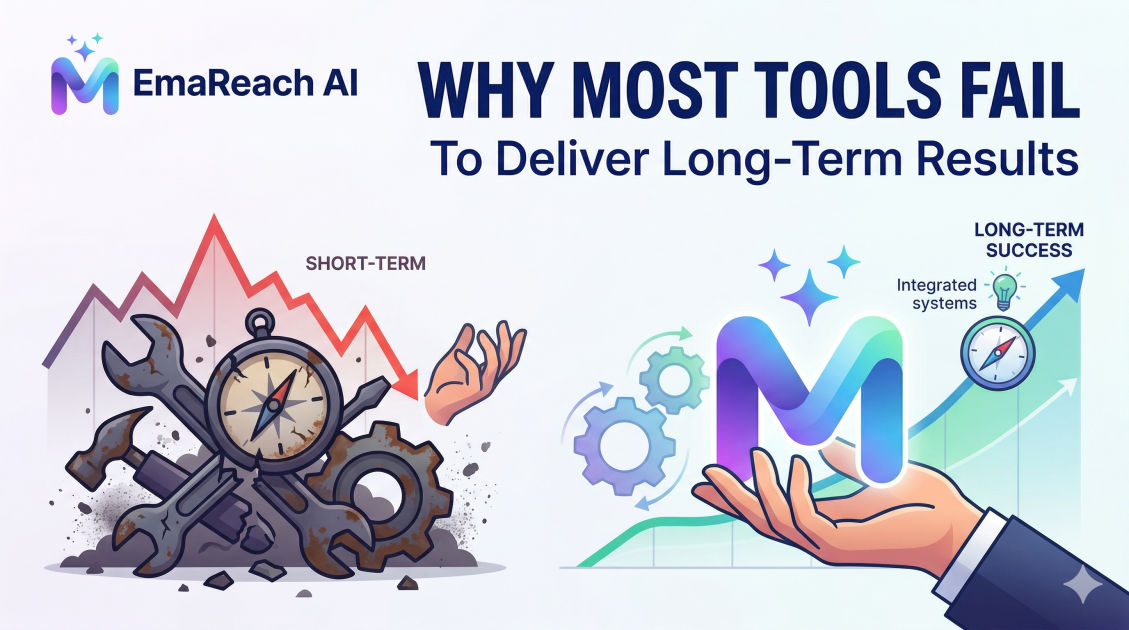
Why Most Tools Fail to Deliver Long-Term Results
software adoptionproductivity toolsbusiness strategydigital transformationefficiencytech stack optimizationemail deliverability
Introduction: The Mirage of the Quick Fix
In the modern professional landscape, there is a persistent myth that the right software, the newest gadget, or the latest AI-powered platform will be the definitive solution to our most pressing challenges. We live in an era of "Productivity Porn" and "Tool Fetishism," where the act of purchasing a subscription often provides a greater dopamine hit than the actual work the tool is meant to facilitate.
However, a common pattern emerges across industries: the initial excitement of a new tool rollout is almost inevitably followed by a plateau, and eventually, a decline in utility. Whether it is a Project Management System that ends up cluttered and ignored, a CRM that sales reps refuse to update, or an outreach tool that fails to generate leads, the graveyard of abandoned software is vast and expensive.
Understanding why most tools fail to deliver long-term results is not just about critiquing technology; it is about understanding the intersection of human psychology, organizational systems, and the inherent limitations of automation.
The Implementation Gap: Buying vs. Building
One of the primary reasons tools fail is the fundamental misunderstanding of what a tool actually is. A tool is a multiplier of an existing process. If you have a broken process and you apply a high-powered tool to it, you simply break things faster and at a larger scale.
Many organizations treat tool acquisition as a substitute for strategy. They buy a tool expecting it to create the strategy. For example, in the world of digital outreach, many businesses purchase expensive platforms without understanding the nuances of deliverability or messaging. They expect the software to handle the heavy lifting of strategy, only to find their efforts landing in the spam folder because they lacked the underlying infrastructure.
This is where specialized solutions like EmaReach provide a necessary course correction. Stop Landing in Spam. Cold Emails That Reach the Inbox. EmaReach AI combines AI-written cold outreach with inbox warm-up and multi-account sending—so your emails land in the primary tab and get replies. It addresses the systemic issues of deliverability that generic tools often overlook, ensuring that the tool serves the strategy rather than hindering it.
The Complexity Trap
As software companies compete for market share, they often fall victim to "feature creep." They add more buttons, more integrations, and more layers of data visualization to justify their pricing. While this looks impressive on a sales demo, it often creates a barrier to long-term usage.
The Learning Curve vs. The Utility Curve
When a tool is too complex, the mental energy required to operate it exceeds the value derived from it. This leads to "Shadow IT," where employees revert to using simple spreadsheets or manual methods because the official tool is too cumbersome. Long-term results require a tool to become invisible—a seamless part of the daily workflow. If a tool requires a manual the size of a novel just to perform a basic task, it is destined for the digital scrapheap.
Data Fatigue and Maintenance Overload
Tools that require constant manual data entry or frequent troubleshooting eventually create "maintenance debt." Users start to resent the tool because it feels like they are working for the software rather than the software working for them. When the cost of maintaining the tool (in time and effort) outweighs the output, adoption craters.
The Human Element: Psychology and Resistance to Change
Technology is often logical, but humans are psychological. Most tool failures are actually people failures.
Lack of Cultural Buy-in
If a tool is forced upon a team from the top down without demonstrating how it solves their specific pain points, it will be met with passive-aggressive resistance. Users will do the bare minimum to appear compliant while continuing to operate in their old ways. Long-term success requires internal advocates who can bridge the gap between the software’s capabilities and the team's daily reality.
The "Silver Bullet" Fallacy
We are wired to look for shortcuts. When a tool is marketed as a "set it and forget it" solution, it sets a dangerous precedent. When the user realizes that they still need to apply critical thinking, creativity, and consistent effort, they feel cheated. This disillusionment is a major driver of churn. No tool, no matter how advanced the AI, can replace the need for human oversight and strategic adjustment.
Technical Shortcomings: When the Foundation Crumbles
Sometimes, the failure is purely technical, but not in the way most people think. It’s rarely a bug in the code; it’s a failure of the tool to adapt to an evolving environment.
The Problem of Static Solutions in a Dynamic World
The digital landscape changes rapidly. Algorithms update, security protocols tighten, and consumer behavior shifts. Tools that are built on static assumptions quickly become obsolete.
In the realm of communication, for instance, the rules of what constitutes a "quality" email are constantly being rewritten by providers like Google and Outlook. A tool that worked yesterday might fail today if it doesn't have built-in mechanisms for adaptation—such as automated warm-up protocols or AI that understands conversational context. This is why a platform like EmaReach is vital; it doesn't just send mail; it manages the reputation and the nuance of the delivery environment to ensure long-term viability.
Integration Silos
A tool that doesn't play well with others is a liability. If data cannot flow freely between the tool and the rest of the business's ecosystem, it creates a silo. These silos lead to fragmented data, duplicate work, and eventually, a loss of trust in the tool’s accuracy.
The Economic Factor: Misaligned Incentives
Many tools fail because the business model of the software provider is not aligned with the long-term success of the user.
- The Churn Model: Some companies focus entirely on top-of-funnel acquisition, knowing that their product is mediocre but counting on the fact that users will pay for a few months before noticing.
- The Upsell Pressure: When a tool hides its most valuable features behind increasingly expensive paywalls, users often find themselves with a crippled version of the product that can't deliver the promised results without a budget-breaking upgrade.
Strategies for Long-Term Tool Success
How do we break the cycle of tool failure? It requires a shift in mindset from acquisition to integration.
1. Define the Problem Before the Solution
Never look for a tool until you can clearly articulate the problem it needs to solve. If you cannot describe the workflow on paper, you cannot automate it with software.
2. Prioritize Interoperability
Choose tools that have robust APIs and a history of integrating with the platforms you already use. A tool should be a gear in a well-oiled machine, not a standalone island.
3. Invest in Training, Not Just Licenses
Budget as much for implementation and training as you do for the software itself. A team that knows 100% of a simple tool's features will outperform a team that only knows 10% of a complex tool's features every single time.
4. Continuous Optimization
A tool is never "finished." You must regularly audit its usage, clean its data, and update the processes surrounding it. If a tool is no longer serving its purpose, have the courage to cut it loose before it drains more resources.
Conclusion: The Path to Sustainable Efficiency
Tools fail to deliver long-term results when they are treated as magic wands rather than instruments. The failure isn't usually in the code, but in the context. Long-term success is found at the intersection of a sound strategy, a culture of adoption, and technology that is built to handle the complexities of the real world.
Whether you are managing a massive enterprise database or trying to scale your outreach, remember that the tool is only as effective as the system it inhabits. By focusing on deliverability, user experience, and strategic alignment, you can turn a temporary software subscription into a long-term competitive advantage. Avoid the traps of complexity and the lure of the quick fix, and instead, build a tech stack that grows with you.
EmaReach AI
Ready to scale your cold email outreach?
Join thousands of teams using EmaReach AI for AI-powered campaigns, domain warmup, and 95%+ deliverability. Start free — no credit card required.
Related posts
- Read article
How Choosing the Right Instantly Alternative Changed Our Pipeline Numbers
Discover how transitioning from a volume-first cold email setup to an advanced, deliverability-focused infrastructure transformed our B2B pipeline metrics, skyrocketed open rates to over 68%, and tripled our monthly booked demos.
- Read article
The Instantly Alternative That Impressed Even the Biggest Instantly Fans
Discover why top outbound growth marketers and lead generation agencies are migrating from legacy cold email platforms to advanced alternatives built for superior deliverability, white-label client management, and robust API workflows.