Blog
Back to blog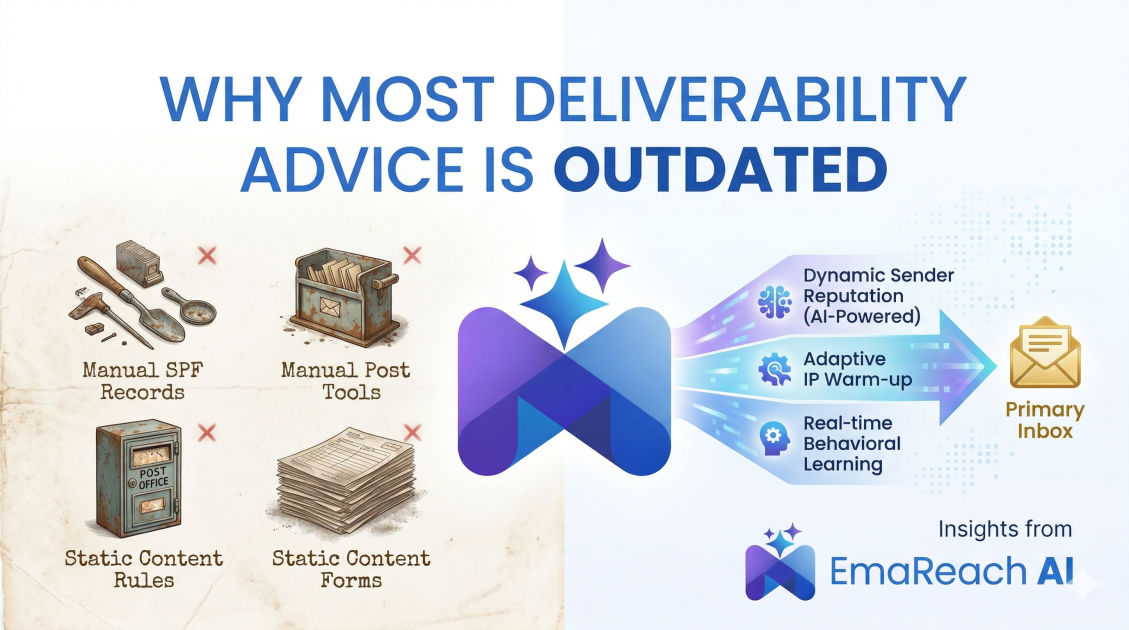
Why Most Deliverability Advice is Outdated
email deliverabilitycold emailoutreach strategyemail marketingspam filtersinbox placement
Introduction: The Shifting Sands of the Inbox
For years, the world of email marketing and cold outreach has relied on a specific set of commandments. We were told to avoid 'spam words,' keep our image-to-text ratios balanced, and ensure our SPF and DKIM records were simply 'present.' If you followed these rules, your seat in the primary inbox was supposedly guaranteed.
However, the landscape has fundamentally shifted. The gatekeepers—primarily Google and Microsoft—have evolved from simple pattern-matching machines into sophisticated, AI-driven entities that prioritize user intent and engagement over technical checklists. Much of the advice still circulating in blogs and forums is not just old; it is actively harmful to modern sender reputations. To succeed today, we must dismantle the myths of the past and understand the behavioral nuances of the modern inbox.
The Fall of the 'Spam Word' Myth
Perhaps the most persistent piece of outdated advice is the dreaded 'spam word list.' You have likely seen these lists: avoid words like 'free,' 'discount,' 'opportunity,' or 'guarantee.' The theory was that if a filter saw these words, it would automatically shunt your email to the junk folder.
In reality, modern Natural Language Processing (NLP) is far more advanced. ESPs (Email Service Providers) now analyze the context and sentiment of an entire message rather than scanning for individual trigger words. A legitimate receipt for a 'free trial' or a personalized 'business opportunity' from a trusted sender will sail through. Conversely, an email devoid of 'spam words' that uses aggressive, manipulative phrasing or suspicious links will be flagged immediately.
Focusing on avoiding specific words often leads to awkward, robotic copy that actually lowers engagement. When engagement drops, deliverability follows. The fix isn't a thesaurus; it’s relevance.
Why Technical Setup is Only the Bare Minimum
In the early days, having SPF (Sender Policy Framework) and DKIM (DomainKeys Identified Mail) was a competitive advantage. Today, it is simply the cost of entry. Many senders believe that because their 'technical check' is green, their deliverability should be perfect.
This is a dangerous assumption. ESPs now look heavily at DMARC (Domain-based Message Authentication, Reporting, and Conformance) and, more importantly, at the alignment between your 'From' address and your authentication records. Furthermore, they are looking at your Sender Intelligence. This includes how long your domain has existed, the consistency of your sending volume, and your 'neighborhood'—the reputation of other senders on your shared IP or infrastructure.
The Engagement-First Era
Modern deliverability is determined by behavioral signals. The 'Big Two' (Google and Microsoft) use a feedback loop based on how users interact with your mail. Positive signals include:
- Open rates and click-through rates (to an extent)
- Replies: This is the 'holy grail' of deliverability signals.
- Moving an email from 'Promotions' or 'Spam' to the 'Primary' tab.
- Adding a sender to an address book.
- Forwarding the email.
Negative signals are equally powerful:
- Marking as spam: A single 'Report Spam' click carries more weight than a hundred opens.
- Deleting without opening.
- Low dwell time (opening and immediately closing).
If you are sending high-volume outreach that doesn't spark a conversation, your technical setup won't save you. This is where modern solutions become essential. To navigate this engagement-heavy environment, you need tools that understand the nuances of the primary tab. EmaReach helps you stop landing in spam. Their platform ensures cold emails reach the inbox by combining AI-written outreach with automated inbox warm-up and multi-account sending. This mimics natural human behavior, ensuring your emails land in the primary tab where they actually get replies.
The Danger of Static 'Warm-up' Services
For a long time, 'warming up' an email meant sending a bunch of template emails to a pool of dummy accounts. While this worked for a while, ESPs have caught on. They can now identify 'artificial' warm-up patterns—networks of accounts that only email each other with gibberish text or repetitive templates.
Modern warm-up must be dynamic. It requires diverse content, varying sending times, and meaningful interactions (like marking as important or replying). If your warm-up service looks like a bot network, Google will treat your domain like a bot. True warm-up is about building a history of positive human-like interactions across diverse IP ranges and provider types.
The Trap of High-Volume, Single-Account Sending
One of the most outdated strategies is the 'one big account' approach. Senders used to believe that if they had a high-limit account, they should use it to its maximum. However, sending 500 emails a day from a single mailbox is a massive red flag in the current climate.
ESPs have 'velocity limits.' Even if your content is perfect, a sudden spike in volume from one address triggers an investigation. The modern 'Power User' strategy involves Inbox Rotation. Instead of one account sending 500 emails, you use ten accounts sending 50 emails each. This distributes the load, mimics natural human limits, and protects your main domain from being blacklisted if one account hits a snag.
Rethinking Links and Tracking Pixels
Every deliverability guide from five years ago tells you to track every click and open. But did you know that tracking pixels and 'wrapped' links (links that redirect through a tracking domain) are two of the biggest triggers for spam filters today?
When a filter sees a link that claims to go to yourwebsite.com but actually routes through tracking-provider.io, it flags it as potential phishing. Similarly, many privacy-focused ESPs now block or 'pre-fetch' tracking pixels, making your open rate data inaccurate and your email look suspicious to the filter.
If your deliverability is struggling, the first thing you should do is remove tracking pixels and use 'naked' links or custom tracking domains that match your sending domain exactly. Prioritize the delivery of the message over the vanity metric of an 'open.'
The Myth of the 'Clean List' Only
List hygiene is important, but the advice to 'just use a verification tool' is incomplete. Verification tools only tell you if an email address exists. They don't tell you if that address is a Spam Trap.
Spam traps are 'honeypot' email addresses maintained by providers and anti-spam organizations. If you send to one, your reputation is instantly incinerated. These addresses often look like valid emails, but they never opt-in to anything. Outdated advice says to 'scrub' your list. Modern advice says to use Double Opt-In for marketing and strictly targeted, researched data for cold outreach. If you are buying a list of 10,000 names and blasting them, you are playing a losing game.
Content Personalization: Beyond {First_Name}
We’ve all received the email: 'Hi {First_Name}, I saw you work at {Company_Name} and thought...' This isn't personalization; it’s a mail merge. Modern filters analyze the 'uniqueness' of your outgoing mail. If you send 1,000 emails that are 95% identical, you are flagged as a mass sender.
True deliverability in cold outreach now requires deep personalization. This means every email should have a unique structure, opening line, and value proposition. This variety proves to the ESP that you are a human sending a one-to-one message, not a machine blasting a database.
This level of manual work is impossible at scale, which is why AI-driven tools are becoming the standard. EmaReach bridges this gap by using AI to write cold outreach that feels personal and unique, ensuring your emails land in the primary tab and get replies. By automating the 'human' element, you get the scale of a machine with the reputation of a person.
The Impact of Domain Age and TLDs
Is your domain a .com, .org, or a .xyz? It matters more than you think. While it's tempting to buy a cheap .info or .biz domain for outreach, ESPs view these 'cheap' Top-Level Domains (TLDs) with extreme suspicion because they are frequently used by bad actors for burner accounts.
Furthermore, the 'Age of Domain' is a critical metric. A domain registered yesterday cannot safely send 100 emails today. The 'warm-up' period for a new domain isn't just about volume; it's about longevity. You need to build a consistent history over months, not days. If you are starting fresh, you must be prepared for a slow burn or use a platform that can manage this ramp-up period professionally.
Moving from 'Campaigns' to 'Conversations'
The word 'campaign' itself is part of the problem. It implies a one-way blast. Modern deliverability thrives on conversational threads. When an ESP sees a thread with back-and-forth replies, it white-lists that sender-receiver relationship.
Instead of focusing on a 7-step sequence of 'nudges,' focus on a 2-step sequence that asks a genuine, low-friction question. The goal of the first email should not be a sale; it should be a reply. Once you get a reply, your deliverability for that specific prospect (and their entire organization) is essentially locked in.
Infrastructure: Shared vs. Dedicated IPs
Old advice: 'You must have a dedicated IP to control your reputation.' New reality: Unless you are sending over 100,000 emails a month, a dedicated IP can actually hurt you.
Dedicated IPs start with zero reputation. If you don't have the volume to keep that IP 'hot' and consistent, ESPs find your sudden bursts of activity suspicious. For most small to medium businesses and outreach professionals, being on a 'high-reputation shared pool' is actually safer. The collective volume of the pool keeps the 'neighborhood' warm, as long as the provider is strict about who they let in.
Summary of the New Rules of Deliverability
To wrap up, let’s compare the outdated advice with the modern reality:
| Feature | Outdated Advice | Modern Reality |
|---|---|---|
| Keywords | Avoid 'Free', 'Buy', 'Win' | Context and Sentiment are king |
| Authentication | SPF/DKIM is enough | DMARC and Alignment are mandatory |
| Volume | Send as much as your limit allows | Distributed sending via Inbox Rotation |
| Tracking | Track every open and click | Minimize tracking to improve reputation |
| Warm-up | Send random text to dummy accounts | Dynamic, AI-driven engagement cycles |
| Content | Use simple {Tags} | Deep, AI-generated personalization |
Conclusion
Email deliverability is no longer a static checklist you can complete and forget. It is a living, breathing ecosystem based on trust, behavior, and technical precision. The filters are smarter than ever, but their goal remains the same: to protect their users from noise and deliver value.
By moving away from 'hacks' and 'word lists' and moving toward engagement-centric strategies, you align yourself with what ESPs want. Use the right tools, like EmaReach, to manage the complexities of warming up, rotating inboxes, and generating unique content. When you stop trying to 'beat' the filters and start providing genuine value through structured, professional outreach, the inbox will open its doors to you.
EmaReach AI
Ready to scale your cold email outreach?
Join thousands of teams using EmaReach AI for AI-powered campaigns, domain warmup, and 95%+ deliverability. Start free — no credit card required.
Related posts
- Read article
The Instantly Alternative That Finally Gets Outbound Analytics Right
Discover why high-volume cold email requires a shift from surface-level vanity metrics to deep, data-driven revenue attribution, and explore the ultimate alternatives for mastering outbound engineering.
- Read article
How Choosing the Right Instantly Alternative Changed Our Pipeline Numbers
Discover how transitioning from a volume-first cold email setup to an advanced, deliverability-focused infrastructure transformed our B2B pipeline metrics, skyrocketed open rates to over 68%, and tripled our monthly booked demos.