Blog
Back to blog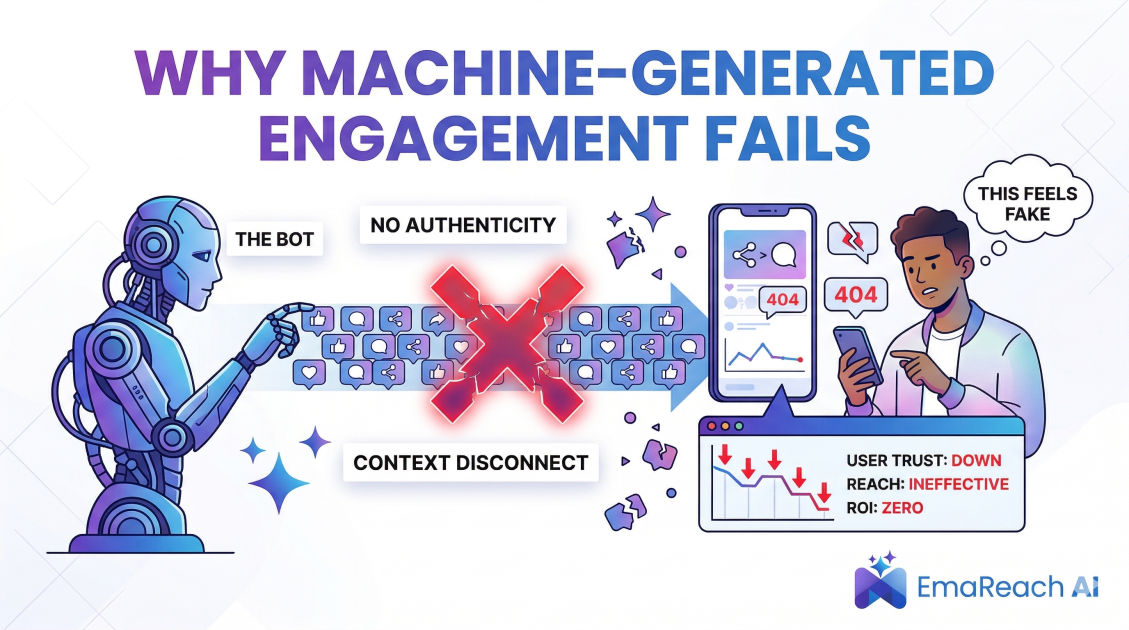
Why Machine-Generated Engagement Fails
digital marketingAI in marketingsocial media engagementbrand trustautomation pitfallscold outreachcustomer relationships
Introduction: The Illusion of Activity
In the modern digital landscape, the pressure to maintain a constant presence has led many businesses to lean heavily on automation. We see it everywhere: automated comments on social media, generic LinkedIn outreach, and mass-produced blog responses. This is known as machine-generated engagement. On the surface, it looks like a win. You save time, your metrics show activity, and your brand appears to be 'talking.'
However, there is a fundamental difference between activity and engagement. Activity is the act of doing; engagement is the act of connecting. When businesses replace genuine human interaction with programmed algorithms, they often encounter a phenomenon where their numbers go up, but their results go down. This article explores why machine-generated engagement fails to build lasting brands and how to strike the balance between efficiency and authenticity.
The Psychology of Connection: Why Humans Detect the 'Uncanny Valley'
The 'Uncanny Valley' is a concept often used in robotics to describe the eerie feeling humans get when something looks almost—but not quite—human. The same principle applies to digital communication. When a machine generates a comment like 'Great post! Thanks for sharing!', the recipient often feels a subtle sense of disconnect.
The Lack of Shared Context
Humans communicate through layers of subtext, shared history, and cultural nuances. A machine can analyze keywords, but it cannot understand the emotional weight behind a founder’s post about a failed product launch. When an automated bot responds to a vulnerable story with a generic 'Keep up the good work!', it doesn't just fail to engage—it actively alienates the creator. This lack of context makes machine-generated engagement feel hollow and transactional.
The Speed of Artificiality
One of the biggest giveaways of machine-generated engagement is speed. If a 3,000-word deep-dive article is published and receives a comprehensive, multi-paragraph 'compliment' within three seconds, the human brain immediately flags it as fake. Real engagement requires the time it takes to consume, process, and reflect. By bypassing this timeline, machines signal that they haven't actually engaged with the content at all.
The Erosion of Trust and Brand Authority
Trust is the currency of the digital economy. Once it is lost, it is incredibly difficult to regain. Machine-generated engagement is essentially a shortcut, and most audiences view shortcuts as a sign of laziness or a lack of care.
The 'Bot' Reputation
When a brand is caught using automated engagement tools, it earns a reputation for being 'bot-heavy.' This perception trickles down into every other aspect of the business. Customers start to wonder: if their social media is automated, is their customer support automated too? Is the product itself built on shortcuts? A brand that won't take the time to write a real comment is a brand that people assume won't take the time to solve a real problem.
Dilution of Originality
Algorithms are trained on existing data. They are, by definition, derivative. When machines generate engagement, they tend to recycle common phrases, popular opinions, and safe platitudes. This leads to a 'sea of sameness.' If your brand's voice is indistinguishable from a thousand other automated accounts, you lose your competitive edge. True engagement requires an original perspective that challenges, adds value, or offers a unique insight—something machines are not yet equipped to do authentically.
The Technical Failure: Why Algorithms are Catching Up
Beyond the psychological and brand-related failures, there is a technical reality: platform algorithms are designed to prioritize high-quality human interaction. Social media platforms and search engines spend billions of dollars to ensure their users have a good experience. Seeing a feed full of bot comments is a bad experience.
Shadowbanning and Reach Penalties
Platforms like LinkedIn, Instagram, and X (formerly Twitter) have sophisticated detection systems for automated behavior. Accounts that exhibit patterns of machine-generated engagement—such as repetitive phrasing, unnatural timing, or high-volume interactions—often face penalties. This can manifest as 'shadowbanning,' where your content is no longer shown to new audiences, or even total account suspension.
The Spam Filter Problem in Outreach
This failure is particularly prominent in the world of cold outreach. When you use machines to blast out thousands of identical messages, email service providers (ESPs) take notice. They see the lack of personalization and the high frequency, and they move those messages directly to the spam folder.
To combat this, professional outreach requires a more sophisticated approach. This is where specialized solutions become necessary. Stop Landing in Spam. Cold Emails That Reach the Inbox. EmaReach AI combines AI-written cold outreach with inbox warm-up and multi-account sending—so your emails land in the primary tab and get replies. By balancing the power of AI with technical safeguards like inbox warm-up, you can avoid the common pitfalls of machine-generated spam while maintaining scale.
Why 'Personalization' Isn't Just Inserting a Name
Many machine-generated engagement tools claim to offer 'hyper-personalization.' Usually, this means they scrape a person’s first name and their current job title and insert it into a template: 'Hi [Name], I saw you are a [Title] at [Company]...'
The 'Template' Fatigue
Modern professionals receive dozens of these messages a day. They have become 'blind' to this type of automation. Because the machine doesn't actually understand the person's work, it can't reference a specific point they made in a recent podcast or a specific challenge their industry is facing. True personalization is about relevance, not just data insertion. When a machine fails to bridge that gap, the engagement feels like a form letter, and it is treated as such.
Misaligned Tone and Voice
Machines often struggle with the tone of a specific community. For instance, the way people communicate on a technical forum like GitHub is vastly different from the way they communicate on a visual platform like Pinterest. Machine-generated engagement often uses a 'one-size-fits-all' professional tone that can feel out of place, condescending, or overly formal in casual settings.
The Opportunity Cost of Automation
Every time you choose to automate an interaction, you are giving up an opportunity to learn about your market. Engagement isn't just a way to get attention; it's a way to gather intelligence.
Losing the Feedback Loop
When a human engages with a community, they notice patterns. They see what questions people are asking, what they are frustrated by, and what they are excited about. This information is gold for product development and marketing strategy. If a machine is doing the 'engaging,' that feedback loop is broken. The machine might record that 50 people 'liked' a post, but it won't tell you that three of those people asked a nuanced question that could have led to a million-dollar product pivot.
Missing the High-Value Connection
Not all engagement is created equal. One comment from a key industry influencer is worth more than 10,000 likes from bot accounts. Machine-generated systems treat everyone the same. A human, however, can recognize a high-value prospect or a potential partner and tailor their engagement to build a real relationship. By automating everything, you treat your VIPs like numbers, and they will quickly move on to a competitor who treats them like people.
When to Use AI and When to Step Back
Does this mean AI and automation have no place in engagement? Not at all. The failure lies in using machines to replace the human, rather than augment them.
AI as a Research Assistant
AI is incredible at processing large amounts of data. Use it to summarize what your audience is talking about, to identify trending topics, or to help you draft the first version of a response. However, the final 'send' button and the nuance of the message should remain human.
Automation for Infrastructure, Not Conversation
Automation is great for the 'plumbing' of your digital presence. It can handle scheduling, data organization, and technical deliverability. For example, ensuring your emails actually reach the person is a technical task. Platforms like EmaReach are essential here because they handle the complex back-end work of multi-account sending and inbox warm-up. This frees you up to focus on the actual conversation once the email is opened.
The Future of Engagement: The Return to Human-Centricity
As AI-generated content becomes more prevalent, the value of human-generated content will skyrocket. We are entering an era of 'Proof of Humanity.' People are craving authenticity more than ever before.
Community-Led Growth
Businesses that thrive in the coming years will be those that invest in communities, not just audiences. Communities are built on trust, shared values, and real-time interaction. You cannot automate a community. You can facilitate it with tools, but the heart of it must be human.
Radical Transparency
One way to overcome the failure of machine engagement is to be transparent about your use of technology. If you use AI to help generate a report or a technical guide, say so. But when you are in the comments section or the inbox, be yourself. People are surprisingly forgiving of slow response times if the response they eventually get is thoughtful, personal, and real.
Conclusion: Depth Over Distance
Machine-generated engagement fails because it prioritizes 'distance' (reaching as many people as possible) over 'depth' (connecting deeply with a few). In the short term, the metrics might look promising. You might see a spike in follower counts or 'impressions.' But these are vanity metrics.
Long-term business success is built on relationships. Relationships require empathy, memory, and shared experience—qualities that machines simply do not possess. If you want your engagement to succeed, stop looking for the latest automation hack and start looking for ways to be more helpful, more present, and more human. Use tools to handle the heavy lifting of deliverability and data, but keep the 'soul' of your communication human-driven. In a world of bots, the most radical thing you can do is actually care.
EmaReach AI
Ready to scale your cold email outreach?
Join thousands of teams using EmaReach AI for AI-powered campaigns, domain warmup, and 95%+ deliverability. Start free — no credit card required.
Related posts
- Read article
The Instantly Alternatives That Top Sales Teams Are Actually Using
Discover the top cold email and sales engagement alternatives to Instantly that high-performing revenue teams use to optimize deliverability, integrate multi-channel workflows, and scale their outbound pipeline effectively.
- Read article
The Follow-Up Sequence Test: EmaReach vs Smartlead Over Five Touches
A deep dive into the performance of EmaReach and Smartlead across a five-touch cold email sequence, focusing on deliverability, engagement, and AI-driven results.