Blog
Back to blog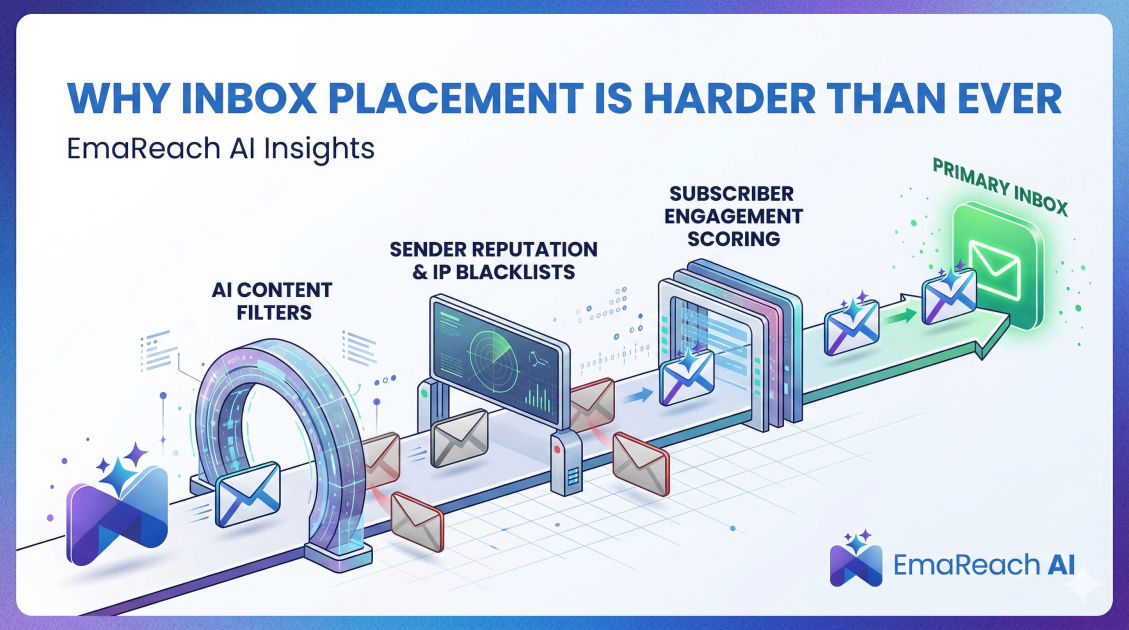
Why Inbox Placement Is Harder Than Ever
email deliverabilityinbox placementcold emailspam filtersdomain reputationemail marketingoutreach strategy
The Invisible Gatekeepers: Why The Inbox Is Moving Further Away
For years, email marketing and cold outreach followed a relatively simple blueprint: build a list, write a message, and hit send. If your content wasn't overly 'salesy' and your list was decent, you could expect a reasonable delivery rate. Those days are officially over. Today, the digital landscape is governed by sophisticated algorithms, stringent authentication protocols, and a hyper-vigilant user base that has grown weary of cluttered inboxes.
Inbox placement is no longer just about avoiding the 'Spam' folder; it is about earning a spot in the 'Primary' tab. As Mailbox Provider (MBP) giants like Google and Microsoft continue to refine their defensive measures, the bar for entry has been raised to an all-time high. Understanding why this shift has occurred is the first step in reclaiming your ability to reach your audience.
The Evolution of Mailbox Provider Intelligence
The primary reason inbox placement has become a mountain to climb is the evolution of machine learning and artificial intelligence within MBPs. In the past, spam filters relied on static rules—specific keywords like 'free,' 'guaranteed,' or 'money-back.' If you avoided those words, you were mostly safe.
Modern filters are dynamic. They analyze trillions of data points across millions of users in real-time. They aren't just looking for bad words; they are looking for patterns. They examine the relationship between the sender and the recipient, the frequency of sends, and the engagement levels of previous campaigns. If an algorithm notices that users typically ignore or delete emails from your domain without opening them, your reputation drops across the entire network, not just for those specific users.
Behavioral Filtering
Today's filters prioritize user behavior above all else. This means that even if your technical setup is perfect, poor engagement can sink your ship. Actions that hurt you include:
- Deleting without opening: High volumes of this signal that your content is irrelevant.
- 'Mark as Spam' hits: This is the ultimate red flag.
- Low dwell time: If users open and immediately close your email, it suggests the content wasn't what they expected.
Conversely, positive signals like 'Move to Primary,' 'Reply,' and 'Add to Contacts' are the gold standard for maintaining a high placement rate.
The Technical Wall: SPF, DKIM, and DMARC
Technical authentication used to be optional for smaller senders. Now, it is a mandatory ticket for entry. Without SPF (Sender Policy Framework), DKIM (DomainKeys Identified Mail), and DMARC (Domain-based Message Authentication, Reporting, and Conformance), your emails are likely to be rejected outright by major servers.
However, the challenge has intensified because simply having these records isn't enough. MBPs now look for alignment. If your 'From' address doesn't match the domain in your DKIM signature, or if your return-path is misconfigured, you lose trust. Setting up these protocols requires a level of technical precision that many marketers struggle to maintain, especially when using multiple sending tools or third-party platforms.
The Surge in Volume and the 'Noise' Problem
The sheer volume of email sent globally has exploded. With the barrier to entry for starting a business or an outreach campaign lower than ever, MBPs are being flooded. To protect the user experience, they have tightened the valves.
When every company is sending automated sequences, the 'Primary' tab becomes a premium piece of real estate. To stay in that tab, you have to prove you aren't a 'bulk sender' in the eyes of the algorithm. This is where many cold outreach campaigns fail; they look like automated blasts rather than one-to-one communication.
To combat this, savvy marketers are turning to specialized solutions. For those in the outreach space, it is crucial to Stop Landing in Spam. Cold Emails That Reach the Inbox. EmaReach AI combines AI-written cold outreach with inbox warm-up and multi-account sending—so your emails land in the primary tab and get replies. This level of sophistication is no longer a luxury; it's a requirement to cut through the noise.
Domain Reputation vs. IP Reputation
In the early days of email, reputation was tied almost exclusively to the IP address you used to send mail. If you were on a 'clean' IP, you were good to go. This led to the rise of shared IP pools and dedicated IPs as the primary solution for deliverability.
Today, the focus has shifted toward Domain Reputation. MBPs have realized that bad actors can easily jump from one IP to another. By tracking the reputation of the domain itself, they create a permanent record of a brand's sending history. This means that if you burn your domain reputation by sending low-quality outreach, you can't just change your email service provider (ESP) and expect a fresh start. Your domain follows you, and rebuilding a tarnished reputation can take months of perfect behavior.
The Rise of Content Fingerprinting
One of the most advanced (and frustrating) hurdles in modern inbox placement is content fingerprinting. MBPs now create digital 'fingerprints' of email templates. If they see the same template—even with slight variations—being sent to thousands of people across different domains, they flag it as 'commercial' or 'spammy.'
This is why 'spin-tax' and basic personalization (like using a first name) are no longer sufficient. If the core structure of your email matches a known bulk template, you are relegated to the Promotions tab or the Spam folder. High-level placement requires unique, high-quality content for every recipient, a feat that is nearly impossible to achieve manually at scale.
The Impact of Privacy Protections
Privacy initiatives, such as Apple's Mail Privacy Protection (MPP), have fundamentally changed how we measure success. These features often 'pre-fetch' images and pixels, resulting in inflated open rates that don't reflect actual human engagement.
While this might seem like a reporting issue, it also affects deliverability. Because marketers can no longer rely on accurate open rates, they struggle to prune their lists of inactive subscribers. Sending to 'dead' accounts is a major trigger for spam filters. Without clear data on who is actually reading your emails, you risk bloating your list with unengaged users, which eventually drags down your overall domain health.
Why Warm-Up Is Non-Negotiable
Gone are the days when you could buy a new domain on Monday and send 500 emails on Tuesday. Attempting this is the fastest way to get your domain blacklisted. Modern inbox placement requires a 'warm-up' period—a phase where you gradually increase your sending volume while ensuring high engagement.
Warm-up mimics human behavior. It signals to the MBPs that you are a legitimate sender who builds relationships over time. This process is tedious and requires a sophisticated network of accounts to interact with your emails. This is exactly why tools like EmaReach have become essential. By automating the warm-up process and ensuring that your domain is constantly interacting with other 'healthy' inboxes, you build a foundation of trust that allows your real outreach to bypass the filters.
The Multi-Account Strategy
As MBPs implement stricter daily limits on how many emails a single account can send before being flagged as a 'bulk sender,' the strategy of 'sending more from one place' has died. The new gold standard is the multi-account approach.
Instead of sending 200 emails from one account, sophisticated senders send 20 emails from 10 different accounts across multiple domains. This spreads the load and reduces the footprint of your campaign. However, managing this manually is a logistical nightmare. It requires synchronized signatures, centralized reporting, and careful rotation of accounts—all while maintaining consistent branding and messaging.
The Shift to Value-First Outreach
Because the 'Spam' button is so close at hand for every user, the content of your email has a direct impact on your technical deliverability. If a user feels annoyed by your email, they report it. If enough people report it, your technical setup won't save you.
This has forced a shift toward 'Value-First' outreach. Every email must provide immediate relevance. This involves:
- Deep Research: Understanding the recipient's current challenges.
- Hyper-Personalization: Going beyond 'Hi {{FirstName}}' to mention specific company news or pain points.
- Clear Opt-Outs: Ironically, making it easy to unsubscribe can actually help your deliverability. If a user can easily opt-out, they are less likely to hit the 'Report Spam' button.
The 'Grey' Area: The Promotions Tab
For many, the Promotions tab is where emails go to die. While it's better than the Spam folder, it still results in significantly lower open and reply rates. MBPs use a variety of signals to determine if an email belongs in 'Primary' or 'Promotions.'
Signals that trigger the Promotions tab include:
- Too many links: Especially links to social media or multiple product pages.
- Heavy imagery: Emails that look like newsletters or flyers.
- Unusual formatting: Bold colors, multiple font sizes, or excessive use of HTML.
To land in the Primary tab, your emails need to look like they were sent from one human to another. This means plain-text formatting, a single clear call-to-action, and a conversational tone.
List Hygiene: The Silent Killer
Sending an email to a non-existent address results in a 'Hard Bounce.' MBPs track your bounce rate closely. A bounce rate higher than 2% is often enough to trigger a temporary block or a move to the spam folder.
In the current climate, lists decay faster than ever. People change jobs, companies fold, and 'catch-all' servers become more common. Regular list cleaning is no longer a quarterly task; it must be part of your continuous workflow. Verifying every email address before it enters your sending queue is a baseline requirement for modern inbox placement.
Conclusion
Inbox placement is harder than ever because the gatekeepers have become smarter, the technical requirements have become stricter, and the competition for attention has reached a fever pitch. It is no longer a game of volume; it is a game of reputation, relevance, and technical excellence.
To succeed, you must treat your domain reputation as your most valuable digital asset. This means implementing rigorous authentication, maintaining perfect list hygiene, and using tools that can simulate human-like engagement. The landscape will only continue to get more difficult, but for those who adapt to these new rules, the reward is a direct line of communication with their most important prospects. By leveraging advanced systems like EmaReach, you can navigate these complexities and ensure that your voice is heard in an increasingly crowded digital world.
EmaReach AI
Ready to scale your cold email outreach?
Join thousands of teams using EmaReach AI for AI-powered campaigns, domain warmup, and 95%+ deliverability. Start free — no credit card required.
Related posts
- Read article
The Instantly Alternative That Finally Gets Outbound Analytics Right
Discover why high-volume cold email requires a shift from surface-level vanity metrics to deep, data-driven revenue attribution, and explore the ultimate alternatives for mastering outbound engineering.
- Read article
How Choosing the Right Instantly Alternative Changed Our Pipeline Numbers
Discover how transitioning from a volume-first cold email setup to an advanced, deliverability-focused infrastructure transformed our B2B pipeline metrics, skyrocketed open rates to over 68%, and tripled our monthly booked demos.