Blog
Back to blog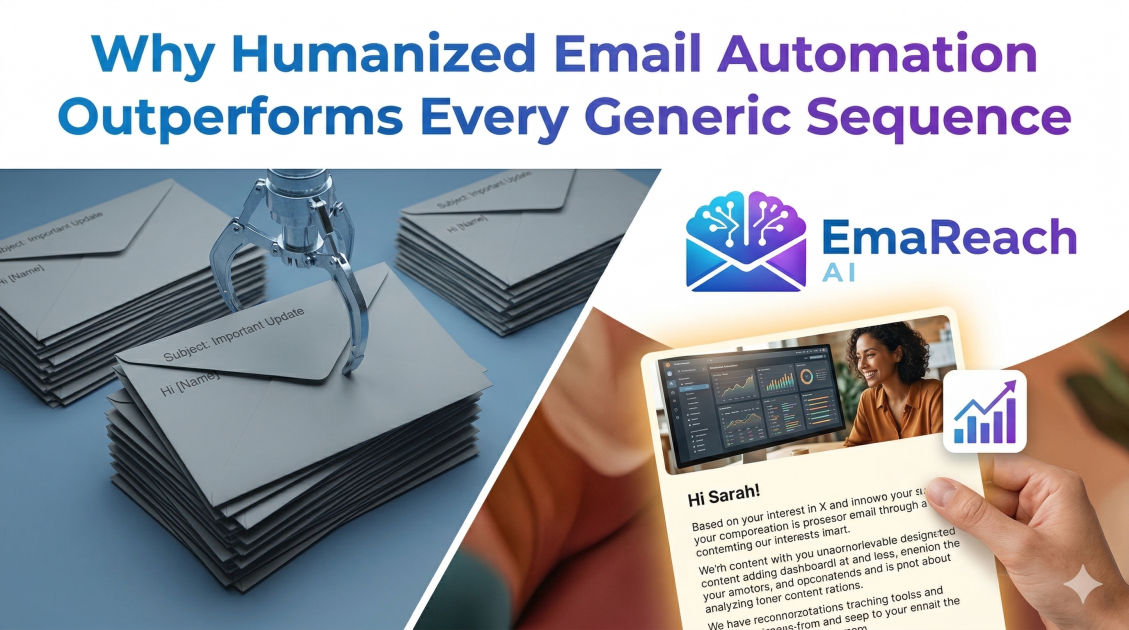
Why Humanized Email Automation Outperforms Every Generic Sequence
email automationcold outreachdeliverabilitysales strategypersonalizationb2b marketing
Introduction
The era of "spray and pray" cold outreach is officially over. For years, businesses relied on a numbers game to drive their revenue pipelines. The logic was simple, albeit flawed: if you send enough generic emails to a massive list of unverified contacts, eventually, someone will bite. However, this outdated approach has created a digital landscape where inboxes are relentlessly bombarded with irrelevant, tone-deaf pitches. Decision-makers are overwhelmed, spam filters are more aggressive than ever, and the traditional "Dear [First Name]" template is now a glaring red flag for instant deletion.
Enter humanized email automation. This paradigm shift represents the perfect marriage between scalable technology and genuine human connection. It acknowledges a fundamental truth of modern business: people do not buy from automated robots; they buy from other people. Humanized email automation leverages sophisticated data, behavioral triggers, and highly personalized copywriting to create sequences that feel as though they were written individually for each recipient.
By moving away from static, one-size-fits-all campaigns and embracing dynamic, context-driven communication, businesses can dramatically increase their engagement metrics. This comprehensive guide will explore exactly why humanized email automation systematically outperforms generic sequences, the underlying psychology of buyer engagement, and how you can transition your outreach strategy to build genuine relationships that generate revenue.
The Hidden Costs of Generic Email Sequences
To understand why humanization is so critical, we first need to dissect the failure of generic automation. Sending broad, untargeted emails carries severe hidden costs that can cripple a company's growth trajectory and severely damage its brand reputation over time.
The Burnout of the Total Addressable Market (TAM)
Every business has a finite Total Addressable Market. When you blast generic sequences, you are essentially burning through your potential customer base at an alarming rate. If a prospect receives a poorly researched, highly generic pitch, they do not just ignore that specific email; they form a lasting negative impression of your entire brand. When you attempt to reach out to them again in the future with a better offer, you will likely find that they have already permanently tuned you out or blocked your domain entirely. Generic automation treats prospects as disposable commodities, which is a disastrous strategy for long-term growth.
The Deliverability Crisis
Spam filters have evolved into highly sophisticated gatekeepers. Email service providers analyze engagement metrics meticulously. If your emails consistently generate low open rates, zero replies, and high bounce rates—hallmarks of a generic automated sequence—your sender reputation will plummet. Over time, even your legitimate, well-crafted emails will start landing straight in the spam folder.
This is where having the right infrastructure becomes non-negotiable. To truly succeed, you need systems designed to bypass these algorithmic hurdles. Stop Landing in Spam. Cold Emails That Reach the Inbox. EmaReach AI combines AI-written cold outreach with inbox warm-up and multi-account sending—so your emails land in the primary tab and get replies. Protecting your deliverability is just as important as the words you write; without a pristine sender reputation, even the most personalized email is completely useless.
The Illusion of Efficiency
Many sales and marketing teams cling to generic sequences because they appear highly efficient on paper. It takes only a few minutes to load a list of ten thousand contacts into a sending tool and hit "launch." However, true efficiency is measured by outcomes, not outputs. Sending ten thousand emails to book zero meetings is infinitely less efficient than sending one hundred highly personalized emails to book ten high-quality meetings. Generic automation optimizes for the wrong metric, prioritizing the illusion of activity over actual revenue generation.
What Exactly is Humanized Email Automation?
Humanized email automation is not simply inserting a {{Company_Name}} variable into the subject line and calling it a day. It is an intricate methodology that uses automation to scale the delivery of the message, but uses deep research and dynamic data to craft the substance of the message.
Moving Beyond Surface-Level Personalization
Surface-level personalization relies on basic demographic data: first name, company name, and perhaps an industry vertical. It reads like a Mad Libs puzzle: "Hi John, I see you work at Acme Corp in the Software industry." Decision-makers instantly recognize this pattern.
Deep personalization—the core of humanized automation—focuses on contextual relevance. It involves referencing specific pain points, recent company news, personal achievements, or shared connections. It answers the critical question every prospect asks subconsciously: "Why are you emailing me, specifically, right now?"
Behavioral and Intent Triggers
Generic sequences run on a rigid timeline (e.g., Day 1, Day 3, Day 7). Humanized sequences, on the other hand, are often triggered by prospect behavior or intent signals. If a prospect engages with a specific piece of content on your website, attends a relevant industry webinar, or posts about a specific challenge on professional networking platforms, a humanized system recognizes this signal. The subsequent automated outreach is highly contextualized around that specific action, making the communication feel serendipitous and incredibly timely.
The Psychology Behind the Reply
To master humanized outreach, one must understand the psychological drivers that compel a busy professional to stop what they are doing and formulate a response to a stranger.
The Reciprocity Principle
When a prospect reads an email and realizes that the sender has taken genuine time to research their business, read their recent blog post, or understand their specific market challenges, it triggers the psychological principle of reciprocity. The prospect feels a subconscious obligation to, at the very least, acknowledge the effort. Generic emails demand value (the prospect's time and money) without offering anything upfront. Humanized emails offer value first through insight and attention, making the "ask" feel earned rather than assumed.
Cognitive Fluency and Breaking the Wall
Business-to-business (B2B) communication is often plagued by rigid, overly formal language. Generic sequences rely heavily on jargon and stiff corporate speak, which creates a high cognitive load for the reader. Humanized automation utilizes conversational, peer-to-peer language. It speaks to the prospect exactly how you would speak to them over a cup of coffee. By lowering the cognitive barrier and breaking down the formal "corporate wall," humanized emails become easier to read, easier to understand, and much easier to reply to.
The Need to Be Seen
Fundamentally, every professional wants to feel recognized for their work. An email that genuinely compliments a recent project launch, a podcast appearance, or a specific strategic move strokes the ego in a professional, non-manipulative way. Generic emails treat the recipient as a row on a spreadsheet. Humanized emails treat them as the protagonist in their own professional story.
Core Pillars of a Humanized Automated Sequence
Building a sequence that feels bespoke but operates at scale requires a sturdy architectural foundation. Here are the core pillars that differentiate a truly humanized sequence from its generic counterparts.
1. Granular Micro-Segmentation
The foundation of relevance is segmentation. Grouping your audience simply by "Founders" or "VP of Sales" is no longer sufficient. Humanized automation requires micro-segmentation based on intersecting data points: firmographics (company size, revenue), technographics (the specific software stack they use), and psychographics (their assumed pain points based on industry shifts).
When you segment deeply, your core messaging can become incredibly specific. Instead of writing an email to "SaaS Founders," you are writing an email to "Bootstrapped SaaS Founders in the HR Tech space who recently integrated with a new CRM." This level of specificity allows the underlying template to feel astonishingly personal, even before individual data variables are injected.
2. Dynamic Content Block Architecture
Instead of writing a single, static email body, advanced outreach professionals write modular content blocks. The automation platform then dynamically assembles the email based on the data available for that specific prospect.
For example, the introductory sentence might dynamically change depending on the lead source (e.g., an inbound webinar attendee vs. a cold outbound prospect). The case study highlighted in the third paragraph might dynamically swap to match the prospect's specific sub-industry. This fluid architecture ensures that every single recipient receives a version of the email that is most statistically likely to resonate with their unique situation.
3. Asymmetric Cadences
Generic sequences batter the prospect with identical follow-ups: "Just bubbling this up," or "Did you see my last email?" These are selfish follow-ups that provide zero additional value.
A humanized sequence utilizes an asymmetric cadence. Each touchpoint offers a new angle, a new piece of value, or a different format.
- Email 1: The highly personalized, context-driven introduction.
- Email 2: A short, thoughtful follow-up providing a relevant industry report or tool.
- Email 3: A shift in angle, perhaps focusing on a different pain point or offering a relevant micro-case study.
- Email 4: The "breakup" email, maintaining a polite and professional tone, leaving the door open for future interaction.
4. Natural Text formatting
Humanized emails look like they were typed out by hand. They avoid heavily designed HTML templates with massive header images, complex multi-column layouts, and aggressive button colors. Plain text (or lightweight HTML that mimics plain text) is the standard. Formatting should be used sparingly—perhaps a single bolded word for emphasis or a short bulleted list for readability. If an email looks like a marketing newsletter, the recipient's brain instantly categorizes it as a generic broadcast and ignores it.
Step-by-Step: Transitioning to a Humanized Strategy
If your current infrastructure is heavily reliant on generic batch-and-blast methods, shifting to a humanized model requires a structural overhaul. Here is the blueprint for making the transition smoothly and effectively.
Phase 1: The Audience Audit and Deep Data Enrichment
The first step is to stop sending. Pause your generic sequences and look at your data. If all you have is a list of emails and first names, you cannot execute humanized automation. You must invest in data enrichment.
Utilize tools and processes to append contextual data to your leads. Find out their recent funding rounds, the technologies installed on their websites, their hiring trends, and their recent social media activity. The quality of your humanized output is directly correlated to the depth and accuracy of your input data.
Phase 2: Identifying Key "Icebreaker" Variables
Determine which data points will serve as the opening hook for your emails. An "icebreaker" is the first sentence that proves you did your homework. Common effective icebreakers include:
- The Content Hook: Commenting on a specific thought or quote they recently shared online.
- The Company Milestone: Congratulating them on a recent merger, acquisition, or product launch.
- The Technology Hook: Referencing a specific piece of software they just started using and how it relates to your offering.
- The Shared Experience: Mentioning a mutual connection, a shared alma mater, or a common industry event.
Phase 3: Developing the "Value Wedge"
Once you have broken the ice, you must immediately transition into the value wedge. The value wedge is the intersection between the prospect's current problem and your unique solution. It must flow naturally from the personalized introduction.
If your icebreaker was about their recent rapid hiring spree, your value wedge should address the operational chaos that typically follows rapid scaling, and how your service stabilizes that chaos. The transition must be seamless, making the pitch feel like a logical continuation of the personalized observation.
Phase 4: Softening the Call to Action (CTA)
Generic sequences often demand too much, too soon. Asking for a 30-minute introductory call in the very first email is a high-friction request. Humanized automation relies on low-friction, interest-based CTAs.
Instead of asking for a meeting, ask for permission to share a resource.
- "I put together a brief video showing how a similar company solved this exact issue. Open to seeing it?"
- "Are you currently the right person to speak with about streamlining this process?"
- "Is this a priority for your team this quarter, or is your focus elsewhere?"
These soft CTAs reduce anxiety, respect the prospect's time, and dramatically increase reply rates by simply asking to start a conversation rather than demanding a calendar booking.
Measuring What Truly Matters
Finally, transitioning to humanized email automation requires a fundamental shift in how you measure success.
The Death of the Open Rate
Due to privacy updates from major tech companies (such as Apple's Mail Privacy Protection), open rates are heavily inflated by automated server pings and bot activity. Relying on open rates to gauge the success of a sequence is like navigating with a broken compass. While a consistently near-zero open rate might indicate a severe spam issue, fluctuations in the 40-60% range are largely meaningless noise.
Optimizing for Positive Reply Sentiment
The ultimate metric for humanized email automation is the positive reply rate. It is not just about getting any reply—a high volume of "unsubscribe" or "take me off your list" replies is a symptom of a generic, annoying sequence.
You must track the sentiment of the responses. How many prospects are saying, "Thanks for the thoughtful note," "Good timing," or "Let's chat next week"? A successful humanized sequence might send far fewer emails overall but will generate a significantly higher percentage of positive, relationship-building responses.
Tracking Pipeline Velocity and Meeting Quality
When a prospect enters a meeting after reading a highly personalized, humanized email, their posture is different. They do not view you as a spammer who tricked them into a call; they view you as a consultant who understands their business. Consequently, you will notice that humanized automation not only increases the number of meetings booked but also drastically improves the close rate and decreases the overall time a prospect spends in the sales cycle.
Conclusion
The transition from generic email blasts to humanized email automation is no longer an optional upgrade; it is a fundamental requirement for survival in a noisy digital economy. Buyers have developed an impenetrable filter against mass-produced outreach. By leveraging accurate data, behavioral context, and empathetic copywriting, businesses can break through the noise, bypass spam filters, and build authentic connections at scale. Investing in the architecture of humanized communication ensures that your outreach strategy protects your brand reputation, maximizes the value of your market, and consistently generates high-quality pipeline.
EmaReach AI
Ready to scale your cold email outreach?
Join thousands of teams using EmaReach AI for AI-powered campaigns, domain warmup, and 95%+ deliverability. Start free — no credit card required.
Related posts
- Read article
The Instantly Alternative That Finally Gets Outbound Analytics Right
Discover why high-volume cold email requires a shift from surface-level vanity metrics to deep, data-driven revenue attribution, and explore the ultimate alternatives for mastering outbound engineering.
- Read article
What You Gain and What You Give Up When Switching From Instantly
Thinking about migrating your cold email stack? This detailed guide breaks down the exact operational advantages you gain and the core features you sacrifice when switching away from Instantly's popular outreach platform.