Blog
Back to blog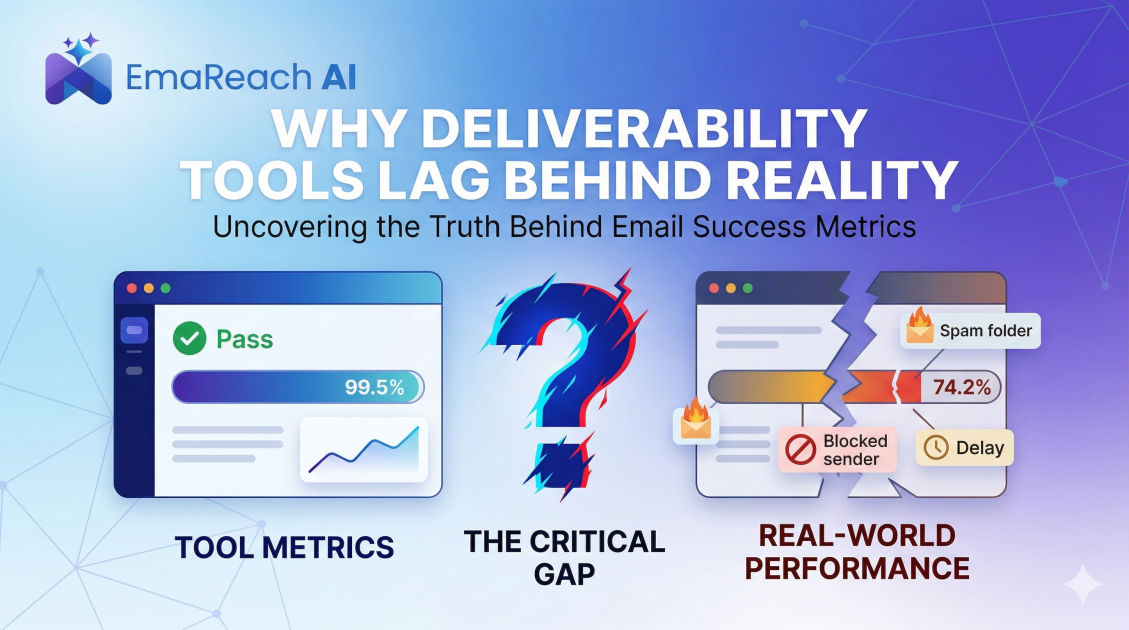
Why Deliverability Tools Lag Behind Reality
email deliverabilitycold outreachemail marketingsender reputationspam filtersinbox placement
The Mirage of 100% Deliverability
In the high-stakes world of digital communication, email deliverability is often treated as a binary metric: your email either arrived, or it didn't. To manage this, businesses rely on a suite of deliverability tools designed to monitor sender reputation, track blacklists, and provide 'spam scores.' However, there is a growing, uncomfortable gap between what these tools report and what is actually happening within the recipient's inbox.
While a tool might show a green checkmark and a high deliverability score, your actual open rates might be plummeting. This discrepancy exists because most deliverability tools operate on static logic, while the major Mailbox Providers (MBPs) like Google and Microsoft have shifted to dynamic, AI-driven, and behavior-based filtering. Understanding why these tools lag behind reality is the first step in reclaiming control over your email outreach.
The Evolution of Spam Filtering vs. Static Monitoring
In the early days of the internet, spam filtering was rudimentary. It relied on 'fingerprinting' and keyword matching. If an email contained certain 'trigger words' or came from an IP address known for sending bulk mail, it was blocked. Deliverability tools were built during this era, and many still rely on these foundational concepts.
Today, the reality is far more complex. Modern filters use machine learning models that analyze thousands of data points in real-time. They don't just look at the content; they look at the relationship between the sender and the receiver. They look at how many people moved your previous email from 'Promotions' to 'Primary,' how many clicked 'Report Spam' after opening, and even how long a user spent reading the message.
Deliverability tools lag because they cannot replicate the 'brain' of a Google or Outlook filter. They can check if your SPF, DKIM, and DMARC records are set up correctly—which is basic hygiene—but they cannot tell you how a specific AI filter will react to your message at 10:00 AM on a Tuesday based on your last thirty days of sending behavior.
The Problem with Seed Lists
Most deliverability testing tools use 'seed lists'—a cluster of email addresses owned by the tool provider. When you send a test email, the tool checks which folder the email landed in across these various addresses. While this provides a snapshot, it is a deeply flawed methodology for several reasons:
- Lack of Engagement History: Seed accounts are 'ghost' accounts. They don't have a human-like engagement history. Real filters prioritize emails based on past interactions. A seed account has no past interaction with you, so the filter treats the email as a cold interaction every single time.
- Static Environments: Seed lists are often hosted on the same subnets or managed environments. MBPs can recognize these patterns and may treat mail sent to seed lists differently than mail sent to active, organic users.
- The 'Observer Effect': By the time a deliverability tool identifies a trend across its seed list, the actual filtering algorithms have already evolved. The tools are reactive, whereas the reality of the inbox is proactive.
Why Technical Setup Isn't Enough
Many users find themselves frustrated when their deliverability tools report 'Perfect Technical Health' but their results suggest otherwise. This is because technical protocols like SPF and DKIM are now the bare minimum. They are no longer a 'boost' to deliverability; they are simply the ticket to enter the stadium.
The reality of the inbox is determined by Sender Reputation, which is subdivided into IP reputation and Domain reputation. Domain reputation is now the dominant factor. A tool can tell you if your domain is on a public blacklist, but it cannot see your 'internal' reputation score within Google Postmaster Tools or Microsoft’s proprietary filters. These internal scores are the 'reality,' and they are invisible to third-party monitoring tools.
The Human Element: Engagement-Based Filtering
Modern deliverability is a social credit system for your domain. If users reply to your emails, your reputation goes up. If they delete them without opening, it goes down. Deliverability tools struggle to measure this because they cannot simulate human interest.
This is where many cold outreach campaigns fail. You might have a clean list and a 'spam-free' template according to your tool, but if your message doesn't resonate with the audience, their lack of engagement will eventually sink your deliverability. Traditional tools monitor the pipes, but they don't monitor the sentiment of the water flowing through them.
For those looking to bridge this gap between technical checks and actual inbox success, a more holistic approach is required. Stop Landing in Spam. Cold Emails That Reach the Inbox. EmaReach (https://www.emareach.com/) addresses the reality that tools often miss. EmaReach AI combines AI-written cold outreach with inbox warm-up and multi-account sending—so your emails land in the primary tab and get replies. By simulating real human engagement and spreading volume across multiple accounts, it bypasses the limitations of static monitoring and aligns with how modern filters actually operate.
The Latency Gap in Blacklist Reporting
Blacklists were once the ultimate authority on deliverability. If you were on Spamhaus, you were in trouble. Today, while major blacklists still matter, many MBPs use their own internal 'reputation clusters.'
A deliverability tool might scan 100+ public blacklists and tell you that you are 'Clean.' However, you might be 'greylisted' by an ISP locally or throttled by Gmail because of a sudden spike in volume. By the time a sender appears on a public blacklist, the damage to their campaign is already done. The reality of filtering happens in the milliseconds before an email is accepted or rejected, long before the data is aggregated into a public list that a tool can crawl.
Content Analysis: Beyond 'Spam Words'
We have all seen the tools that highlight words like 'Free,' 'Buy Now,' or 'Winner' in red. While avoiding aggressive sales language is good practice, modern Natural Language Processing (NLP) used by MBPs is much more sophisticated. They can detect the intent of a message.
An email can avoid every single 'spam word' and still be flagged as spam if its structure, link-to-text ratio, and metadata resemble a phishing attempt or a low-value blast. Deliverability tools often lag because their content checkers are based on 'if-this-then-that' logic, whereas the reality of the inbox is based on 'contextual probability.'
The Impact of Recipient Behavior and Localized Filtering
One of the biggest reasons tools lag behind reality is the localization of deliverability. Your email might land in the inbox for a recipient in New York but hit the spam folder for a recipient in London, even if they use the same provider. Factors like local server load, regional filtering rules, and even the recipient's personal historical behavior (e.g., they always mark 'Marketing' emails as spam) play a role.
Deliverability tools provide a global average. Reality is a series of individual events. If your tool says you have a 98% deliverability rate, but that 2% of 'missing' emails represents your highest-value enterprise leads, the tool is effectively useless for your business goals.
How to Manage Deliverability in the Modern Era
Since tools can only tell us part of the story, how do we navigate the reality of the inbox? It requires a shift from 'monitoring' to 'orchestration.'
1. Focus on Inbox Warm-up
Warm-up is the process of gradually increasing email volume and generating positive engagement signals. Static tools can't do this; you need a system that interacts with other real inboxes to show MBPs that your mail is wanted. This builds the 'social proof' your domain needs to survive.
2. Diversify Your Infrastructure
Relying on a single 'perfect' IP or domain is a risk. Reality dictates that even the best senders will face temporary dips in reputation. By using multi-account sending strategies, you distribute the risk. If one account sees a dip in deliverability that your tools didn't catch, the rest of your campaign remains unaffected.
3. Prioritize Metadata and Technical Health
While technical health isn't everything, it is the foundation. Ensure your DMARC policy is moving toward 'reject' and that your tracking links are branded. Many deliverability tools miss the fact that using generic tracking domains (shared with thousands of other senders) is a primary reason for hitting the spam folder.
4. Real-time Feedback Loops
Instead of just looking at tool dashboards, look at your 'Reply Rate' and 'Negative Reply Rate.' If people are responding with 'Unsubscribe' or 'Stop,' it's a signal that your content is misaligned. This human feedback is a more accurate predictor of future deliverability than any 'spam score' from a software vendor.
The Role of AI in Closing the Gap
As mailbox providers use AI to block mail, senders must use AI to ensure their mail is relevant. AI can help personalize content at scale, ensuring that each recipient receives a message that feels tailored to them. This increases engagement, which in turn improves deliverability.
Systems that integrate AI-driven writing with smart sending patterns, like EmaReach, represent the next generation of outreach. They don't just 'check' deliverability; they actively create the conditions for it by behaving like a high-quality human sender would, rather than a bulk-mailing script.
Moving Toward a Holistic Strategy
The reality of email deliverability is that it is a moving target. It is an arms race between those trying to protect the inbox and those trying to reach it. Deliverability tools are helpful mirrors, but they are often looking at where the target was, not where it is going.
To succeed, marketers must stop chasing 'perfect scores' in tools and start focusing on the fundamental principles of good communication: sending relevant messages to the right people, maintaining a healthy infrastructure, and generating genuine engagement.
Key Takeaways for Modern Senders:
- Don't trust 'green lights' blindly: Always cross-reference tool data with your actual engagement metrics (opens and replies).
- Reputation is fluid: Your standing with Google can change hourly based on how the first few recipients of your day interact with your mail.
- Human signals are the ultimate currency: Replies, 'not spam' marks, and long dwell times are what actually keep you out of the junk folder.
- Tools are diagnostic, not curative: A tool can tell you your heart rate is high, but it can't run the marathon for you.
Conclusion
Deliverability tools lag behind reality because they are built on the logic of the past—static lists, keyword checks, and public database monitoring. The reality of the inbox is dynamic, powered by invisible AI models and individual user behaviors. While these tools remain necessary for catching technical errors and major configuration blunders, they cannot be the sole compass for your outreach strategy.
By acknowledging the limitations of these tools and focusing on high-engagement strategies, infrastructure diversification, and advanced platforms like EmaReach, you can ensure that your voice is heard in an increasingly crowded digital landscape. The goal isn't just to 'pass a test' provided by a tool; the goal is to land in the primary inbox of a real person and start a meaningful conversation. At the end of the day, your recipients—not your tools—are the final judges of your deliverability.
EmaReach AI
Ready to scale your cold email outreach?
Join thousands of teams using EmaReach AI for AI-powered campaigns, domain warmup, and 95%+ deliverability. Start free — no credit card required.
Related posts
- Read article
The Instantly Alternative That Finally Gets Outbound Analytics Right
Discover why high-volume cold email requires a shift from surface-level vanity metrics to deep, data-driven revenue attribution, and explore the ultimate alternatives for mastering outbound engineering.
- Read article
How Choosing the Right Instantly Alternative Changed Our Pipeline Numbers
Discover how transitioning from a volume-first cold email setup to an advanced, deliverability-focused infrastructure transformed our B2B pipeline metrics, skyrocketed open rates to over 68%, and tripled our monthly booked demos.