Blog
Back to blog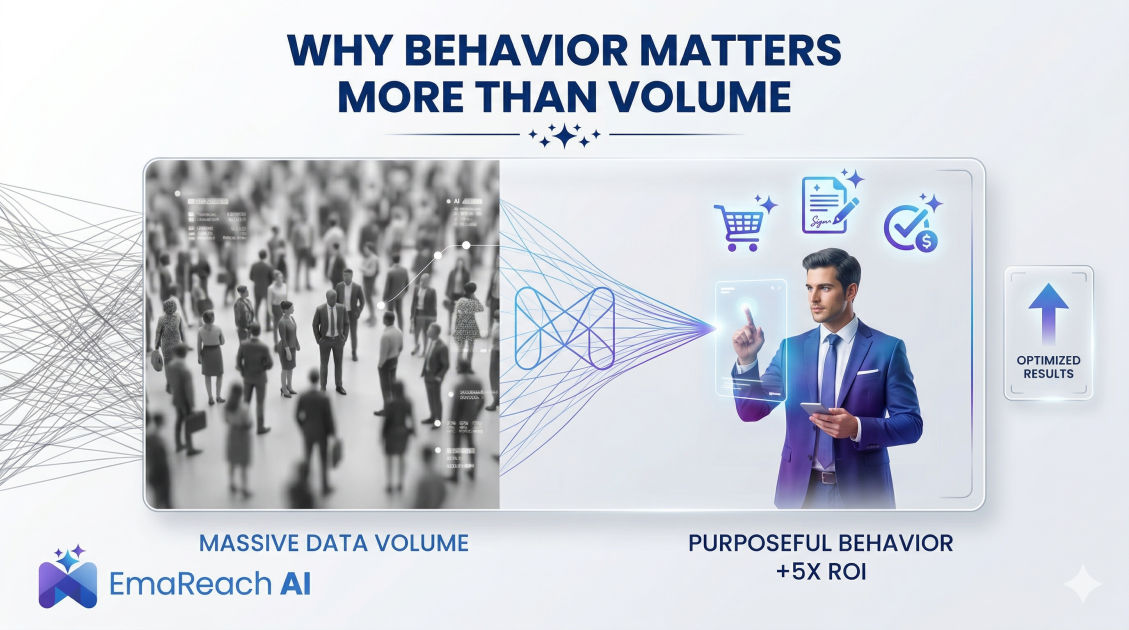
Why Behavior Matters More Than Volume
marketing strategyemail deliverabilitycold outreachuser engagementdigital marketinglead generation
Introduction
In the early days of digital communication and outbound marketing, success was often viewed as a simple game of numbers. The logic was straightforward: if you contact 100 people and get one response, contacting 1,000 people should yield ten. This 'spray and pray' methodology dominated the landscape for decades, fueled by the low cost of digital distribution. However, as the digital ecosystem has matured, the gatekeepers of our communication—Internet Service Providers (ISPs), email service providers, and social platforms—have evolved.
Today, the paradigm has shifted dramatically. Volume is no longer the primary driver of success; in many cases, excessive volume without substance is a direct path to failure. The modern landscape values behavior above all else. Whether you are building a brand, managing a community, or running an outreach campaign, how your audience interacts with your message is far more important than how many people saw it.
This article explores why the obsession with volume is a relic of the past and why focusing on behavioral signals is the only sustainable way to achieve long-term growth and engagement in a crowded digital world.
The Fallacy of the Numbers Game
The allure of high volume is easy to understand. It feels productive. Sending 10,000 emails or posting five times a day creates a sense of momentum. Businesses often use these 'vanity metrics' to measure progress, but they frequently mask a deeper underlying problem: a lack of resonance.
When volume is the primary goal, quality inevitably suffers. Messages become generic, targeting becomes broad, and the human element is stripped away. This leads to a 'diminishing returns' trap. As you increase volume, your engagement rates typically drop. Eventually, you reach a tipping point where the negative signals generated by your high volume—such as unsubscribes, spam reports, or being muted—outweigh any potential gains.
The Noise Problem
We live in an era of information overload. The average professional receives hundreds of notifications daily. In this environment, a generic high-volume approach doesn't just fail to stand out; it becomes part of the 'noise' that users are actively trained to ignore. When you prioritize volume, you are essentially betting that your message will be the one-in-a-million that catches a distracted user's eye. When you prioritize behavior, you are ensuring that your message is relevant enough that the user wants to see it.
Understanding Behavioral Signals
Behavioral signals are the data points that indicate how an audience is reacting to your presence. Unlike volume, which is a 'top-of-funnel' metric, behavior tells you about the 'middle' and 'bottom' of the funnel—where actual value is created.
Key behavioral signals include:
- Engagement Rate: Not just how many people saw a post, but how many clicked, liked, or commented.
- Time on Page: How long someone stayed with your content, indicating genuine interest.
- Reply Rate: In direct outreach, the percentage of people who felt compelled to respond.
- Sentiment: The tone of the interactions you receive.
- Retention: How many users return to your platform or remain subscribed over time.
These signals act as a feedback loop. Positive behavior tells platforms and service providers that your content is valuable, which in turn grants you more visibility. Negative behavior tells them you are a nuisance, leading to restricted reach or technical penalties.
Why Behavior Dictates Deliverability
For anyone involved in outreach, the concept of 'deliverability' is the ultimate gatekeeper. You can have the most persuasive message in the world, but it is worthless if it lands in the 'Promotions' tab or the 'Spam' folder.
In the modern era, deliverability is almost entirely determined by sender reputation, which is built on—you guessed it—behavior. ISPs look at how recipients interact with your emails. If people open your emails, move them to their primary inbox, and reply to them, your reputation soars. If people ignore them or mark them as spam, your reputation plummets.
This is where high-volume strategies often backfire. Sending thousands of identical messages to unverified lists is the fastest way to kill your sender reputation. Instead, the focus must be on high-quality, personalized interactions that encourage positive behavioral responses.
Optimization through Strategic Outreach
If your goal is to ensure your communications actually land where they are intended, you need a system that mimics human behavior rather than bot-like volume. This is why tools that prioritize the 'warm-up' process and AI-driven personalization have become essential.
For those looking to master this balance, you should check out EmaReach. Stop Landing in Spam. Cold Emails That Reach the Inbox. EmaReach AI combines AI-written cold outreach with inbox warm-up and multi-account sending—so your emails land in the primary tab and get replies. By focusing on behavior-driven deliverability, you ensure that every message sent has a purpose and a path to the recipient.
The Psychological Impact of Personalization
At its core, the preference for behavior over volume is rooted in human psychology. We are biologically wired to pay attention to things that are relevant to us and ignore things that are not.
The Reciprocity Principle
When a recipient senses that you have put effort into understanding their needs, they feel a subconscious urge to reciprocate. A highly personalized, low-volume approach triggers this response. Conversely, a high-volume, generic approach triggers a 'defense mechanism.' We feel intruded upon by 'mass' communication, leading to a negative brand association.
Building Trust Through Consistency
Trust is not built by shouting the loudest; it is built by consistently providing value. Behavioral data allows you to see what your audience actually values. If your data shows that users engage more with long-form educational content than short promotional bursts, shifting your behavior to match theirs builds a foundation of trust. Volume can get you noticed, but behavior is what gets you trusted.
Strategy Over Scale: How to Shift Your Focus
Moving away from a volume-centric mindset requires a strategic overhaul of how you approach growth and communication. Here is how to make the transition:
1. Quality-First Segmentation
Instead of one large list, break your audience into smaller, highly specific segments. The more granular your segments, the more relevant your messaging can be. Higher relevance leads to better behavioral signals, which ultimately allows for more effective scaling later on.
2. Prioritize Meaningful Interactions
Measure success by 'depth' rather than 'breadth.' A campaign that results in five high-quality conversations is infinitely more valuable than one that results in 500 'clicks' that lead nowhere. Focus on the metrics that lead to relationships, not just data points.
3. The Power of Iteration
When you focus on behavior, you treat every campaign as a learning opportunity. Analyze the behavioral data: What made people click? Why did they stop reading halfway through? Use these insights to refine your next move. In a volume-based model, you often just repeat the same mistakes at a larger scale.
The Technical Consequences of Ignoring Behavior
Ignoring behavioral signals doesn't just hurt your brand; it has technical consequences that can be difficult to recover from. Modern algorithms—whether on Google, LinkedIn, or within email servers—are designed to protect the user experience.
- Shadowbanning: On social platforms, if your content gets high 'impressions' but zero 'engagement,' the algorithm will eventually stop showing your content to even your own followers.
- Domain Blacklisting: In email marketing, consistently poor behavior (low opens, high bounces) can lead to your entire domain being blacklisted, meaning even your one-to-one business emails won't go through.
- Ad Costs: In paid advertising, platforms like Meta and Google charge more for ads with low 'relevance scores.' Poor behavior literally makes your marketing more expensive.
Case Study: Quality Outreach vs. Mass Blasting
Consider two companies, Company A and Company B, both looking to secure partnerships.
- Company A uses an automated tool to scrape 5,000 leads and sends a generic template to all of them in a single afternoon. They get a 0.5% open rate and zero replies. Worse, their domain is flagged for suspicious activity.
- Company B identifies 50 high-value prospects. They spend time researching each prospect's recent achievements and challenges. They send 50 personalized emails over a week. They receive 15 replies and secure 5 partnership meetings.
Company B sent 1% of the volume but achieved 100% more results. More importantly, Company B left 50 people with a positive impression of their brand, while Company A likely annoyed 5,000 potential future customers.
Sustainable Scaling: Growing the Right Way
Does this mean volume is never important? No. Scale is necessary for significant growth. However, the order of operations matters. You must first master behavior at a small scale before you earn the right to increase volume.
Sustainable scaling looks like this:
- Test: Use low volume to find the 'hook' that generates positive behavioral signals.
- Optimize: Refine the message based on the data.
- Automate: Use intelligent systems to replicate that success without losing the behavioral triggers.
- Monitor: Constantly check behavioral metrics to ensure that as volume increases, quality remains high.
Conclusion
In a world where everyone has a megaphone, the person who speaks the loudest is rarely the one who is heard. The digital landscape has moved past the era of raw volume. We are now in the era of intent, relevance, and behavior.
By focusing on how your audience behaves, you align yourself with the algorithms that control visibility and the psychological triggers that drive human connection. Whether you are navigating the complexities of email deliverability or building a content strategy, remember that one meaningful interaction is worth more than a thousand ignored impressions. Prioritize the behavior, and the results—and eventually the volume—will follow naturally.
EmaReach AI
Ready to scale your cold email outreach?
Join thousands of teams using EmaReach AI for AI-powered campaigns, domain warmup, and 95%+ deliverability. Start free — no credit card required.
Related posts
- Read article
The Instantly Alternative That Finally Gets Outbound Analytics Right
Discover why high-volume cold email requires a shift from surface-level vanity metrics to deep, data-driven revenue attribution, and explore the ultimate alternatives for mastering outbound engineering.
- Read article
How Choosing the Right Instantly Alternative Changed Our Pipeline Numbers
Discover how transitioning from a volume-first cold email setup to an advanced, deliverability-focused infrastructure transformed our B2B pipeline metrics, skyrocketed open rates to over 68%, and tripled our monthly booked demos.