Blog
Back to blog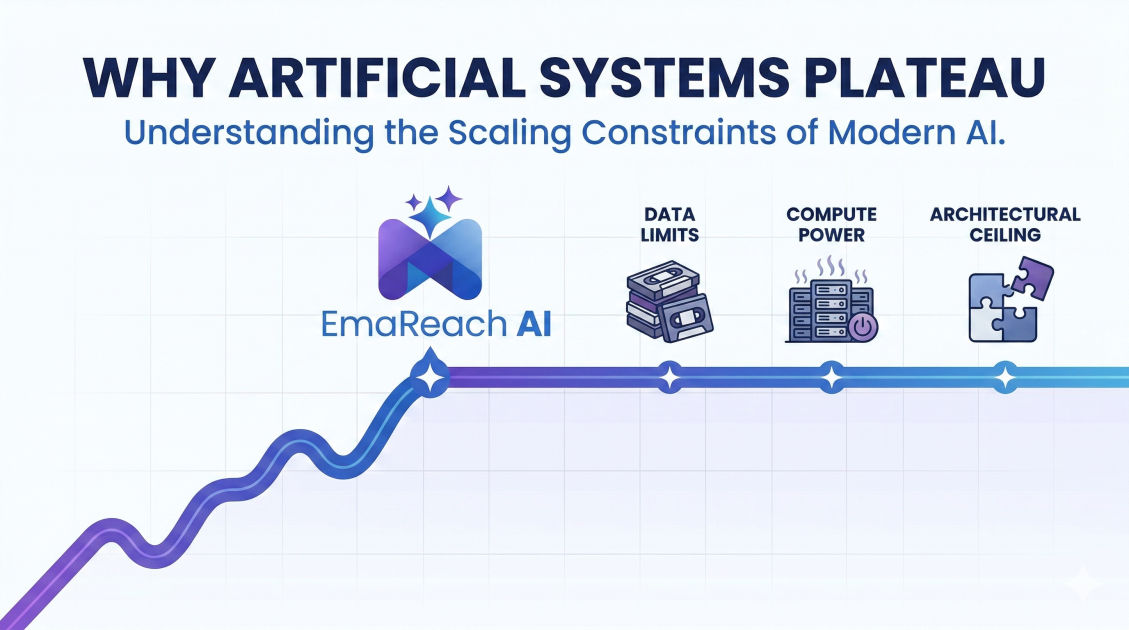
Why Artificial Systems Plateau
artificial intelligencemachine learningscaling lawsdata scienceneural networkstechnology trendsmodel collapse
Introduction
The rapid advancement of artificial systems often creates an illusion of exponential, unending progress. From natural language processing algorithms that generate human-like text to complex computer vision networks that power autonomous navigation, the leaps in computational capability have fundamentally reshaped how we interact with technology. However, history and mathematics both suggest that no technological development curve climbs infinitely without eventually encountering systemic friction. Eventually, artificial systems hit a plateau—a phase where exponentially more effort, data, and computational power yield increasingly marginal improvements in actual performance.
Understanding why this deceleration occurs requires looking past the surface-level hype and diving deep into the foundational architecture, data pipelines, and physical constraints of modern machine learning. A plateau is not necessarily a sign of failure; rather, it is a naturally occurring asymptote in the S-curve of technological evolution. When current paradigms stretch to their absolute physical, mathematical, and logical limits, the rate of innovation naturally slows. This comprehensive analysis explores the multifaceted reasons why artificial systems inevitably plateau, examining the compounding challenges of data scarcity, computational thermodynamics, architectural limitations, and the fundamental complexities of true cognitive reasoning.
The Illusion of Infinite Scaling Laws
For an extended period, the development of artificial systems has been driven by remarkably consistent scaling laws. The underlying premise was straightforward: if you increase the amount of computational power (compute), the volume of training data, and the number of parameters within a neural network, the performance of the system will improve predictably. This empirical observation fueled a massive arms race in infrastructure build-outs and data acquisition.
However, scaling laws are bound by the law of diminishing returns. Initially, transitioning a model from a few million parameters to a few billion yields catastrophic leaps in capability, solving previously intractable problems. But as systems scale into the trillions of parameters, the performance gains begin to shrink relative to the investment required. To achieve a linear improvement in performance, organizations must apply an exponentially larger amount of resources.
This phenomenon is comparable to pushing a boulder up a mountain that grows steeper the higher you climb. At the base, forward momentum is relatively easy to achieve. Near the peak, the same amount of effort might only move the boulder a few inches. Artificial systems hit a plateau because the brute-force method of simply "making it bigger" eventually becomes economically and physically unsustainable. We reach a point where the cost of training a slightly smarter model far outweighs the commercial or scientific utility of that incremental intelligence.
The Impending Data Wall: Quality vs. Quantity
Artificial systems, particularly deep neural networks, are notoriously data-hungry. They learn by identifying statistical patterns across unimaginably massive datasets. Historically, the internet served as an ever-expanding, seemingly limitless reservoir of text, images, and video to feed these algorithms.
However, researchers are increasingly encountering what is known as the "data wall." While the sheer volume of digital information continues to grow, the supply of high-quality, human-generated data—the "clean" data necessary for training highly capable and reliable systems—is fundamentally finite. Artificial systems have already ingested vast portions of the world's digitized books, articles, code repositories, and curated conversational text.
Once the well of premium data runs dry, developers are forced to rely on lower-quality sources to maintain the scaling trajectory. This introduces noise, inaccuracies, and toxic content into the training pipeline. The principle of "garbage in, garbage out" remains an immutable law of computer science. When an artificial system is fed degraded or highly repetitive data, its cognitive capabilities do not merely stagnate; they can actively degrade. The plateau occurs because the system can no longer find novel, high-quality information from which to extract complex underlying world models.
The Perils of Synthetic Data and Model Collapse
To circumvent the exhaustion of human-generated data, developers have increasingly turned to synthetic data—using advanced artificial systems to generate new training data for subsequent models. On the surface, this creates a theoretically infinite feedback loop of information.
In reality, this approach risks a phenomenon known as "model collapse." When artificial systems train primarily on data generated by other artificial systems, they begin to over-amplify common patterns and progressively forget the rare, edge-case information that represents the true diversity of the real world. Over multiple generations, the synthetic data loop acts as a lossy compression algorithm. The system loses its variance and its outputs become increasingly generic, bland, and disconnected from reality. Model collapse acts as a hard ceiling, forcing a plateau in system capability because an AI cannot learn entirely new concepts from an echo chamber of its own creation.
Thermodynamic and Computational Ceilings
Beyond data limitations, artificial systems are bound by the harsh realities of physics and thermodynamics. The hardware required to train and run massive neural networks—specialized graphics processing units (GPUs) and application-specific integrated circuits (ASICs)—consumes staggering amounts of electricity and generates immense heat.
As models grow exponentially larger, the energy required to train them scales proportionately. We are approaching a threshold where the power requirements for training the next generation of artificial systems could rival the energy consumption of small nations. This thermodynamic ceiling forces a plateau not merely due to technological limitations, but due to absolute planetary and economic constraints. The cost of electricity, the environmental impact, and the physical limits of data center cooling systems all act as a brake on unending scaling.
The Von Neumann Bottleneck and the Memory Wall
Even if energy were unlimited, hardware architecture presents its own plateau. Most modern computing relies on the Von Neumann architecture, which separates the processing unit from the memory storage. In the context of artificial intelligence, which requires shuffling terabytes of data back and forth continuously, this separation creates a severe latency issue known as the "memory wall."
Processors have become incredibly fast at performing mathematical operations, but the speed at which data can be transferred between memory chips and processors has not kept pace. Therefore, artificial systems often plateau because their computational cores spend the majority of their time idling, waiting for data to arrive from memory. Until fundamental breakthroughs in hardware architectures—such as analog computing or in-memory processing—are widely commercialized, the memory wall will enforce a strict limit on system speed and capability.
Architectural Constraints: The Limits of Pattern Matching
The most dominant paradigm in modern artificial intelligence is deep learning, heavily reliant on architectures like Transformers. These systems are extraordinary at pattern recognition and statistical prediction. Given a sequence of data, they can predict the most statistically probable next element with astonishing accuracy.
However, statistical prediction is fundamentally different from grounded reasoning, causal understanding, or true intelligence. Artificial systems plateau because their underlying architectures are optimized for mimicking cognition rather than performing actual cognitive deduction. They do not have an internal, structured model of the physical world. They do not inherently understand the laws of physics, temporal logic, or human psychology; they merely map relationships between tokens of data.
This lack of causal reasoning becomes painfully apparent when systems encounter "out-of-distribution" problems—scenarios that were not heavily represented in their training data. A human can abstractly reason through a completely novel problem by applying first principles. An artificial system, constrained by its reliance on pattern matching, will often fail catastrophically or hallucinate entirely incorrect answers when faced with the unknown. The plateau exists because predicting the next word or pixel is an inherently limited paradigm that cannot indefinitely scale into true artificial general intelligence.
The Curse of Dimensionality and Catastrophic Forgetting
As we demand artificial systems to handle more complex, multi-faceted tasks, we increase the mathematical dimensionality of the space they must navigate. In machine learning, the "curse of dimensionality" dictates that as you add variables, the volume of the mathematical space grows so rapidly that the available training data becomes sparse. This leads to overfitting, where the system memorizes the training data perfectly but fails to generalize to the real world, causing a sharp plateau in practical usefulness.
Furthermore, artificial systems suffer from "catastrophic forgetting." Unlike humans, who can continuously learn new skills while retaining old ones, a neural network struggles to update its weights with new information without accidentally overwriting previously learned knowledge. If a system must be entirely retrained from scratch just to learn a minor new fact, the friction of continuous learning becomes overwhelmingly high, leading to a functional plateau in how adaptable the system can be in real-time environments.
The Human Bottleneck in Alignment and Evaluation
As artificial systems become more sophisticated, ensuring their outputs are safe, accurate, and aligned with human values becomes an increasingly complex challenge. The current industry standard involves techniques like Reinforcement Learning from Human Feedback (RLHF), where human evaluators score the outputs of the system to guide its behavior.
This creates a profound plateau driven by the "human bottleneck." As systems become capable of generating complex code, advanced mathematical proofs, or highly nuanced technical analysis, the average human evaluator loses the ability to accurately assess the quality of the output. If the system is smarter than the human grading it, the feedback loop breaks down.
Humans are also inherently biased, inconsistent, and easily persuaded by confident-sounding but factually incorrect outputs. This limitation in the alignment process means that models can only become as reliable as the humans evaluating them. Once artificial systems reach a level of complexity that surpasses the cognitive bandwidth of their human supervisors, their ability to self-correct and improve safely hits a definitive plateau.
Moving Forward: Breaking Through the Plateau
Recognizing that artificial systems plateau is not a reason for pessimism, but rather a catalyst for the next great paradigm shift. Brute-force scaling of current architectures is giving way to a focus on efficiency, novel structures, and algorithmic elegance.
Researchers are actively exploring "neurosymbolic AI," which attempts to combine the pattern-recognition strengths of deep learning with the strict logical and rules-based reasoning of traditional symbolic AI. This could bypass the limits of statistical guessing by embedding actual causal logic into the system's core. Additionally, architectures like Mixture of Experts (MoE) are being deployed to make systems larger without proportionally increasing the computational cost during inference, essentially allowing the system to only activate the "parts of its brain" necessary for a specific task.
Furthermore, there is a massive push toward algorithmic efficiency—achieving the same level of performance with a fraction of the parameters and data. Grounded learning, where systems learn by interacting with simulated physical environments rather than just passively ingesting static text, may eventually solve the lack of world models that currently constrain development.
Conclusion
The plateau of artificial systems is a complex, multifaceted phenomenon driven by the exhaustion of high-quality training data, the thermodynamic and physical limits of hardware, and the inherent logical constraints of statistical pattern matching. While the illusion of infinite scaling has propelled the industry to incredible heights, relying solely on expanding current paradigms will yield diminishing returns. The true path forward requires looking beyond sheer size. Breaking through the current plateau will not be achieved merely by building larger data centers or scraping more of the internet, but through fundamental architectural breakthroughs, the integration of causal reasoning, and the transition from systems that merely predict, to systems that truly understand.
EmaReach AI
Ready to scale your cold email outreach?
Join thousands of teams using EmaReach AI for AI-powered campaigns, domain warmup, and 95%+ deliverability. Start free — no credit card required.
Related posts
- Read article
The Instantly Alternative That Finally Gets Outbound Analytics Right
Discover why high-volume cold email requires a shift from surface-level vanity metrics to deep, data-driven revenue attribution, and explore the ultimate alternatives for mastering outbound engineering.
- Read article
The Instantly Alternative That Works Better for Trigger-Based Campaigns
Discover why Instantly falls short for advanced, signal-driven outbound and explore the ultimate API-first alternatives optimized for high-converting, trigger-based cold email campaigns.