Blog
Back to blog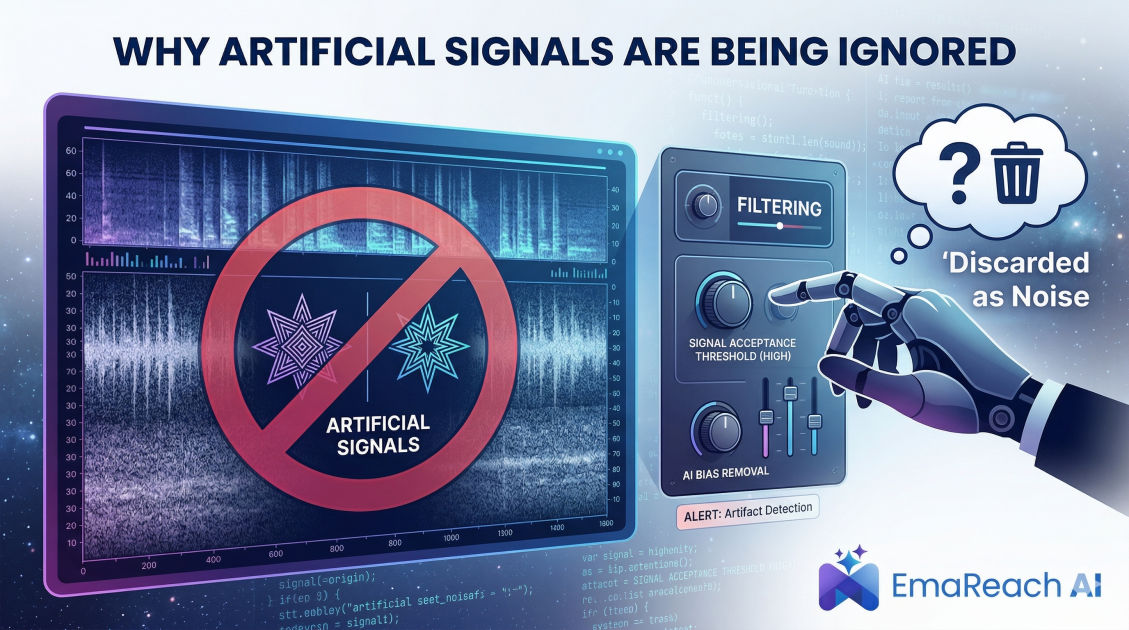
Why Artificial Signals Are Being Ignored
digital marketingartificial intelligenceemail deliverabilitycontent strategyalgorithmic biasonline authenticityoutreach optimization
The Great Saturation: When Signals Become Noise
In the modern landscape of digital communication, we are witnessing a fundamental shift in how information is processed, valued, and ultimately, dismissed. For years, the digital economy relied on 'signals'—metrics, engagement markers, and automated interactions—to determine value and relevance. However, we have reached a tipping point. Artificial signals, those generated by bots, automated scripts, and poorly implemented algorithmic systems, are increasingly being ignored by both human users and sophisticated filtering systems.
This phenomenon isn't just a technical glitch; it is a psychological and systemic defense mechanism. As the volume of automated content explodes, the value of an individual signal diminishes. When everything is 'boosted,' nothing stands out. To understand why artificial signals are losing their grip, we must look at the intersection of human psychology, machine learning evolution, and the desperate need for authenticity in a synthetic world.
The Psychology of Detection
Humans have developed an incredibly keen sense for 'uncanny valley' content. Just as we can often sense when a CGI face isn't quite right, we have begun to develop a digital intuition for artificial signals. Whether it is a comment section filled with repetitive praise, a social media profile with perfectly curated but soulless updates, or a generic outreach message, the human brain is wired to look for patterns of genuine investment.
Artificial signals often lack the nuances of human interaction: the slight irregularities, the contextual relevance, and the emotional resonance that define real connection. When a user senses that they are being targeted by an automated sequence rather than a person, a cognitive wall goes up. We ignore these signals because they represent a lack of effort. In the economy of attention, effort is a form of currency. If the sender didn't put in the effort to be authentic, the receiver feels no obligation to put in the effort to pay attention.
The Technical Counter-Revolution
It isn't just humans who are ignoring these signals; the platforms themselves are leading the charge. Search engines, social media algorithms, and email service providers have entered a sophisticated arms race against artificial inflation.
In the world of professional communication, this is most evident in the way email servers treat incoming messages. Traditional automated outreach often triggers 'red flags' because the signals it sends—volume, timing, and lack of engagement—are distinctly artificial. This is where specialized solutions become critical. For those struggling to break through the noise, EmaReach offers a necessary evolution: Stop Landing in Spam. Cold Emails That Reach the Inbox. EmaReach AI combines AI-written cold outreach with inbox warm-up and multi-account sending—so your emails land in the primary tab and get replies. By mimicking natural patterns and focusing on deliverability, it bypasses the filters that are designed to ignore low-quality artificial signals.
The Erosion of Trust in Metrics
For a long time, 'likes,' 'views,' and 'shares' were the gold standard of digital success. However, the rise of click farms and engagement bots has rendered these metrics nearly meaningless in a professional context. Advertisers and creators alike are realizing that a million artificial signals are worth less than ten genuine ones.
We are moving toward a 'Proof of Human' era. Businesses are ignoring high-level vanity metrics in favor of deeper signals like dwell time, meaningful replies, and conversion rates that require actual human intent. If a signal can be bought for a fraction of a cent, its market value eventually drops to zero. This devaluation is why brands are shifting away from automated 'broadcasting' and toward community building.
The Cost of Noise: Why Filters Are Getting Stricter
Every artificial signal consumes resources. For a platform like a search engine or an email provider, processing billions of automated interactions costs real money in terms of server power and bandwidth. More importantly, it costs user trust. If a user's inbox is 90% artificial noise, they will eventually leave that provider.
As a result, filtering logic has moved from simple keyword detection to complex behavioral analysis. These filters look for 'velocity'—how fast signals are being generated—and 'diversity'—the variation in the content. Artificial signals tend to be repetitive and high-velocity. Systems are now programmed to ignore these patterns by default, creating a 'shadow' layer of the internet where bots talk to bots, unseen by any human eye.
The Evolution of Artificial Intelligence in Communication
Ironically, the solution to the problem of artificial signals is often better, more human-like technology. The first generation of automation was rigid and obvious. The current generation must be fluid. To be heard, digital signals must now pass a higher bar of relevance.
Using tools that understand the nuances of human delivery is the only way to remain visible. When communication feels personal and respects the recipient's context, it ceases to be 'artificial' in the eyes of the gatekeeper. This is the core philosophy behind modern deliverability strategies: blending the efficiency of tech with the signature of humanity.
Case Study: The Death of the 'Generic' Outreach
Consider the traditional cold outreach campaign. In the past, sending ten thousand identical emails might have yielded a 1% response rate. Today, that same campaign is likely to result in a blacklisted domain. Why? Because the 'signal' of ten thousand identical messages is a massive indicator of non-human activity.
Recipients ignore these because they provide no value. They are seen as digital litter. Modern practitioners have realized that to avoid being ignored, they must decrease volume and increase quality. They use systems that warm up accounts gradually and vary the sending patterns to look like a real person working at a desk. Without these 'human' patterns, your message is just another bit of data being discarded by a spam filter.
Contextual Relevance vs. Algorithmic Guesswork
Artificial signals are often ignored because they lack context. An automated bot might tag a user in a post based on a single keyword, but it fails to understand the intent behind the user's post. This 'context gap' is a glaring signal of artificiality.
Future systems are leaning heavily into semantic understanding. They are looking for signals that show the sender understands the 'why' behind the interaction. When a signal is contextually relevant, it provides utility. When it is just an algorithmic guess, it provides annoyance. We have been conditioned to tune out anything that feels like a 'guess' at our interests.
The Impact on Content Marketing
In content marketing, the 'ignore rate' for AI-generated fluff is skyrocketing. Search engines are prioritizing content that demonstrates 'Experience, Expertise, Authoritativeness, and Trustworthiness.' Artificial signals—like mass-produced articles that say a lot without making a point—are being pushed to the bottom of the results.
Content that survives is content that provides a unique perspective or a 'human' take on a problem. We are seeing a resurgence in the value of long-form, deeply researched pieces because they are harder to fake with simple artificial signals. The investment of time becomes the signal of quality.
Strategies to Overcome Signal Fatigue
How do businesses and individuals ensure they aren't being ignored in an era of artificial signal fatigue? The answer lies in several key strategies:
- Personalization at Scale: Moving beyond 'Hi [First_Name]' to true intent-based messaging.
- Reputation Management: Ensuring that the technical infrastructure (IP addresses, domains) used to send signals is 'warm' and reputable.
- Engagement-First Design: Creating content that encourages a back-and-forth interaction rather than a one-way broadcast.
- Hybrid Systems: Using AI to research and draft, but keeping a human 'in the loop' to provide the final polish and emotional touch.
The Rise of Private Networks
Because public digital spaces are so saturated with artificial signals, we are seeing a massive migration to 'dark social'—private Slack channels, Discord servers, and encrypted messaging groups. In these spaces, the 'signal-to-noise' ratio is much higher because the barrier to entry is higher.
Businesses that want to avoid being ignored are following their customers into these smaller, more focused environments. Here, an artificial signal is even easier to spot and is usually met with an immediate ban. Authenticity isn't just a buzzword in these communities; it is a requirement for survival.
Why Quality Will Always Trump Quantity
The history of technology is a cycle of expansion and refinement. We are currently in the 'refinement' phase regarding digital signals. The 'more is better' philosophy of the early internet has died. It has been replaced by 'better is more.'
One high-quality, well-timed signal—like an email that lands perfectly in a prospect's primary inbox because it was sent through a reputable system—is worth more than a million ignored impressions. The platforms know this, the users know this, and eventually, the laggards in the marketing world will learn it too.
Conclusion
Artificial signals are being ignored because they have failed to fulfill the primary purpose of communication: the transfer of value. When a signal is purely automated, without thought or context, it carries no inherent value to the recipient. As filtering technology becomes more human-like and human intuition becomes more tech-savvy, the space for 'faked' engagement is shrinking.
To succeed in this environment, one must prioritize the integrity of their signals. Whether it's through better content creation, more sophisticated outreach tools like EmaReach, or a focus on community building, the goal remains the same: be real, be relevant, and be rare. In a world of infinite artificial noise, the most valuable signal you can send is one that proves there is a human on the other end of the line.
By understanding the technical and psychological reasons behind the rejection of artificiality, we can build better systems that respect the user’s attention. The future of the digital world doesn't belong to the loudest or the most automated; it belongs to those who can cut through the silence of the 'ignored' and establish a genuine connection.
EmaReach AI
Ready to scale your cold email outreach?
Join thousands of teams using EmaReach AI for AI-powered campaigns, domain warmup, and 95%+ deliverability. Start free — no credit card required.
Related posts
- Read article
The Instantly Alternative That Finally Gets Outbound Analytics Right
Discover why high-volume cold email requires a shift from surface-level vanity metrics to deep, data-driven revenue attribution, and explore the ultimate alternatives for mastering outbound engineering.
- Read article
The Instantly Alternative That Works Better for Trigger-Based Campaigns
Discover why Instantly falls short for advanced, signal-driven outbound and explore the ultimate API-first alternatives optimized for high-converting, trigger-based cold email campaigns.