Blog
Back to blog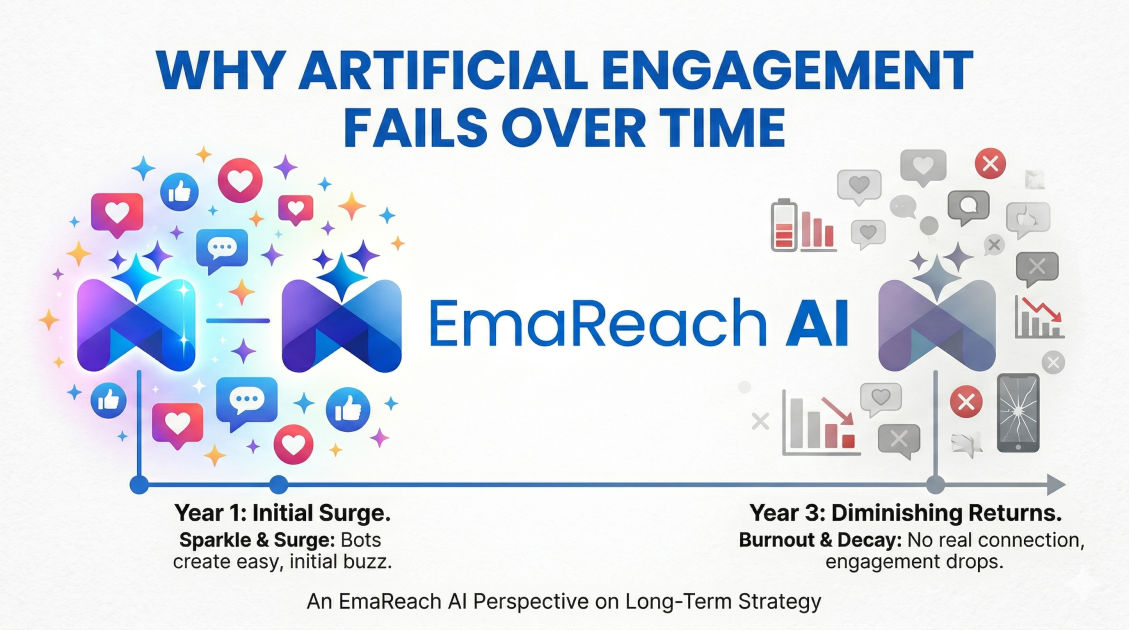
Why Artificial Engagement Fails Over Time
digital marketingsocial media strategybrand authenticityalgorithm updatesonline credibilityoutreach marketingemail deliverability
The Illusion of Popularity: Understanding Artificial Engagement
In the digital age, the pressure to maintain a high-performing online presence has never been greater. Whether you are a brand, a content creator, or a business professional, metrics like likes, comments, and follower counts often serve as the primary yardstick for success. This pressure has given rise to the phenomenon of artificial engagement—the practice of using bots, click farms, or incentivized pods to inflate social proof.
While the allure of an overnight spike in numbers is tempting, artificial engagement is a house of cards. It offers a fleeting sense of authority but lacks the foundational strength required for long-term growth. Over time, these shortcuts do more than just plateau; they actively erode the credibility and technical health of a digital profile. To understand why this strategy is destined for failure, we must look at the intersection of human psychology, platform algorithms, and the fundamental mechanics of digital trust.
The Algorithm's Evolution: From Quantity to Quality
Early digital platforms operated on relatively simple logic: the more engagement a piece of content received, the more it was promoted. However, developers have spent years refining their algorithms to prioritize authentic human interaction. Today’s systems are highly sophisticated, utilizing machine learning to distinguish between a genuine comment and a bot-generated response.
Detection of Patterns and Anomalies
Algorithms are designed to recognize patterns. Human behavior is naturally erratic; users log in at different times, engage with content in varying sequences, and leave comments that reflect personal nuances. Artificial engagement, by contrast, is often systematic. When a post receives five hundred likes in the first three minutes followed by total silence, it triggers a red flag.
Platforms now monitor the 'velocity' and 'source' of engagement. If the engagement originates from accounts with no profile pictures, no activity history, or IP addresses linked to known bot networks, the content is flagged. Instead of boosting the post, the algorithm may 'shadowban' the account, ensuring that its reach is restricted to a fraction of its actual following. Over time, the platform learns to distrust the account entirely, making it nearly impossible for organic content to ever gain traction.
The Feedback Loop of Irrelevance
One of the most damaging effects of artificial engagement is the corruption of your data profile. Algorithms use your current engagers to determine who else might like your content. If your posts are being 'liked' by bots or disinterested parties in an engagement pod, the algorithm builds a lookalike audience based on those fake profiles.
Consequently, the platform begins showing your content to more fake accounts or users who have zero interest in your niche. This creates a death spiral where your content is shown to the wrong people, resulting in zero genuine conversions and further signaling to the platform that your content is of low quality.
The Psychology of Trust and Social Proof
Beyond the technical hurdles, there is the human element. The modern internet user is more savvy than ever. They can spot 'ghost followers' and 'bot comments' with surprising accuracy. When a user visits a profile with 100,000 followers but sees only two generic comments on a post, the cognitive dissonance creates immediate distrust.
The Erosion of Brand Authority
Trust is the most valuable currency in the digital economy. Once a brand is caught using artificial shortcuts, that trust is shattered. Authenticity is a primary driver for consumer loyalty. If a potential client or customer perceives that your engagement is faked, they will naturally wonder what else about your product or service is inauthentic.
Authentic engagement represents a community. Artificial engagement represents a facade. In the long run, a small, highly engaged community of 500 real people is infinitely more valuable than a million silent bots. Real people buy products, provide feedback, and become brand advocates. Bots do none of the above.
The Pitfalls of Cold Outreach and Deliverability
This principle of authenticity extends beyond social media into the realm of direct communication and email marketing. When businesses attempt to scale their outreach using 'spray and pray' methods or artificial lists, they run into the same brick wall of technical detection and human rejection.
In the world of professional outreach, the stakes are even higher because you aren't just fighting an algorithm; you are fighting spam filters that protect a user’s most private digital space: the inbox. If your emails lack personalization or if your sending domain hasn't been properly warmed up with real interactions, your messages will never see the light of day.
To bridge the gap between scale and authenticity, professionals turn to specialized solutions. EmaReach is a prime example of how to handle this correctly. Stop Landing in Spam. Cold Emails That Reach the Inbox. EmaReach AI combines AI-written cold outreach with inbox warm-up and multi-account sending—so your emails land in the primary tab and get replies. By simulating genuine human behavior and ensuring high deliverability, it avoids the pitfalls of artificial 'blasting' while maintaining the efficiency that businesses need.
The Financial Cost of Faking It
Artificial engagement is rarely a one-time expense. It is a recurring cost that yields a negative return on investment (ROI). Because bot accounts are frequently purged by platforms like Instagram, X (formerly Twitter), and LinkedIn, those who buy followers must constantly purchase more to maintain their numbers.
Misleading Marketing Analytics
Data-driven decision-making is the cornerstone of modern business. When your engagement data is skewed by artificial numbers, your analytics become useless. You cannot accurately measure which topics resonate with your audience, which time of day is best for posting, or what your actual conversion rate is.
Marketing teams might see a '10% engagement rate' and assume their strategy is working, only to realize at the end of the quarter that sales haven't moved. This leads to wasted budgets and misguided strategies. By investing in artificial metrics, you are essentially paying to lie to yourself.
The Inevitability of the 'Purge'
Social media platforms are in a constant arms race with bot creators. Periodically, these platforms conduct massive 'purges' where they delete millions of inactive or fraudulent accounts.
For an account built on artificial engagement, a purge is a public relations disaster. Seeing a follower count drop from 50,000 to 5,000 overnight is a clear signal to your peers, competitors, and customers that your previous growth was fraudulent. This sudden drop often triggers further algorithmic penalties, as the platform identifies the account as a violator of its terms of service. Recovery from such a blow is a grueling process that often takes longer than building an organic following from scratch would have taken in the first place.
The Better Path: Sustainable Organic Growth
If artificial engagement is a dead end, how does one build a presence that lasts? The answer lies in sustainability and the 'slow burn' of genuine connection.
Value-Driven Content Creation
The only way to ensure long-term engagement is to provide value. This can be educational, entertaining, or inspirational. When you focus on solving a problem or sparking a genuine conversation, the engagement follows naturally. Real users leave thoughtful comments, share your work with their networks, and bookmark your content for later. This 'high-intent' engagement is what algorithms actually want to promote.
Community Management
Engagement is a two-way street. Instead of buying comments, reply to the ones you have. Engaging with your audience creates a sense of community. When followers see that a real person is behind the account, they are more likely to stay loyal and interact in the future.
Strategic Outreach and Networking
For businesses, growth often requires proactive outreach. Rather than relying on automated bots that leave 'Great post!' comments on random accounts, focus on strategic networking. This means finding people in your industry, offering genuine insights on their work, and building relationships over time.
In the context of email, this means using tools that prioritize the health of your sender reputation. As mentioned, EmaReach helps navigate this by ensuring your outreach feels personal and technically sound. By focusing on reaching the primary inbox rather than just sending high volumes, you ensure that your efforts lead to actual conversations rather than just 'sent' statistics.
Conclusion
Artificial engagement is the digital equivalent of a high-calorie, zero-nutrient diet. It might provide a temporary energy boost, but it eventually leads to the systemic failure of your online presence. From the sophisticated detection capabilities of modern algorithms to the discerning eyes of human users, the world is increasingly biased toward authenticity.
Choosing the path of organic growth is undeniably harder. It requires patience, strategy, and a consistent commitment to quality. However, the rewards—a loyal audience, a clean data profile, and a resilient brand reputation—are assets that cannot be purchased. In a landscape filled with noise and fakes, the most radical and effective thing you can be is real.
EmaReach AI
Ready to scale your cold email outreach?
Join thousands of teams using EmaReach AI for AI-powered campaigns, domain warmup, and 95%+ deliverability. Start free — no credit card required.
Related posts
- Read article
The Instantly Alternative That Finally Gets Outbound Analytics Right
Discover why high-volume cold email requires a shift from surface-level vanity metrics to deep, data-driven revenue attribution, and explore the ultimate alternatives for mastering outbound engineering.
- Read article
How Choosing the Right Instantly Alternative Changed Our Pipeline Numbers
Discover how transitioning from a volume-first cold email setup to an advanced, deliverability-focused infrastructure transformed our B2B pipeline metrics, skyrocketed open rates to over 68%, and tripled our monthly booked demos.