Blog
Back to blog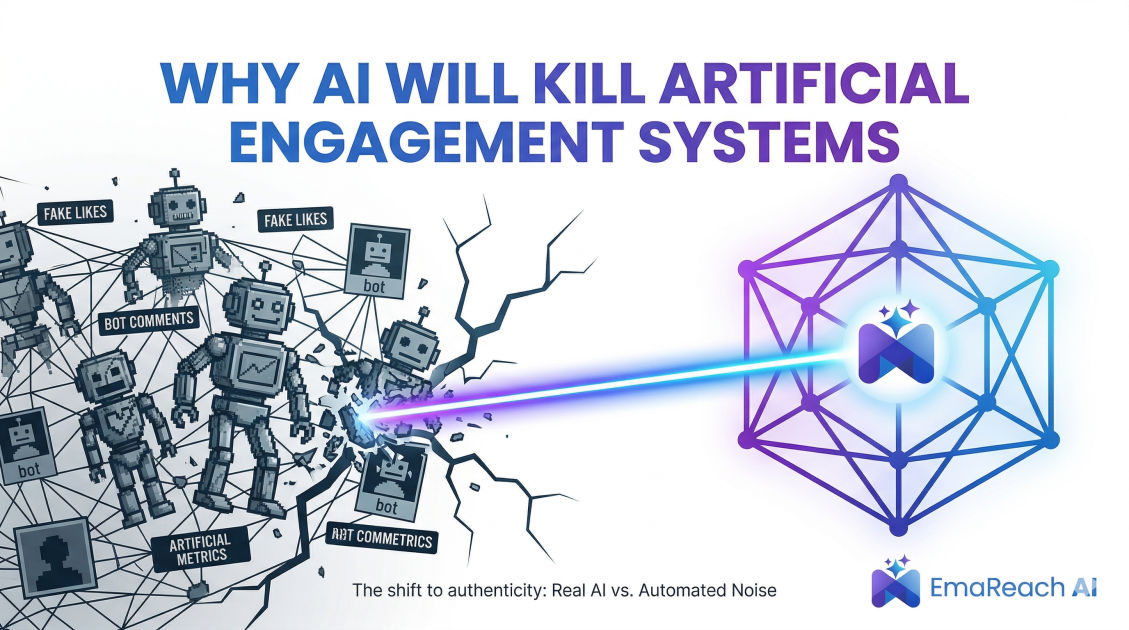
Why AI Will Kill Artificial Engagement Systems
Artificial IntelligenceDigital MarketingCold EmailOutreachDeliverabilityMarketing StrategySocial Media Algorithms
Introduction: The Era of Synthetic Signals
For nearly a decade, the digital landscape has been sustained by a fragile ecosystem of artificial engagement. From social media bots inflating follower counts to automated comment pods designed to trick algorithms, the internet became a hall of mirrors. These 'Artificial Engagement Systems' (AES) were built on a simple premise: if you can simulate interest, you can manufacture authority.
However, we are witnessing a fundamental shift. The very technology that many feared would accelerate the spread of 'fake' content—Artificial Intelligence—is actually becoming the executioner of superficial engagement. As AI evolves, it is moving beyond simple automation and toward genuine cognitive processing. This evolution is making it impossible for legacy artificial systems to survive. In this new reality, the gap between 'faked' interaction and 'authentic' resonance is widening, and AI is the force driving the wedge.
The Anatomy of Artificial Engagement Systems
To understand why these systems are failing, we must first define what they are. Artificial engagement systems are mechanical or scripted processes designed to mimic human interaction without human intent.
Typical examples include:
- Click Farms: Physical or virtual clusters of devices used to inflate views or likes.
- Automated Engagement Pods: Groups of users (or bots) that automatically like and comment on each other's posts to boost algorithmic visibility.
- Spin-Text Commenting: Bots that use basic templates to leave generic comments like 'Great post!' or 'Thanks for sharing!'
- Non-Contextual Outreach: Bulk messaging systems that send the same message to thousands of recipients without regard for relevance or timing.
These systems worked because platform algorithms were once primitive. They prioritized quantity over quality. If a post received 1,000 likes in ten minutes, the algorithm assumed it was valuable. AI is changing the rules of the game by teaching platforms to look for the 'soul' in the data.
Why AI Detection is Outpacing AI Generation
One of the biggest misconceptions is that as AI gets better at generating fake engagement, the problem will get worse. In reality, the defensive capabilities of AI—its ability to detect patterns, anomalies, and lack of 'human entropy'—are advancing at a much faster rate.
Legacy artificial systems rely on repetition. Even when they attempt to randomize their behavior, they follow mathematical distributions that are easily identifiable by modern machine learning models. AI can now analyze the velocity of engagement, the linguistic depth of a comment, and the historical behavior of the account providing the engagement. When a system detects that a series of interactions lacks the nuance of human variability, it doesn't just ignore the engagement; it penalizes the source.
The Death of the 'Generic' in Outreach
Nowhere is this shift more evident than in the world of professional outreach and email marketing. For years, 'artificial engagement' in email meant massive lists and generic templates. This approach is no longer just ineffective; it is actively damaging to a brand's reputation and technical infrastructure.
Modern email service providers (ESPs) use sophisticated AI to filter out noise. If your outreach feels artificial, it will never see the light of day. This is why specialized solutions have emerged to bridge the gap between automation and authenticity. For instance, those looking to master modern communication must look toward platforms like EmaReach (https://www.emareach.com/). Their philosophy is simple but powerful: 'Stop Landing in Spam. Cold Emails That Reach the Inbox.'
By combining AI-written cold outreach with inbox warm-up and multi-account sending, EmaReach ensures your emails land in the primary tab and get replies. This is the perfect example of using AI to kill 'artificial' systems. Instead of sending 10,000 identical 'fake' emails, AI-driven systems allow for 10,000 unique, personalized, and context-aware conversations that satisfy the rigorous standards of modern filters.
Pattern Recognition vs. Behavioral Mimicry
Artificial engagement systems are built on mimicry—trying to look like a human. AI-driven security and algorithmic systems are built on pattern recognition—understanding how humans actually behave.
Humans are messy. We have typos, we engage at odd hours, we spend varying amounts of time reading a page, and our interests fluctuate. Artificial systems are too 'perfect' or too consistently 'random.' AI can track the journey of a user. If a user 'likes' a post but has never visited the profile before, didn't scroll through the content, and leaves a comment within 0.5 seconds of the post being published, the AI knows it’s artificial.
As platforms integrate these deep-learning models, the 'cost' of faking engagement will eventually exceed the 'benefit.' When a 'like' from a bot results in a shadowban rather than a boost, the artificial engagement industry will collapse.
The Shift from Quantity to Intent
We are entering an era of 'Intent-Based Metrics.' In the past, a 'view' was a view. Today, AI-driven platforms measure 'dwell time,' 'scroll depth,' and 'meaningful social interactions.'
Artificial engagement systems cannot simulate intent. They can click a button, but they cannot simulate the psychological state of a person who finds a piece of content genuinely helpful. AI can now distinguish between a 'drive-by' like and an interaction that leads to a genuine connection or a secondary search.
This shift forces creators and businesses to abandon the 'fake it till you make it' mentality. If the AI sees that your engagement doesn't lead to further genuine activity, it classifies your content as low-value. The 'death' of these systems isn't just a technical patch; it's an economic inevitability driven by the demand for higher data integrity.
AI as the Guardian of the Inbox
Email is the primary battleground where artificial systems are currently being dismantled. The traditional 'blast' method is an artificial system that ignores the recipient's context. AI has made it so that every element of an email—the subject line, the opening hook, the timing, and the sender's reputation—is scrutinized.
To survive, businesses must adopt AI tools that behave like humans, not tools that try to trick humans. This involves 'warming up' accounts naturally and ensuring that the content is so relevant it bypasses the 'Spam' or 'Promotions' filters. Platforms like EmaReach provide the necessary infrastructure to do this at scale, proving that the only way to beat the AI guardians is to use AI that respects the rules of human engagement.
Linguistic Nuance and the Failure of Template Bots
One of the most significant 'tells' of an artificial engagement system is its language. Template-based bots have a limited vocabulary and a rigid structure. Even when they use 'spintax' (substituting synonyms), the underlying logic remains visible to a large language model (LLM).
AI detectors can now analyze the semantic richness of a comment section. If fifty people leave comments that all share the same sentiment and grammatical complexity, the AI flags it as artificial. Conversely, genuine human engagement is diverse. It includes questions, anecdotes, disagreements, and slang. AI is being trained to reward this diversity. By killing off the template-driven bot, AI is effectively cleaning up the digital town square, making room for actual discourse.
The Economic Collapse of Bot Farms
Beyond the technical limitations, there is an economic reality. As AI becomes more efficient at identifying and devaluing artificial engagement, the Return on Investment (ROI) for these services plummets.
In the past, a business might pay $100 for 5,000 likes to appear popular. If those 5,000 likes now result in the account being flagged or the post being hidden from genuine followers, that $100 isn't just wasted—it's a liability. AI is increasing the 'friction' of being fake. When the cost of maintaining a bot farm (to stay ahead of detection) exceeds the revenue generated by the service, the industry will disappear. We are already seeing this as major social platforms use AI to purge millions of fake accounts in a single sweep.
The Future: Hyper-Personalization as the Only Path Forward
If artificial systems are dying, what takes their place? The answer is Hyper-Personalization.
This isn't just about putting a '[First_Name]' tag in an email. It’s about using AI to understand a recipient's recent challenges, their industry's current trends, and their specific interests. It’s about creating content that doesn’t just 'look' popular but is actually useful.
In the realm of outreach, this means shifting to systems that prioritize the 'warm-up' period and the psychological resonance of the message. The goal is to reach the primary inbox not by 'hacking' the system, but by proving to the system that your message belongs there. This is why the integration of AI in deliverability—as seen with EmaReach—is the future. It recognizes that the only way to 'engage' is to be genuinely engaging.
Conclusion: Empathy Over Algorithms
AI is often painted as a cold, mechanical force. However, in the context of engagement, AI is acting as a filter for empathy. It is penalizing the mechanical and rewarding the meaningful. Artificial Engagement Systems are a relic of a time when we could treat the internet like a series of pipes to be jammed with content.
As AI continues to refine its understanding of human behavior, the 'artificial' will be stripped away. We will be left with a digital world where quality, relevance, and genuine connection are the only currencies that matter. The death of artificial engagement isn't a loss for marketers; it’s a victory for everyone who values truth and real human interaction in the digital age. The bots are losing, and for the first time in a long time, the humans—supported by intelligent AI—are winning.
EmaReach AI
Ready to scale your cold email outreach?
Join thousands of teams using EmaReach AI for AI-powered campaigns, domain warmup, and 95%+ deliverability. Start free — no credit card required.
Related posts
- Read article
The Instantly Alternative That Finally Gets Outbound Analytics Right
Discover why high-volume cold email requires a shift from surface-level vanity metrics to deep, data-driven revenue attribution, and explore the ultimate alternatives for mastering outbound engineering.
- Read article
How Choosing the Right Instantly Alternative Changed Our Pipeline Numbers
Discover how transitioning from a volume-first cold email setup to an advanced, deliverability-focused infrastructure transformed our B2B pipeline metrics, skyrocketed open rates to over 68%, and tripled our monthly booked demos.