Blog
Back to blog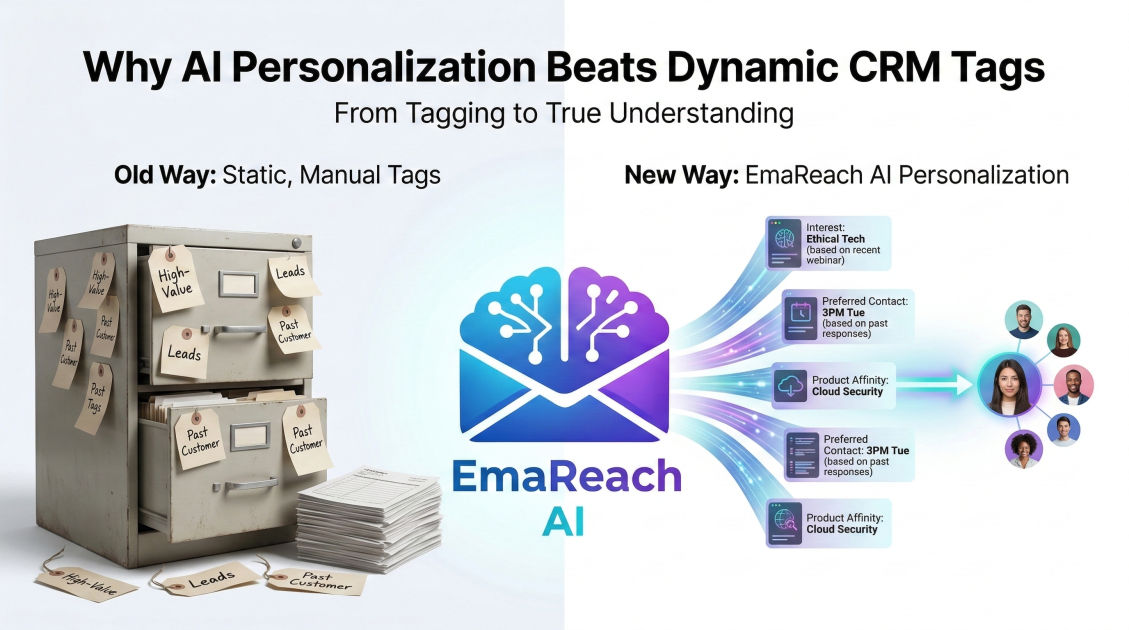
Why AI Personalization Beats Dynamic CRM Tags
AI personalizationCRM strategyemail marketingsales automationoutreach optimizationdigital transformation
Introduction: The Evolution of Digital Outreach
For decades, the gold standard of 'personalized' email marketing was the dynamic tag. You know the ones: {{first_name}}, {{company_name}}, and perhaps the occasional {{job_title}}. At the time, these placeholders were revolutionary. They allowed a single marketer to send thousands of emails that felt, at a very surface level, like they were intended for a specific recipient.
However, the digital landscape has shifted. Modern professionals are inundated with hundreds of emails every day. They have developed a 'sixth sense' for automated outreach. When a prospect sees their name and company dropped into a generic template, they don't feel seen—they feel like a row in a spreadsheet.
True personalization has moved beyond variables. We are now in the era of AI-driven personalization, where machine learning models analyze intent, context, and relevance to craft messages that resonate on a human level. This article explores why the traditional dynamic CRM tag is dying and why AI personalization is the only way to maintain a competitive edge in modern outreach.
The Limitations of Dynamic CRM Tags
To understand why AI is superior, we first must look at the inherent flaws of the legacy system. Dynamic tags are essentially 'find and replace' functions. They rely entirely on the cleanliness and depth of your CRM data.
The 'Data Decay' Problem
CRM data is notoriously messy. If a contact's first name is entered as 'JOHN' in all caps, your dynamic tag will scream 'Hi JOHN' at them, immediately flagging the email as automated. If the company name is listed as 'Acme Corp, Inc. - North America Division,' the email feels clunky and robotic.
Lack of Contextual Relevance
A dynamic tag can tell a prospect you know where they work, but it cannot tell them why you are reaching out to them specifically. It cannot reference a recent podcast they appeared on, a specific pain point mentioned in their recent financial reports, or a shared professional philosophy. Tags are static; they don't adapt to the nuance of a conversation.
The Predictability Factor
Because every major sales organization uses the same five or six tags, prospects have become desensitized to them. The 'Hi {{first_name}}, I saw you are the {{job_title}} at {{company_name}}' formula is the digital equivalent of a cold call that starts with 'How are you doing today?'—it’s an immediate signal to hang up or hit delete.
Enter AI Personalization: Moving Beyond the Variable
AI personalization doesn't just fill in the blanks; it understands the subject. By leveraging Large Language Models (LLMs), businesses can now automate the 'research' phase of outreach that used to take SDRs hours to complete manually.
Hyper-Contextualization
Instead of just pulling a name, AI can scan a prospect's LinkedIn profile, their company’s recent press releases, and even their Twitter feed to find a 'hook.' It can then synthesize this information to write a unique opening sentence. For example, instead of saying 'I see you work at Google,' the AI might say, 'I really enjoyed your recent piece on the future of neural networks; your point about ethical scaling was particularly insightful.'
Sentiment and Tone Matching
One of the most powerful aspects of AI is its ability to adapt its tone. If you are reaching out to a creative director at a boutique agency, the AI can adopt a vibrant, informal tone. If you are reaching out to a CFO at a Fortune 500 company, it can pivot to a concise, data-driven, and formal approach. Dynamic tags are tone-deaf; AI is emotionally intelligent.
Problem-Solution Mapping
AI can analyze a prospect's role and industry to predict their likely challenges. Rather than sending a generic list of features, AI personalization allows you to map your product's specific benefits to the recipient's current situation. This turns a 'sales pitch' into a 'consultative suggestion.'
Why AI Wins the Deliverability Battle
It’s not just about the content of the message; it’s about whether the message even gets seen. Email service providers (ESPs) like Google and Outlook have become incredibly sophisticated at detecting mass-blast patterns.
Breaking the Pattern
When you send 1,000 emails using the same template with only three dynamic tags changed, the 'fingerprint' of those emails is nearly identical. Spam filters identify this pattern as a bulk send and are more likely to divert your messages to the 'Promotions' or 'Spam' folders.
AI personalization generates unique sentence structures and word choices for every single recipient. Because each email is technically unique, it lacks the repetitive signature of a mass blast. This is where tools like EmaReach become invaluable. By combining AI-written cold outreach with sophisticated inbox warm-up and multi-account sending, EmaReach ensures that your hyper-personalized messages actually land in the primary tab where they can be read. Stop Landing in Spam. Cold Emails That Reach the Inbox is not just a slogan; it's a technical requirement in the modern age.
The Psychology of Personalization
At its core, sales is about human connection. When we receive a message that shows someone took the time to understand us, our brain triggers a reciprocity response.
The 'Effort' Heuristic
Humans subconsciously weigh the effort put into a message. A dynamic tag represents zero effort—everyone knows it’s automated. An AI-generated message that references a specific, niche detail about a person’s career creates the illusion of high effort. Even if the recipient suspects AI was involved, the fact that the sender configured a system to be that precise still commands more respect than a generic template.
Reducing Cognitive Load
A generic email forces the recipient to do the work: 'Who is this? What do they want? How does this apply to me?' A personalized AI email does the work for them: 'I am reaching out because of [Specific Event], and I think I can help with [Specific Problem].' By reducing the friction of understanding, you vastly increase the likelihood of a reply.
Scalability: The Final Frontier
The biggest argument in favor of dynamic tags used to be scale. You could reach 10,000 people in five minutes. Manual personalization, while effective, was impossible to scale. AI has bridged this gap.
The Efficiency of the 'AI-Human' Hybrid
Modern workflows don't require an AI to write the whole email in a vacuum. Instead, AI can generate 'first drafts' or 'research snippets' for thousands of leads. A human representative can then quickly scan and approve these messages. This 'cyborg' approach allows for the personalization of manual outreach at the speed of automation.
Consistency Across the Board
Human SDRs have bad days. They get tired, they take shortcuts, and their personalization quality fluctuates. AI does not get tired. Every email sent at 4:00 PM on a Friday will be just as researched and thoughtful as the one sent at 9:00 AM on a Monday.
How to Transition from Tags to AI
If you are currently relying on dynamic tags, the shift to AI personalization doesn't have to happen overnight.
- Audit Your Data: AI is only as good as the inputs. Ensure your lead lists include URLs (LinkedIn, Website) rather than just names and emails.
- Start with the 'Hook': You don't need to rewrite your entire sequence. Start by using AI to generate a custom first sentence (the 'icebreaker') while keeping your core value proposition consistent.
- Test and Iterate: Run A/B tests. Send 500 emails using your old dynamic tag method and 500 using AI-generated hooks. Measure the open rates, but more importantly, measure the positive reply rates.
- Integrate Smart Sending: Use a platform like EmaReach to manage the technical side of the house. Personalized content is wasted if it’s sitting in the spam folder. Multi-account sending and inbox warm-up are the necessary foundations for any AI outreach strategy.
Conclusion: The New Standard
The era of 'Dear {{first_name}}' is over. As prospects become more discerning and spam filters become more aggressive, the only way to survive in the inbox is to provide genuine value and relevance. AI personalization is no longer a luxury for tech-forward enterprises; it is a baseline requirement for anyone serious about outbound growth. By moving beyond the limitations of dynamic CRM tags and embracing the contextual power of AI, you can transform your outreach from a numbers game into a relationship-building machine.
EmaReach AI
Ready to scale your cold email outreach?
Join thousands of teams using EmaReach AI for AI-powered campaigns, domain warmup, and 95%+ deliverability. Start free — no credit card required.
Related posts
- Read article
The Instantly Alternative That Finally Gets Outbound Analytics Right
Discover why high-volume cold email requires a shift from surface-level vanity metrics to deep, data-driven revenue attribution, and explore the ultimate alternatives for mastering outbound engineering.
- Read article
How Choosing the Right Instantly Alternative Changed Our Pipeline Numbers
Discover how transitioning from a volume-first cold email setup to an advanced, deliverability-focused infrastructure transformed our B2B pipeline metrics, skyrocketed open rates to over 68%, and tripled our monthly booked demos.