Blog
Back to blog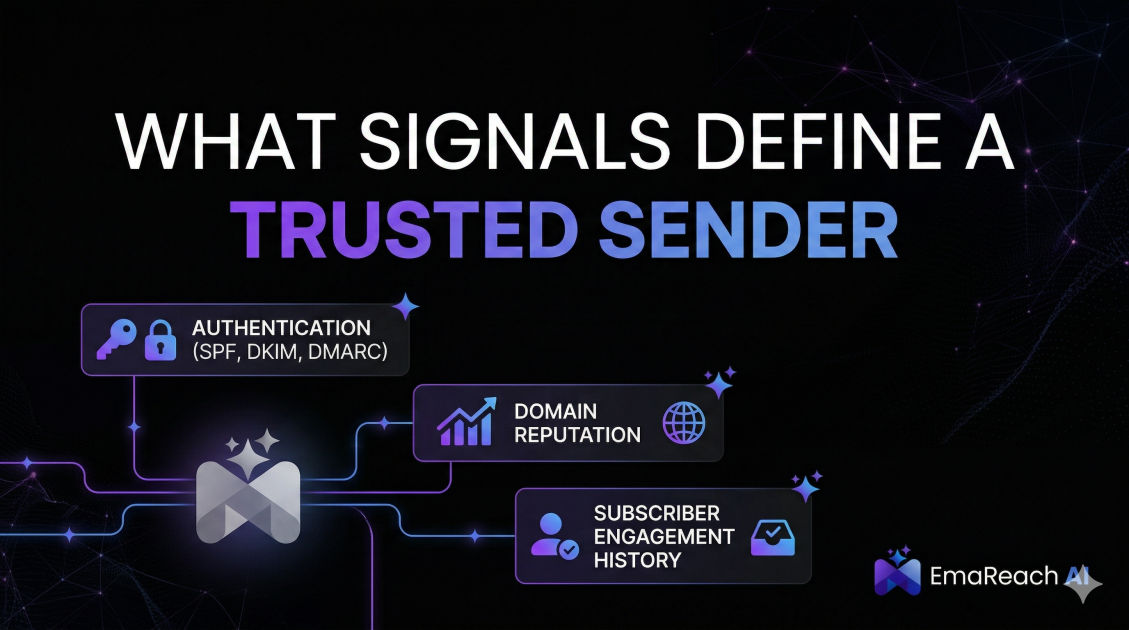
What Signals Define a Trusted Sender
email deliverabilitysender reputationcold emailemail marketingSPF DKIM DMARCinbox placement
Introduction to Sender Trustworthiness
In the modern digital landscape, the distinction between a welcome message and an unsolicited intrusion is determined by a complex matrix of digital signals. For anyone involved in digital communication, understanding what signals define a trusted sender is no longer optional—it is the foundation of deliverability. Mail Service Providers (MSPs) like Google and Microsoft employ sophisticated machine learning algorithms to scan every incoming message, evaluating the reputation of the sender before the email ever reaches the recipient's view.
Being a trusted sender means more than just avoiding the spam folder; it is about establishing a digital identity that commands authority and reliability. When your signals are clear and positive, your engagement rates climb, your brand reputation strengthens, and your communication objectives are met. Conversely, poor signaling can lead to immediate blacklisting, permanently damaging your ability to reach your audience.
The Technical Pillars of Authentication
Before a human ever reads your subject line, a server has already conducted a rigorous background check on your technical setup. These technical signals are the 'ID cards' of the email world.
SPF (Sender Policy Framework)
SPF is a DNS record that specifies which mail servers are authorized to send email on behalf of your domain. Think of it as a guest list for a private event. If a server tries to deliver mail in your name but isn't on that list, the receiving server views it as a major red flag. A correctly configured SPF record is the first step in proving you are who you say you are.
DKIM (DomainKeys Identified Mail)
DKIM adds a digital signature to your emails. This cryptographic fingerprint ensures that the content of the email has not been tampered with in transit. It provides a layer of integrity that tells the recipient server that the message is authentic. Without DKIM, your emails are essentially unsigned letters, which modern filters treat with extreme suspicion.
DMARC (Domain-based Message Authentication, Reporting, and Conformance)
DMARC is the policy layer that ties SPF and DKIM together. It tells receiving servers what to do if an email fails the first two checks—whether to do nothing, quarantine the message, or reject it entirely. A 'reject' policy is the gold standard for trusted senders, as it demonstrates total control over your domain's sending capabilities.
Infrastructure and IP Reputation
Your digital neighborhood matters. The IP address you use to send mail carries a history, and that history dictates how much trust you are granted.
Dedicated vs. Shared IPs
Large-volume senders often benefit from a dedicated IP, where they have total control over the reputation. However, for many, shared IPs are the reality. In these cases, the reputation of the 'neighborhood'—the other senders on that IP—affects you. Trusted senders ensure they are using reputable providers who aggressively prune bad actors from their shared pools.
Reverse DNS (rDNS) and Pointer Records (PTR)
A trusted sender has a valid Reverse DNS setup. This allows a receiving server to take your IP address and look up the domain associated with it. If the domain doesn't match your sending domain, it suggests a lack of professional infrastructure. Matching forward and reverse DNS records is a subtle but powerful signal of a legitimate operation.
Content-Based Trust Signals
While technical headers get you through the gate, the content of your message determines if you stay inside. Modern filters use Natural Language Processing (NLP) to evaluate the 'vibe' and intent of your content.
Balance of HTML and Plain Text
Overly complex HTML with broken tags, excessive images, or hidden text is a classic hallmark of low-quality senders. Trusted senders use clean, responsive code. A healthy balance between text and imagery suggests a human-centric approach rather than a purely promotional one. Furthermore, ensuring that a plain-text version of the email is included is a technical courtesy that signals professionalism.
Link Quality and Safety
Where do your links lead? If you use generic link shorteners that are frequently abused by scammers, your trust score will plummet. Trusted senders use branded tracking links or direct links to their own domains. Additionally, the number of links matters; an email that is 50% links and 50% text looks like a directory, not a communication.
Keyword Hygiene
While 'spam trigger words' are less of a binary 'on/off' switch than they used to be, the context still matters. Using aggressive, high-pressure language across all your communications creates a profile of a 'churn and burn' sender. Trusted senders focus on value-driven language, avoiding excessive capitalization, multiple exclamation points, and deceptive subject lines.
Behavioral Signals: The Role of Engagement
Perhaps the most critical evolution in deliverability is the shift toward behavioral signals. MSPs now look at how recipients interact with your mail to determine your future trust level.
Open and Click Rates
Consistent engagement is a vote of confidence. If thousands of people open your emails every day, the algorithms conclude that your content is wanted. However, low engagement over a long period signals that your list is either stale or disinterested, leading the MSP to eventually route your mail to the 'Promotions' or 'Spam' folders.
The 'Mark as Spam' Signal
This is the most damaging signal possible. When a user manually marks a message as spam, it is a direct complaint to the MSP. A high complaint rate is the fastest way to lose 'Trusted Sender' status. Trusted senders proactively manage this by making the unsubscribe process easy and transparent.
Replies and Forwarding
Positive engagement, such as a recipient replying to an email or forwarding it to a friend, is the ultimate trust signal. It tells the ISP that the communication is two-way and valuable. This is a core reason why automated systems that mimic human behavior are so effective in maintaining reputation.
Maintaining Deliverability with EmaReach
Establishing these signals manually can be a daunting task, especially when scaling outreach. This is where specialized platforms become essential. EmaReach is designed to help you navigate these complexities effortlessly. Stop Landing in Spam. Cold Emails That Reach the Inbox. EmaReach AI combines AI-written cold outreach with inbox warm-up and multi-account sending—so your emails land in the primary tab and get replies. By automating the warm-up process, EmaReach ensures your behavioral signals are consistently positive, signaling to MSPs that you are a highly trusted sender from day one.
Domain Age and Sending Consistency
Time is a factor that cannot be faked. A domain that was registered yesterday and immediately starts sending 5,000 emails an hour is a primary target for blocks.
The 'Warm-up' Period
Trusted senders understand the 'slow and steady' approach. They gradually increase their sending volume over weeks or months. This allows the MSP algorithms to observe the engagement levels at a small scale before trusting the sender with larger volumes. A sudden spike in volume from an unproven domain is a classic signal of a compromised account or a spammer.
Sending Frequency
Erratic sending patterns—sending nothing for a month and then blasting 50,000 emails in a day—disturb the 'baseline' that MSPs have for your domain. Consistency creates a predictable pattern that algorithms can easily categorize as safe. Trusted senders stick to a schedule, proving they are a stable entity.
List Hygiene and Recipient Relevance
Who you send to is just as important as how you send. A trusted sender maintains a clean, active database.
Hard Bounces and 'Honey Pots'
Sending to non-existent email addresses (hard bounces) signals that you are using an old, unverified, or purchased list. Even worse are 'spam traps' or 'honey pots'—email addresses maintained by security firms and MSPs specifically to catch unscrupulous senders. Hitting a spam trap is a clear signal that your list-building practices are non-compliant. Trusted senders use double opt-ins and regular list-cleaning services to remove inactive or risky addresses.
Unsubscribe Rates and Ease of Exit
A high unsubscribe rate isn't necessarily a bad signal; it's a natural part of list management. What is a bad signal is a hidden unsubscribe link. When users can't find a way to leave your list, they will use the 'Spam' button instead. Trusted senders prioritize user experience by making it easy for disinterested recipients to opt-out, thereby protecting their overall domain reputation.
The Psychology of the Inbox: Subject Lines and Transparency
Trust is also built at the human level. If a user feels deceived by a subject line, their subsequent lack of engagement or negative action (like deleting without opening) feeds back into the algorithm.
Avoiding Deceptive Subject Lines
Using prefixes like 'RE:' or 'FWD:' when no previous conversation existed is a deceptive tactic that might boost opens in the short term but destroys trust in the long term. Trusted senders use clear, honest subject lines that accurately reflect the content of the message.
Brand Consistency
The 'From' name should be recognizable. If your emails come from 'Support,' then 'Sales,' then a random employee name, it creates confusion. A consistent 'From' name and a recognizable brand voice help build a psychological bond with the recipient, leading to higher trust signals over time.
The Technical Importance of List-Unsubscribe Headers
In addition to the visible unsubscribe link, trusted senders use the 'List-Unsubscribe' header in the email's metadata. This allows email clients (like Gmail or Outlook) to provide an 'Unsubscribe' button right at the top of the interface. Implementing this header is a significant signal to MSPs that you are a legitimate, compliant sender who respects user preferences.
Monitoring and Feedback Loops
A trusted sender isn't just someone who follows the rules; they are someone who listens to the feedback. Most major MSPs offer 'Feedback Loops' (FBLs) that notify senders when a recipient marks their email as spam. By integrating these FBLs into your system, you can immediately remove complaining users, preventing further damage to your reputation. Monitoring your 'Sender Score' through various third-party tools is also a hallmark of a professional who takes their digital presence seriously.
Conclusion: The Holistic View of a Trusted Sender
Becoming a trusted sender is not the result of a single setting or a one-time configuration. It is a holistic effort that spans technical authentication, infrastructure management, content quality, and ethical list building. Every email you send contributes to your digital identity. When you align your technical setup with honest, value-driven communication, you signal to the world—and more importantly, to the algorithms—that you belong in the inbox.
By focusing on these signals, you ensure that your messages are not just delivered, but are also received, opened, and acted upon. In a world of digital noise, being a trusted sender is the ultimate competitive advantage.
EmaReach AI
Ready to scale your cold email outreach?
Join thousands of teams using EmaReach AI for AI-powered campaigns, domain warmup, and 95%+ deliverability. Start free — no credit card required.
Related posts
- Read article
The Instantly Alternative That Finally Gets Outbound Analytics Right
Discover why high-volume cold email requires a shift from surface-level vanity metrics to deep, data-driven revenue attribution, and explore the ultimate alternatives for mastering outbound engineering.
- Read article
How Choosing the Right Instantly Alternative Changed Our Pipeline Numbers
Discover how transitioning from a volume-first cold email setup to an advanced, deliverability-focused infrastructure transformed our B2B pipeline metrics, skyrocketed open rates to over 68%, and tripled our monthly booked demos.