Blog
Back to blog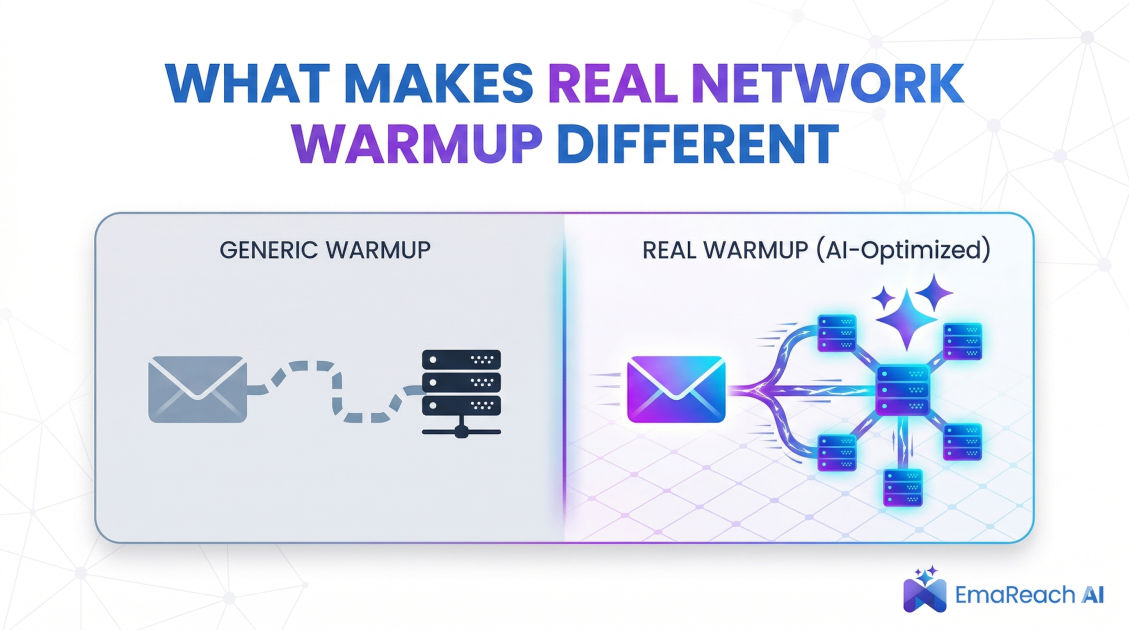
What Makes Real Network Warmup Different
email deliverabilitycold outreachemail warmupinbox placementsender reputationemail marketingsales automation
Introduction to Email Deliverability and Network Reputation
In the modern landscape of digital communication, the success of any outreach campaign hinges on a single, critical factor: deliverability. You can have the most compelling offer, the most elegant copy, and a perfectly curated list of prospects, but if your emails are routed to the spam folder, your efforts are effectively invisible. At the heart of deliverability lies a concept known as 'warmup.' Traditionally, this referred to the slow increase of email volume to build a sender reputation. However, as Mail Service Providers (MSPs) like Google and Microsoft have become more sophisticated, the definition of warmup has shifted.
Today, we must distinguish between basic volume scaling and Real Network Warmup. The latter is a complex, multi-faceted process that mimics authentic human behavior within a massive ecosystem of active inboxes. It is no longer enough to simply send emails; you must prove to the receiving servers that your content is valuable, expected, and engaged with by real people. This article explores the nuances of why real network warmup is the only sustainable path for long-term email success.
The Evolution of Email Warmup: From Volume to Velocity
Years ago, warming up an email account was a mechanical process. You would send five emails on day one, ten on day two, and twenty on day three. The goal was to avoid triggering 'rate limit' alarms. This was a linear approach focused solely on volume. Today, ISPs and MSPs use machine learning and artificial intelligence to look far beyond the number of messages sent. They look at the 'velocity' of engagement.
Real network warmup differs because it focuses on the quality of the interaction. It involves a network of real, high-reputation inboxes that interact with your emails in a way that signals importance to the algorithms. When an email is opened, replied to, marked as important, or moved out of the 'Promotions' or 'Spam' folders, it sends a powerful positive signal to the provider. This is the essence of a real network—it creates a simulated yet authentic environment where your domain's reputation is built on engagement, not just activity.
The Anatomy of an Authentic Engagement Network
What makes a 'real' network different from a bot-driven loop? It comes down to diversity and behavior. A real network consists of thousands of unique domains and IP addresses across various providers. If an email account only interacts with other accounts on the same server or the same subnet, it looks suspicious.
Peer-to-Peer Interaction
In a real network, your email account engages with a wide variety of peers. This includes older, established domains with 'aged' reputations and newer accounts. This diversity prevents the sender's pattern from looking like a closed loop of automated traffic. Real network warmup ensures that your emails are landing in inboxes that have their own unique histories, making the interaction appear organic to the watchful eyes of spam filters.
Human-Like Behavioral Patterns
Automation often leaves footprints—sending emails at exactly the same time every day, using the same subject lines, or having a 0% bounce rate. Real network warmup introduces 'jitter' or randomness. It replicates how a human uses an inbox: checking mail at different times, replying with varying lengths of text, and occasionally deleting or archiving messages. These subtle behavioral cues are what separate a sophisticated warmup strategy from a primitive bot script.
Why Sending Volume Alone Is a Recipe for Failure
Many marketers make the mistake of thinking that if they just send enough 'warmup' emails, they are safe. However, if those emails have low engagement rates, you are actually warming up your way into a permanent spam block. This is known as 'negative reputation building.'
If a provider sees you sending 100 emails a day and only 1% are opened, the provider assumes you are a low-value sender. Real network warmup flips the script. By ensuring a high 'reply-to-send' ratio within the network, you are training the ISP to see your domain as a high-authority sender. This is why tools like EmaReach (https://www.emareach.com/) are so vital. Stop Landing in Spam. Cold Emails That Reach the Inbox. EmaReach AI combines AI-written cold outreach with inbox warm-up and multi-account sending—so your emails land in the primary tab and get replies. It leverages the power of real network dynamics to ensure your reputation is built on a foundation of positive engagement.
The Role of AI in Modern Network Warmup
Artificial Intelligence has changed the game for deliverability. In a real network warmup scenario, AI is used to generate unique, contextually relevant content for every warmup email. In the past, warmup tools would send 'Lorem Ipsum' or repetitive strings of text. Modern spam filters can easily detect this repetitive content and flag it as 'junk.'
Real network warmup uses AI to draft actual conversations. These messages look like real business inquiries, check-ins, or professional updates. When the receiving inbox 'reads' this content, the NLP (Natural Language Processing) engines used by Google and Microsoft recognize it as high-quality, human-like communication. This prevents the domain from being 'content-flagged,' which is a common reason why even warmed-up accounts still end up in spam.
Technical Factors: SPF, DKIM, and DMARC in the Warmup Context
While the network interactions are the 'soul' of the warmup, the technical configuration is the 'skeleton.' Real network warmup doesn't just involve sending mail; it involves monitoring the health of your authentication protocols.
- SPF (Sender Policy Framework): Specifies which mail servers are authorized to send email on behalf of your domain.
- DKIM (DomainKeys Identified Mail): Adds a digital signature to emails, ensuring the content wasn't tampered with in transit.
- DMARC (Domain-based Message Authentication, Reporting, and Conformance): Tells receiving servers what to do if an email fails SPF or DKIM.
A real network warmup process monitors these records. If a DMARC failure occurs during the warmup phase, the process should be paused or adjusted. Without these protocols correctly configured, even the best network interactions won't save your deliverability. The difference with a premium network approach is that it verifies these technical hurdles are cleared before ramping up the engagement pressure.
Handling the 'Spam' Folder During Warmup
One of the most distinct features of a real network warmup is the 'unspam' action. In the real world, occasionally a legitimate email ends up in the spam folder. When a human finds a legitimate email in spam, they click 'Not Spam' and move it to the inbox.
This single action is perhaps the most powerful signal you can send to an ISP. It tells the algorithm, "You made a mistake; this sender is actually important to me." Real network warmup incorporates this intentionally. If a warmup message lands in the spam folder of a network peer, the system automatically marks it as 'Not Spam.' This direct feedback loop quickly corrects the ISP’s perception of your domain and helps 'pull' your future emails into the primary inbox.
The Importance of Multi-Account Sending Strategies
In the current era of outreach, 'burning' a domain is a constant risk. Real network warmup is often paired with a multi-account sending strategy to mitigate this risk. Instead of sending 200 emails from one account, a sophisticated strategy involves sending 20 emails from 10 different accounts across different domains.
Real network warmup handles this complexity by warming up all these accounts simultaneously. It creates a 'reputation web' where multiple domains are being seasoned at once. This diversification ensures that if one account hits a snag, the entire campaign doesn't grind to a halt. This distributed approach is a hallmark of professional-grade outreach and is fundamentally different from the 'single-sender' warmup methods of the past.
Common Myths About Email Warmup
To truly understand what makes real network warmup different, we must dispel some common myths that lead senders astray.
Myth 1: Warmup Is a One-Time Task
Many believe that once you have warmed up an account for two weeks, you are done forever. In reality, reputation is fluid. If you stop sending or if your engagement drops, your reputation will degrade. Real network warmup is often an ongoing process that runs in the background of your actual outreach to maintain a 'baseline' of positive engagement.
Myth 2: Any Engagement Is Good Engagement
If you use a low-quality warmup service where all the accounts are 'new' and have no history, the engagement is worth very little. It’s like getting a recommendation for a job from someone who has no professional standing. Real network warmup uses established, aged inboxes to provide 'high-authority' engagement, which carries significantly more weight with MSPs.
Myth 3: You Can Warm Up Fast if You Pay More
There are no shortcuts to trust. Attempting to accelerate the warmup process too quickly is a red flag for ISPs. Real network warmup respects the natural 'gestation' period of a domain's reputation. It scales gradually, following a curve that mimics a growing business rather than a sudden burst of spam.
How Real Network Warmup Affects Open Rates
The ultimate goal of this entire process is to increase open rates. When you use a real network, your 'Sender Score' and 'IP Reputation' remain high. This ensures that your emails are placed in the Primary Tab rather than the Promotions Tab or the Spam Folder.
Data shows that emails landing in the Primary Tab have a 3x higher open rate than those in the Promotions Tab. By utilizing a real network that emphasizes moving emails out of folders and marking them as important, you are specifically targeting 'Primary' placement. This is the difference between a campaign that generates revenue and one that simply consumes resources.
Integrating Real Warmup Into Your Outreach Workflow
For a business to scale its outreach, the warmup must be integrated seamlessly. You shouldn't have to choose between 'warming' and 'sending.' The best systems allow you to do both. As your real-world outreach increases, the warmup network adjusts its volume to ensure your total 'send-to-receive' ratio remains healthy.
This is where EmaReach excels. By combining the AI-driven writing of cold emails with a robust, real network warmup system, it handles the technical heavy lifting. This allows sales teams and founders to focus on closing deals rather than worrying about whether their emails are being seen. The synergy between high-quality content and high-quality reputation building is what makes a real network approach so effective.
Conclusion: The Sustainable Path to Inbox Success
In conclusion, real network warmup is distinguished by its depth, its reliance on authentic human-like behavior, and its use of high-authority peer interactions. It moves beyond the simplistic volume-based metrics of the past and embraces the complex algorithmic requirements of modern email providers.
By focusing on diverse IP ranges, varied content, meaningful engagement (like 'Not Spam' clicks and replies), and continuous reputation maintenance, real network warmup provides a safety net for your digital outreach. In an environment where the 'Spam' folder is a graveyard for potential business, investing in a real network approach isn't just an option—it's a necessity for any organization serious about email communication. Building trust with ISPs takes time, but by using the right methods, that trust becomes your most valuable asset in the inbox.
EmaReach AI
Ready to scale your cold email outreach?
Join thousands of teams using EmaReach AI for AI-powered campaigns, domain warmup, and 95%+ deliverability. Start free — no credit card required.
Related posts
- Read article
The Instantly Alternative That Finally Gets Outbound Analytics Right
Discover why high-volume cold email requires a shift from surface-level vanity metrics to deep, data-driven revenue attribution, and explore the ultimate alternatives for mastering outbound engineering.
- Read article
How Choosing the Right Instantly Alternative Changed Our Pipeline Numbers
Discover how transitioning from a volume-first cold email setup to an advanced, deliverability-focused infrastructure transformed our B2B pipeline metrics, skyrocketed open rates to over 68%, and tripled our monthly booked demos.