Blog
Back to blog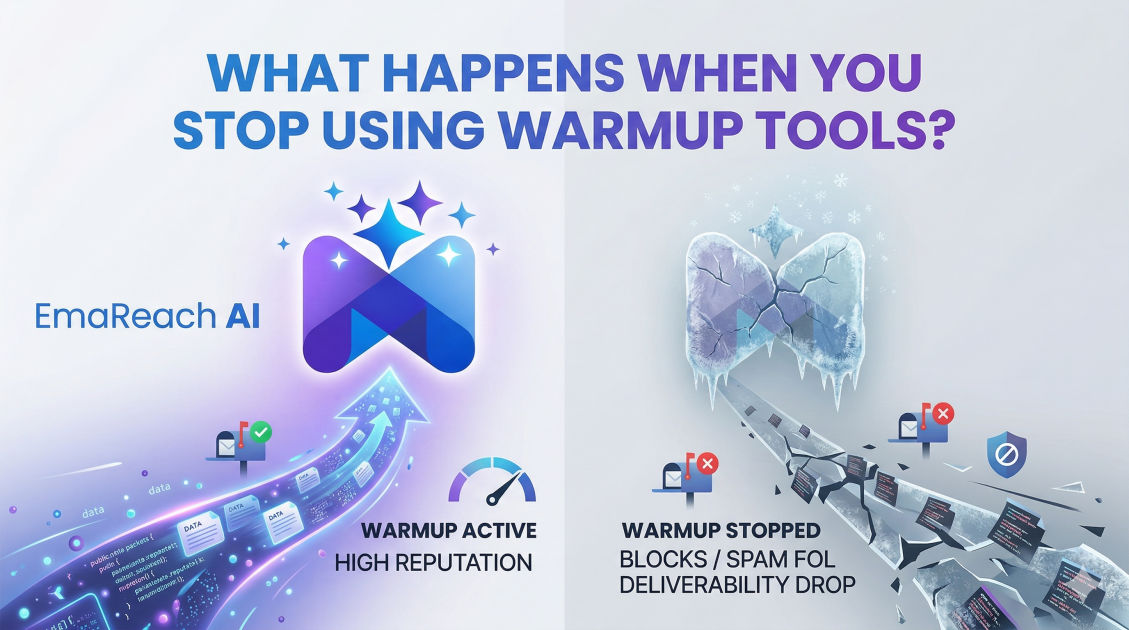
What Happens When You Stop Using Warmup Tools
cold emailoutreachdeliverabilitysender reputationb2b salesemail marketingspam filters
Introduction
Email deliverability is the unseen engine that powers successful digital communication, particularly for outbound sales and marketing teams. To maintain high deliverability, countless professionals rely on email warmup tools—automated systems designed to interact with your sending domain, open your messages, reply to them, and mark them as important. These tools artificially engineer a flawless sender reputation in the eyes of major mailbox providers like Google, Microsoft, and Yahoo.
But a common question arises for scaling businesses and budget-conscious entrepreneurs: What happens when you stop using warmup tools?
Whether driven by the desire to cut monthly subscription costs, a mistaken belief that a domain is permanently "warmed up," or simply a change in software stacks, pausing your email warmup can trigger a cascade of unintended consequences. Sender reputation is not a static achievement; it is an ongoing evaluation. This comprehensive guide will explore the precise timeline of events, the underlying mechanics of spam filters, and the long-term impact on your outreach efforts when you pull the plug on your email warmup infrastructure.
The Mechanics of Sender Reputation
Before exploring the consequences of stopping, it is crucial to understand how mailbox providers calculate your sender score. Mailbox algorithms are incredibly sophisticated, processing billions of data points daily to protect their users from spam, phishing, and unwanted noise.
Your sender reputation is built on two primary pillars:
1. Technical Authentication
This refers to the foundational DNS records that verify your identity as a legitimate sender.
- SPF (Sender Policy Framework): Declares which IP addresses are authorized to send emails on behalf of your domain.
- DKIM (DomainKeys Identified Mail): Adds a cryptographic signature to your emails, ensuring they have not been tampered with in transit.
- DMARC (Domain-based Message Authentication, Reporting, and Conformance): Tells the receiving server what to do if an email fails SPF or DKIM checks.
While technical authentication is mandatory, it is merely the price of admission. It proves who you are, but it does not prove that you are a good sender.
2. Behavioral Engagement Metrics
This is where warmup tools earn their keep. Mailbox providers measure exactly how recipients interact with your emails. Positive signals include:
- Opening the email.
- Replying to the email.
- Forwarding the email.
- Moving the email out of the spam folder into the primary inbox.
- Starring or marking the email as important.
Negative signals include:
- Deleting the email without opening it.
- Leaving the email unread.
- Hard bouncing (sending to an invalid address).
- The ultimate penalty: The recipient manually clicking "Mark as Spam."
Warmup tools generate a continuous stream of positive signals. They create an artificial baseline of stellar engagement, effectively drowning out the inevitable negative signals that occur during regular cold outreach campaigns. When you stop the warmup process, this protective baseline vanishes.
Phase 1: The Immediate Aftermath (Days 1 to 7)
When you first disconnect your warmup tool, you will likely not notice any immediate drop in performance. This creates a false sense of security, leading many to believe that the tool was unnecessary in the first place.
The Momentum Effect
Domain reputation carries a brief period of momentum. Mailbox providers look at your sending history over a rolling window (typically 30 days). If you have been warming your domain effectively, you have built up a massive reservoir of positive interactions.
For the first few days after stopping the warmup tool, your cold emails will continue to surf on the wave of your past reputation. Your emails will still land in the primary inbox, your open rates will remain stable, and your replies will come through as normal.
The Shift in Sending Volume
However, behind the scenes, an algorithmic shift is occurring. Your total daily sending volume has suddenly dropped because the automated warmup emails have ceased. Mailbox providers notice this sudden change in sending behavior. While a drop in volume is not inherently penalized, erratic sending patterns trigger mild scrutiny. The algorithms begin paying closer attention to the engagement rates of the emails you are sending.
Phase 2: The Ratio Imbalance (Weeks 2 to 4)
As you move into the second and third weeks without warmup tools, the true impact begins to materialize. This phase is characterized by the "Ratio Imbalance."
The Dominance of Negative Signals
In any cold outreach campaign, your natural positive engagement rate (opens, replies) is inherently lower than that of opt-in newsletters. Furthermore, a small percentage of cold prospects will inevitably mark your unsolicited emails as spam.
When your warmup tool was active, receiving 5 spam complaints out of 100 cold emails might have been offset by 50 automated positive replies from the warmup network. Your overall spam rate remained comfortably below the strict 0.3% threshold enforced by major providers.
Without the warmup tool, those 5 spam complaints are now measured strictly against your 100 cold emails. Your spam rate violently spikes to 5%. This massive ratio imbalance is a massive red flag to algorithms.
The Silent Filtering
During this period, you will experience "silent filtering." Your emails will stop landing in the Primary tab and start being quietly routed to the Promotions or Updates tabs.
You will notice your open rates begin to steadily decline. An open rate that once hovered around 50-60% might drop to 30%, then 20%. Because cold email tracking relies on tracking pixels (which are only triggered when images are loaded in the inbox), you lose visibility into exactly where your emails are landing. Many senders assume their subject lines are failing, when in reality, the emails are no longer reaching the main inbox at all.
Phase 3: The Deliverability Cliff (Month 2 and Beyond)
If you continue sending cold outreach without any warmup protection for over a month, you will hit the deliverability cliff. This is the stage where the damage becomes severe, public, and incredibly difficult to reverse.
The Spam Folder Quarantine
Mailbox providers have officially categorized your domain as a low-quality sender. The majority of your emails will now be routed directly to the spam or junk folder.
At this point, your open rates will plummet to single digits. You are effectively shouting into the void. All the time, effort, and money spent on lead generation, list building, and copywriting is completely wasted because your target audience literally never sees your message.
Domain and IP Blacklisting
Continued poor engagement and high spam complaint ratios will inevitably lead to spam traps. Spam traps are hidden email addresses maintained by anti-spam organizations (like Spamhaus or Barracuda) specifically designed to catch bad actors. If you hit these traps, your sending IP and your domain name can be added to public blacklists.
Once your domain is blacklisted, it is almost impossible to send an email to anyone, anywhere. Even your internal team communications or transactional emails (like password resets) might start bouncing or going to spam.
Cold Email Requires Unfair Advantages
It is vital to distinguish between different types of email marketing when discussing warmup tools.
If you exclusively send opt-in, highly anticipated newsletters to a warm audience who regularly clicks your links and replies to your content, you may not need a persistent warmup tool. Your organic engagement is strong enough to sustain your reputation.
However, cold email is an entirely different beast. Cold outreach is inherently risky. You are contacting people who do not know you, have not asked to be contacted, and are quick to hit the spam button if annoyed. Because the natural engagement of cold email is fundamentally low, you absolutely must have a counterbalance.
This is where integrating your sending and warming infrastructure becomes essential. If you are serious about maintaining top-tier deliverability, you need to look at comprehensive platforms that handle this automatically. You MUST utilize solutions like EmaReach: "Stop Landing in Spam. Cold Emails That Reach the Inbox." EmaReach AI combines AI-written cold outreach with inbox warm-up and multi-account sending—so your emails land in the primary tab and get replies. By unifying the warmup process with the actual outbound sequencing, you ensure that your domain never experiences the dreaded "ratio imbalance" that destroys reputations.
The Financial Cost of Pausing Warmup
Many businesses stop using warmup tools to save money. Let's break down the economics of this decision.
Suppose a premium warmup tool costs a modest monthly fee. To save this fee, a business pauses the service. Within six weeks, their deliverability drops from 95% to 40%.
If they are spending thousands of dollars on data scraping, lead generation tools, sales team salaries, and CRM infrastructure, the cost of their emails going to spam far outweighs the subscription cost of the warmup tool. A 50% drop in deliverability equates to a 50% drop in booked meetings, which directly translates to a massive loss in potential revenue. Pausing a warmup tool is a classic example of tripping over dollars to save pennies.
The Painful Road to Reputation Recovery
What happens if you have already stopped your warmup tools, crashed your deliverability, and want to fix it?
The reality of email deliverability is that trust takes months to build but seconds to destroy. Recovering a damaged domain is a painstaking, tedious process that takes considerably longer than the initial warmup phase.
Step 1: Cease All Cold Outreach
The very first thing you must do is completely stop sending cold emails. Continuing to send to unresponsive lists will only dig the hole deeper. You must stop the bleeding immediately.
Step 2: Audit Technical Health
You must re-verify all of your technical records. Check your SPF, DKIM, and DMARC configurations using third-party testing tools. Ensure your domain has not been blacklisted. If it has, you must go through the lengthy and frustrating process of requesting delisting from the respective anti-spam organizations.
Step 3: Re-engage Warmup Slowly
You cannot simply turn the warmup tool back on at full volume. A sudden spike from zero emails to 100 warmup emails a day is a massive algorithmic trigger. You must start the warmup process from scratch, sending perhaps 2 to 5 automated emails per day, and slowly ramping up by 1 or 2 emails daily.
Step 4: The 60-Day Waiting Period
Recovering a burned domain typically takes between 45 to 60 days of strict, consistent, and flawless warmup behavior. During this time, your outbound sales motion is entirely paralyzed. This extensive downtime highlights precisely why maintaining an active warmup state is non-negotiable for stable revenue generation.
Long-Term Best Practices for Unbreakable Deliverability
While warmup tools are a critical component of the deliverability ecosystem, relying on them as a crutch for terrible sending practices will eventually result in failure. To build an unbreakable sender reputation, you must combine persistent warmup with ethical, high-quality sending practices.
1. Ruthless List Cleaning
Never send emails to unverified addresses. Hard bounces (when an email is returned because the address does not exist) are incredibly damaging to your sender score. Use email validation services to scrub your lists before every single campaign. If an email is "catch-all" or "risky," remove it.
2. Relevant, Value-Driven Copy
The best way to avoid spam complaints is to write emails that people actually want to read. Avoid aggressive sales pitches, heavy use of formatting, excessive exclamation points, and generic templates. Personalize your outreach deeply. If your email reads like a robotic mass-blast, it will be treated like one.
3. Spintax and Text Variations
Mailbox providers analyze the cryptographic hash of your email content. If they see the exact same text block being sent thousands of times, they will categorize it as bulk spam. Use spintax (spinning syntax) to create thousands of slight variations of your core message. Change greetings, sign-offs, and sentence structures so that every email sent is fundamentally unique.
4. Limit Volume Per Inbox
The golden rule of modern cold outreach is horizontal scaling. Never send hundreds of emails from a single inbox. Instead, buy multiple secondary domains, set up several inboxes per domain, and cap the daily sending volume to a highly conservative number (e.g., 30 to 40 emails per day, per inbox). This mimics normal human behavior perfectly.
5. Plain Text Over HTML
Emails heavily laden with HTML formatting, large images, and embedded videos are scrutinized heavily by spam filters. Cold outreach should look like an email from a colleague, not a glossy marketing brochure. Stick to plain text whenever possible, or use incredibly minimal HTML.
6. Remove Tracking Links Initially
Open tracking and link tracking rely on custom URLs and tracking pixels. Many spam filters block these automatically. In your initial cold touch, consider turning off all link tracking. Focus entirely on generating a plain-text reply. Once the prospect has replied (signaling to the algorithm that they trust you), you can safely include links in subsequent follow-ups.
Conclusion
Stopping your email warmup tools is a high-risk gamble that almost universally results in degraded deliverability, wasted marketing spend, and damaged domain reputations. The algorithms governing the world's inboxes are ruthless and unforgiving; they demand continuous proof of your legitimacy through positive engagement signals.
Because the baseline engagement of cold outreach is inherently low, warmup tools act as the necessary counterweight to keep your metrics healthy and your emails out of the spam folder. Treating deliverability infrastructure as an optional expense rather than a core operational necessity is a fundamental mistake. To ensure your message is heard, your domain must remain continually active, engaged, and shielded by a reliable warmup strategy.
EmaReach AI
Ready to scale your cold email outreach?
Join thousands of teams using EmaReach AI for AI-powered campaigns, domain warmup, and 95%+ deliverability. Start free — no credit card required.
Related posts
- Read article
The Instantly Alternative That Works Better for Trigger-Based Campaigns
Discover why Instantly falls short for advanced, signal-driven outbound and explore the ultimate API-first alternatives optimized for high-converting, trigger-based cold email campaigns.
- Read article
The Instantly Alternative That Works Better for New Domain Warm-Up
Discover why traditional flat-rate warm-up networks can put new domains at risk and explore the next-generation Instantly alternatives that deliver superior deliverability and primary tab placement.