Blog
Back to blog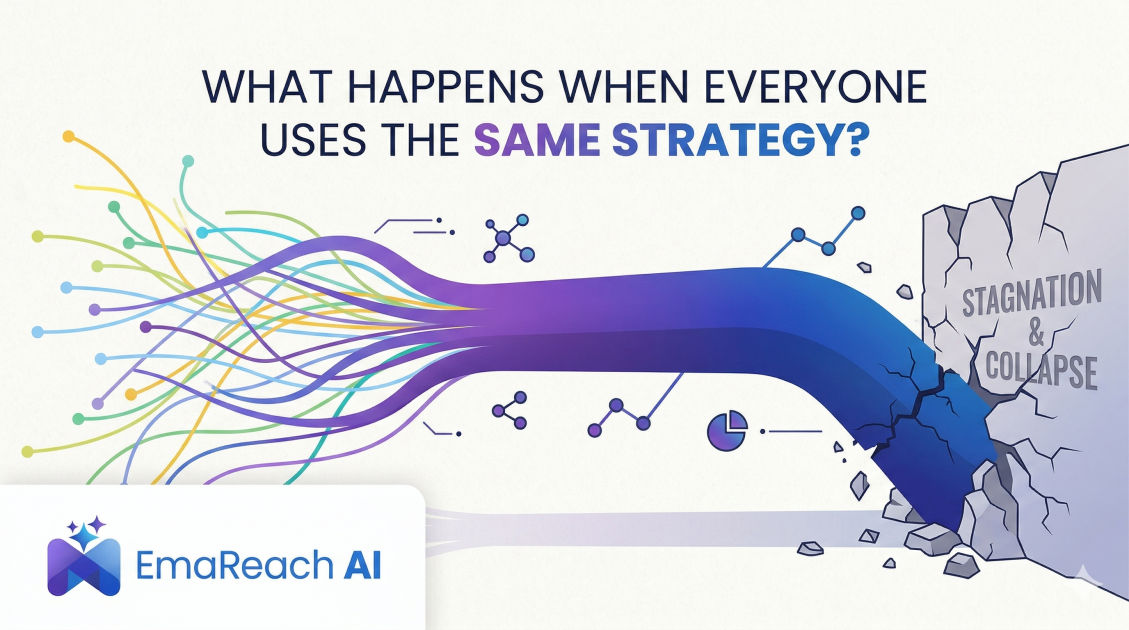
What Happens When Everyone Uses the Same Strategy
business strategymarket saturationcompetitive advantagedifferentiationstrategic convergencemarketing tacticsemail deliverability
The Illusion of the Universal Playbook
In the world of business, marketing, and competitive sports, there is a recurring phenomenon that often goes unnoticed until it is too late: the rush toward a single, 'proven' strategy. When a specific method yields exceptional results for an early adopter, it becomes a blueprint. Soon, everyone—from small startups to massive conglomerates—is following the same steps, using the same language, and targeting the same audience in the exact same way. This is the moment of strategic convergence.
While following a successful model seems like the safest path to success, it creates a unique set of systemic risks. When everyone uses the same strategy, the very advantages that made the strategy effective begin to dissolve. We move from a landscape of innovation to one of pure saturation. This article explores the mechanics of strategic erosion, the psychological drivers behind herd behavior, and how to maintain an edge when the world is reading from the same script.
The Law of Diminishing Returns in Strategy
Every strategy has a carrying capacity. In economics, this is often linked to the law of diminishing returns. When a strategy is novel, it captures 'alpha'—excess returns that come from being smarter, faster, or more creative than the competition. However, as more participants enter the fray with the identical approach, the available alpha is divided into smaller and smaller slices.
Eventually, the cost of executing the strategy rises because the competition for resources (be it ad space, talent, or consumer attention) increases. Simultaneously, the effectiveness of the strategy drops because the audience develops an immunity to it. This is why a marketing tactic that worked wonders three years ago might result in a net loss today, even if the execution is technically perfect. The environment has changed because the volume of people doing the exact same thing has reached a tipping point.
The Saturation of Noise
When every brand uses the same 'authentic' tone of voice, authenticity becomes a commodity. When every salesperson uses the same 'personalized' outreach template, personalization becomes a red flag for spam. This is particularly evident in the digital space. If you are using the same cold outreach templates as ten thousand other agencies, your prospects’ inboxes become a graveyard of identical subject lines.
To break through this saturation, you need more than just a template; you need a system that ensures you actually reach the person you are talking to. This is where EmaReach provides a critical advantage. Stop Landing in Spam. Cold Emails That Reach the Inbox. EmaReach AI combines AI-written cold outreach with inbox warm-up and multi-account sending—so your emails land in the primary tab and get replies. While others are fighting over the same tired strategies that land them in the 'Promotions' tab, a differentiated technical approach keeps you visible.
The Competitive Blind Spot: Strategic Convergence
Strategic convergence occurs when firms in an industry start to look indistinguishable from one another. They offer the same features, price their products similarly, and use the same distribution channels. This leads to what Michael Porter described as 'competitive convergence,' where the only way to win is on price.
When strategy is identical across a sector, the industry undergoes 'commoditization.' Without a unique value proposition or a divergent operational strategy, companies find themselves in a race to the bottom. Profit margins shrink, and the 'winner' is often simply the one with the largest balance sheet who can survive a war of attrition.
The Risk of Systemic Failure
Beyond individual business failure, when an entire ecosystem adopts the same strategy, it creates systemic fragility. We see this in financial markets when every hedge fund uses similar algorithmic models. If the market moves in an unexpected direction, everyone’s 'stop-loss' triggers at the same time, leading to a flash crash.
In marketing and sales, this fragility manifests as a collective loss of credibility. If every 'thought leader' on social media follows the same engagement-bait strategy, the entire platform’s user experience degrades, leading to a mass exodus of the very high-value users everyone was trying to attract in the first place.
The Psychology of the Herd
Why do intelligent leaders fall into the trap of using the same strategy? The answer lies in human psychology.
- Risk Mitigation and Social Proof: Doing what everyone else is doing feels safe. If a strategy fails but everyone else was using it, a manager can claim it was an 'unforeseen market shift.' If they try something radical and fail, they risk being seen as incompetent.
- The Mimetic Desire: Humans are naturally mimetic. We want what others have, and we want to achieve it the way they achieved it. We see a competitor’s success and assume their specific strategy was the sole cause, ignoring the timing, luck, and internal culture that made it work for them.
- Efficiency over Effectiveness: Standardizing a strategy is easier than inventing one. It is much faster to buy a course or a 'business-in-a-box' than to conduct deep market research and build a unique operational model.
The Signal-to-Noise Ratio and Consumer Fatigue
From the perspective of the consumer or the client, the result of everyone using the same strategy is 'noise.' When humans are bombarded with the same patterns, our brains naturally begin to filter them out. This is known as 'Banner Blindness' in web design, but it applies to all strategic communication.
If you receive five LinkedIn requests a day that all start with 'I noticed we have several mutual connections,' you stop reading after the first five words. The strategy of 'building rapport through mutuals' has been used so frequently that it now signals 'automated sales pitch' rather than 'genuine connection.'
To combat this fatigue, a business must pivot. If the industry is leaning heavily into automation, the winning strategy might be high-touch, manual human interaction. If the industry is moving toward ultra-low pricing, the winning strategy might be a premium, high-cost service that promises—and delivers—superior quality.
Breaking the Cycle: How to Differentiate
If you find yourself stuck in a crowded market where everyone is following the same playbook, you have two choices: execute better than anyone else (the 'Hard Way') or change the game (the 'Smart Way').
1. Zig When They Zag
Observation is the first step toward differentiation. Analyze your competitors' touchpoints. What are they saying? How are they saying it? Where are they advertising? If everyone is on TikTok, perhaps your audience is actually craving long-form, high-density whitepapers. If everyone is using aggressive, high-pressure sales tactics, a consultative, education-first approach will stand out like a beacon of trust.
2. Operational Uniqueness
Strategy isn't just what you say; it’s how you do what you do. Most companies copy the 'front-end' of a strategy (the marketing) but ignore the 'back-end' (the operations). You can use similar marketing messages but win by having a vastly superior supply chain, a more robust tech stack, or a unique proprietary algorithm.
For example, in the realm of outreach, while everyone is manually trying to bypass spam filters or using basic tools that result in low deliverability, leveraging a sophisticated system like EmaReach allows you to operate on a different level. By focusing on the technical foundation of email deliverability, you aren't just sending emails; you are ensuring they are seen. This is an operational advantage that a mere 'copy-paste' strategy cannot replicate.
3. Deep Personalization and Niche Focus
Generalized strategies are built for the 'average' customer. But the average customer is a myth. By narrowing your focus to a hyper-specific niche, you can develop a strategy that feels tailor-made. While your competitors are using broad strokes, you are using a scalpel. This allows you to speak a specific sub-culture's language, solve their unique pain points, and build a brand loyalty that a generalist can never touch.
The Evolution of Strategy: A Moving Target
Strategy is not a static object you 'own.' It is a dynamic relationship between you, your competitors, and your environment. A successful strategy is like a secret: it only stays valuable as long as it isn't common knowledge.
As soon as a strategy becomes 'best practice,' it is no longer a strategy for winning—it is simply the price of entry. To win, you must constantly be in search of the next 'unfair advantage.' This requires a culture of experimentation. You must be willing to dedicate 10-20% of your resources to trying things that 'don't scale' or haven't been proven yet.
Conclusion: The Courage to Be Different
The most dangerous place to be in business is in the middle of the herd. While it offers a temporary sense of security, it guarantees a slow decline as competition increases and margins evaporate. When everyone uses the same strategy, the market essentially becomes a lottery where the only variables left are luck and brute force.
Real success comes from the courage to deviate. It comes from understanding the underlying mechanics of your industry well enough to know which 'rules' are essential and which are merely trends. By focusing on genuine value, operational excellence, and tools that give you a functional edge—like ensuring your communications actually reach their destination—you can step out of the noise and into a category of one.
EmaReach AI
Ready to scale your cold email outreach?
Join thousands of teams using EmaReach AI for AI-powered campaigns, domain warmup, and 95%+ deliverability. Start free — no credit card required.
Related posts
- Read article
The Instantly Alternative That Finally Gets Outbound Analytics Right
Discover why high-volume cold email requires a shift from surface-level vanity metrics to deep, data-driven revenue attribution, and explore the ultimate alternatives for mastering outbound engineering.
- Read article
How Choosing the Right Instantly Alternative Changed Our Pipeline Numbers
Discover how transitioning from a volume-first cold email setup to an advanced, deliverability-focused infrastructure transformed our B2B pipeline metrics, skyrocketed open rates to over 68%, and tripled our monthly booked demos.