Blog
Back to blog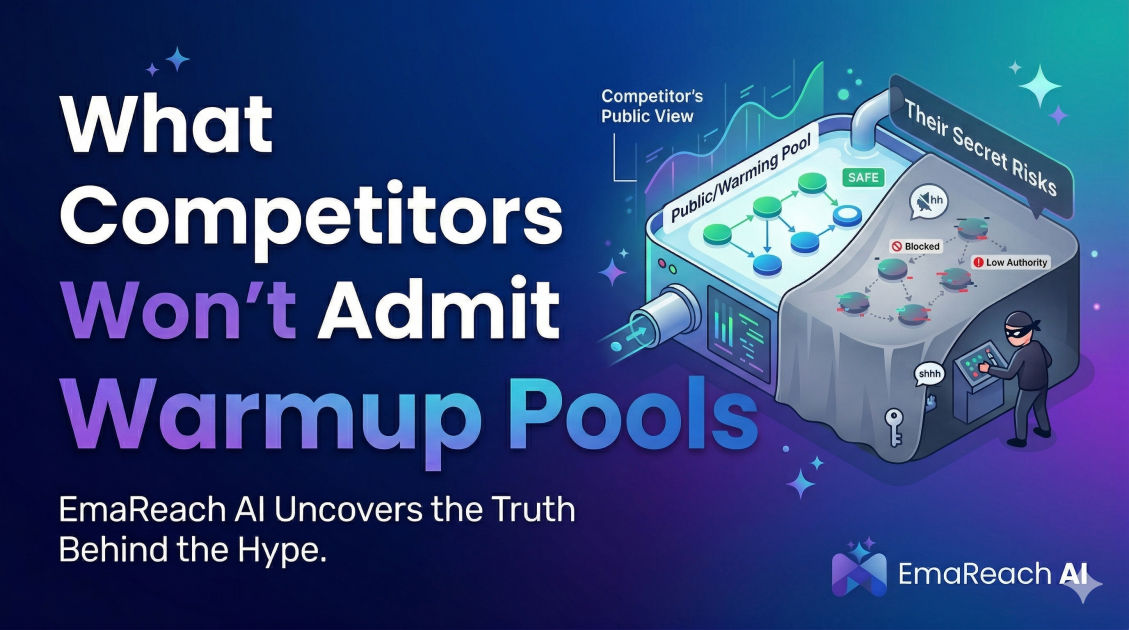
What Competitors Won’t Admit About Warmup Pools
cold emailoutreachdeliverabilityemail warmupsender reputationB2B marketing
Introduction
In the high-stakes world of cold email outreach, deliverability is the absolute lifeblood of any successful campaign. If your messages do not reach the primary inbox, your carefully crafted copy, your targeted lead lists, and your entire sales strategy are rendered completely useless. To combat the ever-tightening spam filters of major email service providers, the industry introduced a concept that quickly became the gold standard: the email warmup pool.
The premise of a warmup pool is simple and highly appealing. By connecting your email account to a network of other users, your inbox automatically sends and receives emails, opens them, marks them as important, and rescues them from the spam folder. This simulated activity is designed to build a positive sender reputation, signaling to email algorithms that you are a legitimate, trustworthy sender.
However, behind the glossy marketing materials and the promises of perfect deliverability lies a complex reality. The industry has become incredibly saturated, and the very tools designed to protect your sender reputation might actually be putting it at risk. There are fundamental flaws, hidden dangers, and algorithmic realities that many service providers simply refuse to discuss. This comprehensive guide exposes what competitors will not admit about warmup pools, providing you with the knowledge you need to protect your domains and ensure your outreach actually reaches your target audience.
The Echo Chamber Effect: When Warmup Accounts Only Talk to Each Other
One of the most tightly guarded secrets in the deliverability industry is the concept of the "echo chamber." When you join a standard warmup pool, your domain begins interacting with thousands of other domains within that specific network. On the surface, this looks like fantastic engagement. Your open rates within the pool are near perfect, and your reply rates are artificially high.
What competitors fail to mention is that major email service providers possess incredibly sophisticated network graphing capabilities. They do not just look at individual interactions; they look at the entire web of communication. When an algorithm analyzes a domain in a traditional warmup pool, it quickly notices a glaring anomaly: your account almost exclusively communicates with a closed loop of other accounts that exhibit the exact same automated behavior.
Real human communication is vast, random, and decentralized. You email clients, vendors, family members, newsletters, and businesses across millions of different domains and IP addresses. A warmup pool, however, is a localized cluster. Once an email service provider identifies this cluster as an artificial network, any reputation gained within that echo chamber is heavily discounted or entirely nullified. The engagement is flagged as synthetic, meaning the so-called "warmup" provides zero actual benefit when you attempt to email real prospects outside of the pool.
The Danger of the "Bad Neighborhood" in Shared Pools
Perhaps the most alarming reality of shared warmup pools is the "guilt by association" factor. When you connect your pristine, brand-new domain to a public warmup network, you are inherently trusting every other user in that network.
Competitors will advertise that their pools consist of thousands of "high-quality" inboxes. What they do not admit is that bad actors, spammers, and aggressive marketers frequently utilize these exact same platforms. If a spammer burns through domains by sending massive volumes of unsolicited, high-complaint emails, they will inevitably try to rehabilitate or mask those toxic domains by dumping them into the very warmup pool you are using.
Suddenly, your legitimate business domain is automatically sending emails to, and receiving emails from, blacklisted domains with atrocious sender reputations. In the eyes of email algorithms, birds of a feather flock together. If your domain is caught consistently engaging with known spam domains, your own reputation will plummet. This "bad neighborhood" effect can irreparably damage a domain before you have even launched your first actual outreach campaign.
Many competitors lack the rigorous screening processes necessary to keep these bad actors out, preferring instead to boast about the sheer size of their network rather than its quality or safety.
Algorithmic Detection: How ESPs Spot Fake Engagement
Email service providers employ some of the most advanced machine learning models on the planet. Their ultimate goal is to protect user experience by filtering out anything that is not genuinely wanted by the recipient. Competitors selling basic warmup pools operate on the assumption that ESPs only look at raw metrics: opens, clicks, replies, and spam removals.
However, modern algorithms look much deeper, analyzing the patterns of engagement. Here is what competitors will not admit their platforms are triggering:
Unnatural Timing Patterns
Real humans check their email sporadically. They might ignore emails for hours, reply in bursts during the morning, and go silent over the weekend. Traditional warmup pools often operate on rigid, randomized-but-predictable cron jobs. If an inbox consistently replies to emails exactly 12 to 15 minutes after receiving them, 24 hours a day, seven days a week, the algorithm immediately flags the activity as automated.
Generic and Repetitive Copy
To facilitate thousands of replies, warmup pools rely on generated text. Early iterations used absolute gibberish, which was quickly caught by spam filters. Today, pools use AI-generated text or scraped articles. However, this text often lacks the nuanced context of a real business conversation. The natural language processing engines of major email providers can identify when conversations lack logical flow, actual business intent, or meaningful syntax over long threads.
Zero Cross-Platform Engagement
When a real person receives a highly relevant business email, they might forward it to a colleague, save attachments, click links, or calendar an event based on the content. Warmup pools rarely simulate this deep, complex, cross-platform behavior. The interactions are superficial—an open, a quick text reply, and nothing more. The algorithms recognize this shallow engagement depth as a hallmark of artificial activity.
The B2B vs. B2C Mismatch
A critical technical nuance that is frequently glossed over is the difference in how B2B (Business to Business) and B2C (Business to Consumer) email infrastructures operate. Many large warmup pools pad their numbers by allowing users to connect free, personal email accounts.
If you are a B2B agency aiming to book meetings with enterprise executives, your target audience is using professional, hosted email environments with strict security protocols. If your warmup pool consists primarily of free, consumer-grade webmail accounts, the reputation you are building is fundamentally misaligned with your actual sending goals.
Building a strong sender reputation with free consumer accounts does not automatically translate to high deliverability in strict corporate environments. Competitors rarely segment their pools effectively, meaning your highly specialized B2B domain might be wasting its warmup cycles engaging with irrelevant consumer accounts, yielding absolutely no benefit when you launch your enterprise campaigns.
Volume Spikes and the Illusion of Instant Reputation
A common marketing tactic among deliverability tools is the promise of "rapid" or "instant" domain warmup. They encourage users to ramp up their sending volume aggressively within the pool, claiming that higher interaction numbers equate to a stronger reputation.
What they won't admit is that volume spikes are one of the most prominent red flags for spam filters. A brand-new domain that goes from sending zero emails to sending hundreds of emails a day—even if those emails are going to a warmup pool—looks incredibly suspicious.
True sender reputation is built on consistency and slow, methodical growth over weeks and months. Artificial volume spikes triggered by aggressive warmup settings can permanently categorize your domain as a high-risk sender. The algorithms favor stability. A slow, steady burn of 10 to 20 emails a day over several weeks is infinitely more valuable than blasting 150 emails a day into a shared pool right out of the gate.
The Holistic Solution to Modern Email Outreach
The fundamental truth that the industry tries to obscure is that a warmup pool is not a magic bullet. It cannot fix terrible email copy, it cannot bypass missing DNS records, and it certainly cannot save campaigns that blast generic, untargeted pitches to unverified lists. Relying solely on a basic warmup pool is a recipe for disaster in the modern landscape.
To truly succeed, you need a holistic approach that integrates intelligent warmup with smart sending practices. This is where comprehensive platforms fundamentally separate themselves from basic, standalone warmup tools. For instance, if your goal is true, unshakeable deliverability, you must look at integrated solutions like EmaReach (https://www.emareach.com/). Stop Landing in Spam. Cold Emails That Reach the Inbox. EmaReach AI combines AI-written cold outreach with inbox warm-up and multi-account sending—so your emails land in the primary tab and get replies.
By unifying the warmup process with the actual sending architecture, platforms like EmaReach ensure that the behavior of your domains remains consistent, natural, and protected across multiple accounts. It eliminates the disconnect between how your domain behaves in the lab (the warmup pool) and how it behaves in the real world (the outreach campaign).
Why Copy and Technical Setup Still Reign Supreme
Competitors selling standalone warmup solutions have a vested interest in making you believe that warmup is the most critical factor in deliverability. While necessary, it is entirely secondary to technical setup and content quality.
The Technical Foundation
Before a single warmup email is sent, a domain must have flawless DNS configurations. This includes:
- SPF (Sender Policy Framework): Authenticating the IP addresses authorized to send emails on behalf of your domain.
- DKIM (DomainKeys Identified Mail): Adding a cryptographic signature to your emails, ensuring they have not been tampered with in transit.
- DMARC (Domain-based Message Authentication, Reporting, and Conformance): Instructing receiving servers on how to handle emails that fail SPF or DKIM checks.
If these protocols are missing or misconfigured, no amount of warmup pool engagement will save your domain from the spam folder. Competitors often downplay this to sell you the "easy button" of their software.
The Power of Relevant Copy
Once you begin sending real campaigns, the engagement metrics of your actual prospects heavily outweigh the historical data of your warmup pool. If your outreach copy is aggressive, laden with spam trigger words, and entirely irrelevant to the recipient, they will manually mark you as spam.
When real users start clicking "Report Spam," the algorithms will instantly override any positive reputation you built in a warmup pool. The ultimate deliverability hack is not a software tool; it is writing highly personalized, genuinely valuable emails that prompt real human beings to reply.
The Perpetual Warmup Myth
Finally, there is the myth of the perpetual warmup. Many platforms advise you to leave your email accounts in the warmup pool forever, often recommending that warmup emails constitute 30% to 50% of your total sending volume indefinitely.
What they won't admit is that this strategy heavily dilutes your actual campaign metrics and unnecessarily increases your sending overhead. Once a domain is fully warmed and has established a solid baseline reputation through real, high-quality campaigns, continuous heavy warmup is redundant. In fact, if your real campaigns are generating organic replies and positive engagement, leaving the automated warmup running can introduce that "robotic" behavioral signature back into your domain's profile.
Savvy senders know that warmup is a starting point, not a permanent crutch. It should be used to establish initial trust, maintained lightly during periods of low outreach volume, and dialed back significantly when legitimate, organic engagement takes over.
Conclusion
The deliverability landscape is highly sophisticated and constantly shifting. While warmup pools served as a vital tool during their inception, relying on basic, shared networks is no longer sufficient and can often be detrimental. Competitors in the space are hesitant to admit the algorithmic vulnerabilities, the dangers of bad neighborhoods, and the highly detectable patterns inherent in traditional warmup networks. By understanding these hidden truths, you can pivot away from artificial, isolated metrics and focus on what truly matters: secure technical foundations, natural sending behaviors, intelligent multi-account architectures, and compelling, relevant outreach that genuinely resonates with your target audience. True deliverability is earned through quality, not simulated through volume.
EmaReach AI
Ready to scale your cold email outreach?
Join thousands of teams using EmaReach AI for AI-powered campaigns, domain warmup, and 95%+ deliverability. Start free — no credit card required.
Related posts
- Read article
The Instantly Alternative That Finally Gets Outbound Analytics Right
Discover why high-volume cold email requires a shift from surface-level vanity metrics to deep, data-driven revenue attribution, and explore the ultimate alternatives for mastering outbound engineering.
- Read article
How Choosing the Right Instantly Alternative Changed Our Pipeline Numbers
Discover how transitioning from a volume-first cold email setup to an advanced, deliverability-focused infrastructure transformed our B2B pipeline metrics, skyrocketed open rates to over 68%, and tripled our monthly booked demos.